

Iraq’s ancient ruins open up to tourism after Daesh atrocities

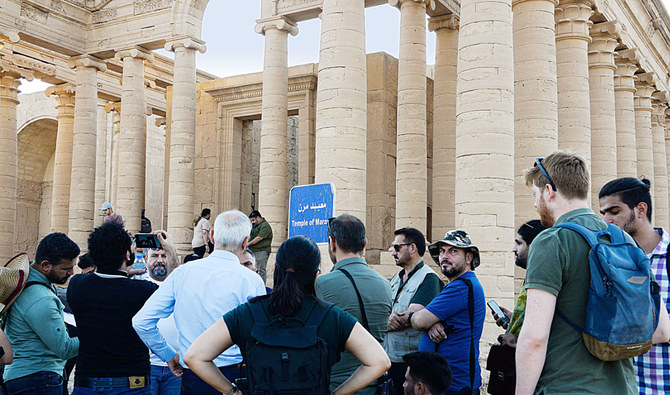
Some 40 visitors, most of them Iraqis, were allowed to walk around the more than 2,000-year-old archaeological site in the golden hour of twilight. (AFP)
Short Url
Updated 11 September 2022
Follow

Iraq’s ancient ruins open up to tourism after Daesh atrocities

  • Designated an endangered world heritage site by UNESCO, Hatra dates back to the 2nd and 3rd centuries BC

HATRA, Iraq: Strolling along the ancient ruins of Hatra in Iraq’s north, dozens of visitors admired the site, where local initiatives seek to turn over a new leaf after a brief but brutal Daesh rule.

Designated an endangered world heritage site by UNESCO, Hatra dates back to the 2nd and 3rd centuries BC.

It is a two-hour drive from Mosul, the former “capital” proclaimed by Daesh, which was recaptured in 2017 by Iraqi forces and an international coalition that backed them.

A tour of the site on Saturday, the first of its kind organized by a private museum in Mosul, aimed to boost tourism in the area.

Some 40 visitors, most of them Iraqis, were allowed to walk around the more than 2,000-year-old archaeological site in the golden hour of twilight.

The tourists took selfies in front of impressive colonnades and inspected the reliefs vandalized by Daesh jihadists.

“It has great history” allowing a peek into an ancient civilization, said Luna Batota, a 33-year-old on tour with her Belgian husband.

“A lot of history but at the same time a lot of unfortunate events took place here with Daesh,” she said.

Batota works for a pharmaceutical company in Belgium, where she has lived since the age of nine.

Twenty-four years later, this is the first time she has returned to her homeland.

Visiting Hatra stirred up “mixed feelings” for her, she said. “You see bullet holes, you see many empty bullets.”

An important religious and trading center under the Parthian empire, Hatra had imposing fortifications and magnificent temples, blending Greek and Roman architectural styles with oriental decorative elements.

In 2015, Daesh released a video showing its militants destroying a series of reliefs, firing at them and hacking away at a statue with a pickaxe.

In February, the authorities unveiled three restorations at the site: A Roman-style sculpture of a life-size figure and reliefs on the side of the great temple.

Five years after the defeat of Daesh, Mosul and its surroundings have regained a sense of normalcy, even as rehabilitation efforts suffer setbacks and many areas still bear the scars of the fight against the militants.

The tour of Hatra was organized by the Mosul Heritage House, a private museum inaugurated in June.

But even before it, the site drew individual visitors, according to one of the organizers, Fares Abdel Sattar, a 60-year-old engineer.

This new initiative seeks to “showcase the heritage and identity” of Mosul and its broader Nineveh province, he said.

After its rise to power in 2014 and the conquest of swathes of Iraq and Syria, Daesh faced counteroffensives in both countries. Iraqi forces finally claimed victory in late 2017.

As Iraq gradually opens up to foreign tourism, dozens of visitors — particularly from the West — are now exploring the country, with some even venturing into Mosul.

The Hatra group are pioneers, visiting at a time when the US, British and other governments are warning their citizens against travel to Iraq, citing the risks of terrorism, kidnapping, armed conflict and civil unrest.

The tourism sector also suffered a setback with the case of British pensioner James Fitton, who was detained and condemned to 15 years in jail over pottery shards he picked at an archaeological site, before a court in July overturned the sentence and he flew back home.

Challenges remain and tourist infrastructure is still basic in Iraq, a country rich in oil but ravaged by decades of fighting.

“Mosul isn’t only war, Daesh, terrorism,” said Beriar Bahaa Al-Din, a doctoral student in anthropology at the University of Exeter in Britain, on the Hatra visit.

“Mosul is a civilization, heritage, culture,” he added. “This impressive site should be full of tourists from across the globe.”


Family of Palestinian-American shot dead by Israeli settler demand accountability

Updated 21 February 2026
Follow

Family of Palestinian-American shot dead by Israeli settler demand accountability

  • Relatives say Abu Siyam was among about 30 residents from the village of Mukhmas who confronted armed settlers attempting to steal goats from the community

LONDON: The family of a 19-year-old Palestinian-American man reportedly shot dead by an Israeli settler in the occupied West Bank have demanded accountability, amid mounting scrutiny over a surge in settler violence and a lack of prosecutions.

Nasrallah Abu Siyam, a US citizen born in Philadelphia, was killed near the city of Ramallah on Wednesday, becoming at least the sixth American citizen to die in incidents involving Israeli settlers or soldiers in the territory in the past two years.

Relatives say Abu Siyam was among about 30 residents from the village of Mukhmas who confronted armed settlers attempting to steal goats from the community. Witnesses said that stones were thrown by both sides before settlers opened fire, wounding at least three villagers.

Abu Siyam was struck and later died of his injuries.

Abdulhamid Siyam, the victim’s cousin, said the killing reflected a wider pattern of impunity.

“A young man of 19 shot and killed in cold blood, and no responsibility,” he told the BBC. “Impunity completely.”

The US State Department said that it was aware of the death of a US citizen and was “carefully monitoring the situation,” while the Trump administration said that it stood ready to provide consular assistance.

The Israeli embassy in Washington said the incident was under review and that an operational inquiry “must be completed as soon as possible.”

A spokesperson for the Israeli Defense Forces said troops were deployed to the scene and used “riot dispersal means to restore order,” adding that no IDF gunfire was reported.

The military confirmed that the incident remained under review and said that a continued presence would be maintained in the area to prevent further unrest.

Palestinians and human rights organizations say such reviews rarely lead to criminal accountability, arguing that Israeli authorities routinely fail to prosecute settlers accused of violence.

A US embassy spokesperson later said that Washington “condemns this violence,” as international concern continues to grow over conditions in the occupied West Bank.

Palestinians and human rights groups say Israeli authorities routinely fail to investigate or prosecute settlers accused of violence against civilians.

Those concerns were echoed this week by the UN, which warned that Israel’s actions in the occupied West Bank may amount to ethnic cleansing.

A UN human rights office report on Thursday said that Israeli settlement expansion, settler attacks and military operations have increasingly displaced Palestinian communities, with dozens of villages reportedly emptied since the start of the Gaza war.

The report also criticized Israeli military tactics in the northern West Bank, saying that they resembled warfare and led to mass displacement, while noting abuses by Palestinian security forces, including the use of unnecessary lethal force and the intimidation of critics.

Neither Israel’s foreign ministry nor the Palestinian Authority has commented on the findings.