

Pakistan to observe a day of mourning on Monday over Queen Elizabeth’s death 

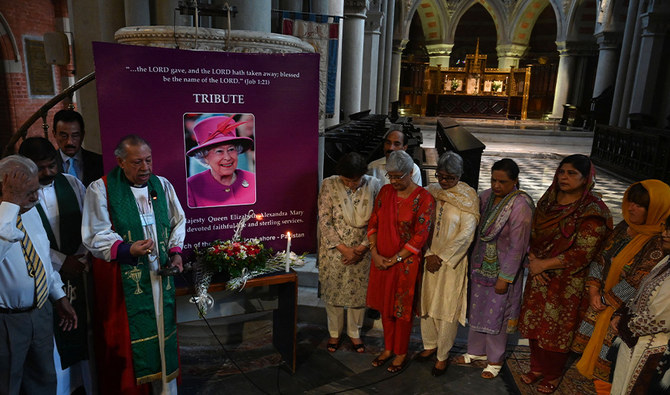
Pakistan's Christians pray for late Britain's Queen Elizabeth II in Cathedral Church in Lahore on September 11, 2022. (AFP)
Short Url
Updated 11 September 2022
Follow

Pakistan to observe a day of mourning on Monday over Queen Elizabeth’s death 

  • Queen Elizabeth II, Britain’s figurehead, died at her Scottish home on Thursday 
  • The royal family has announced a grand state funeral of the Queen on Sept. 19 

ISLAMABAD: Pakistan will observe a day of mourning on Monday over the passing of Britain’s Queen Elizabeth II, the Pakistani information minister said on Sunday. 

Queen Elizabeth, Britain’s figurehead and a towering presence on the world stage for seven decades, died at her Scottish home on Thursday, hours after doctors said she was under medical supervision. 

The royal family has revealed plans for a grand state funeral of the Queen on September 19, which is expected to be attended by foreign leaders and watched by millions worldwide. 

In Pakistan, the foreign ministry had suggested the government to officially observe a day of mourning on the demise of the Queen. 

“Prime Minister Shehbaz Sharif has given an approval to observe a day of mourning on the passing of Britain’s Queen,” Information Minister Marriyum Aurangzeb said in a statement. 

“September 12 will be observed as the day of mourning in Pakistan.” 

She said the government had directed the cabinet division to make all necessary arrangements in this regard. 

Queen Elizabeth had ascended to the throne in 1953 after the death of her father, King George VI, when she was only 25. She ruled Britain for over 70 years. 

Pakistan’s prime minister, president and the foreign minister this week joined several world leaders in paying their respects to the Queen as Britain plunged into sorrow. 

The Queen visited Pakistan as Head of the Commonwealth in 1961, waving to crowds as she rode in a convertible through the streets of Karachi. During her second visit in 1997, she addressed a joint sitting of Pakistan’s parliament in 1997 and spoke at a banquet hosted by former president Farooq Leghari. 

Pakistan remained a dominion within the Commonwealth of Nations until 1956 even after securing independence from the British rule about a decade ago. 

The Queen’s constitutional role was delegated to the governor-general during the initial years after the birth of the country. 

On Sunday, India observed a day of national mourning to honor the late Queen Elizabeth II, as her death showed a glimpse of modern India and its relations to colonialism.

In India, the largest in the Commonwealth of Nations, an association of mostly former British colonies, the national flag was flown at half-mast throughout the country on Sunday as a “mark of respect” for the queen’s passing, the Ministry of Home Affairs said in a statement.

As tributes for the queen poured in from across the world, Indian Prime Minister Narendra Modi said she will be remembered as “a stalwart of our times.”

“She provided inspiring leadership to her nation and people. She personified dignity and decency in public life,” Modi wrote on Twitter.

“Pained by her demise. My thoughts are with her family and people of UK in this sad hour.”

But beyond official remarks, Elizabeth’s death was met with muted reactions across India, a nation that has sought to remove vestiges of the colonial era and has overtaken the British economy in size.


‘Fully stand with Bangladesh’: Pakistan PM backs decision to boycott India match

Updated 04 February 2026
Follow

‘Fully stand with Bangladesh’: Pakistan PM backs decision to boycott India match

  • Pakistan’s government have not allowed the national cricket team to play its World Cup match against India on Feb. 15
  • Pakistan has accused India of influencing ICC decisions, criticized global cricket body for replacing Bangladesh in World Cup

ISLAMABAD: Prime Minister Shehbaz Sharif on Wednesday backed his government’s decision to bar the national men’s cricket team from playing against India in the upcoming T20 World Cup tournament, reaffirming support for Bangladesh. 

Pakistan’s government announced on social media platform X last week that it has allowed its national team to travel to Sri Lanka for the World Cup. However, it said the Green Shirts will not take the field against India on their scheduled match on Feb. 15. 

Pakistan’s participation in the tournament was thrown into doubt after Pakistan Cricket Board (PCB) Chairman Mohsin Naqvi criticized the International Cricket Council (ICC) for replacing Bangladesh with Scotland. The decision was taken after Bangladesh said it would not let its team travel to India out of security concerns. 

During a meeting of the federal cabinet, Sharif highlighted that Pakistan has said that politics should be kept away from sports. 

“We have taken this stand after careful consideration and in this regard, we should stand fully with Bangladesh,” Sharif said in televised remarks. 

“And I believe this is a very reasonable decision.”

Pakistan has blamed India for influencing the ICC’s decisions. The global cricket governing body is currently led by Jay Shah, the head of the Board of Control for Cricket in India. Shah is the son of Indian Home Minister Amit Shah. 

Pakistan’s boycott announcement has triggered media frenzy worldwide, with several Indian cricket experts and analysts criticizing Islamabad for the decision. An India-Pakistan cricket contest is by far the most lucrative and eagerly watched match of any ICC tournament. 

The ICC has ensured that the two rivals and Asian cricket giants are always in the same group of any ICC event since 2012 to capitalize on the high-stakes game. 

The two teams have played each other at neutral venues over the past several years, as bilateral cricket remains suspended between them since 2013 due to political tensions. 

Those tensions have persisted since the two nuclear-armed nations engaged in the worst fighting between them since 1999 in May 2025, after India blamed Pakistan for an attack in Indian-administered Kashmir that killed tourists. 

Pakistan denied India’s allegations that it was involved in the attack, calling for a credible probe into the incident.