

Pakistan urges international community to deal with climate change after devastating floods

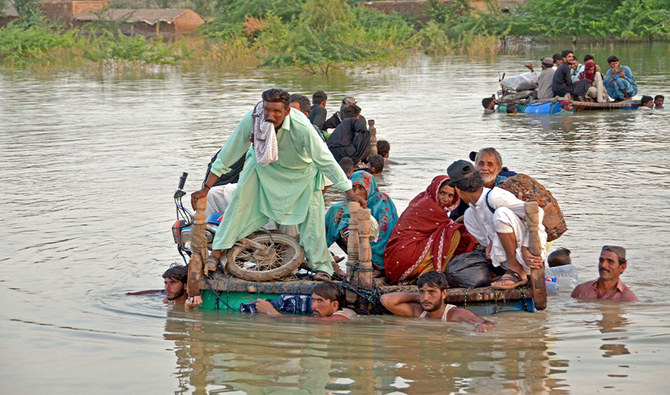
Internally displaced people wade through floodwaters after heavy monsoon rains in Jaffarabad district in Balochistan province on September 8, 2022. (AFP)
Short Url
Updated 11 September 2022
Follow

Pakistan urges international community to deal with climate change after devastating floods

  • Prime Minister Shehbaz Sharif says UN secretary general’s visit to Pakistan raised awareness about the climate disaster
  • General Bajwa says army engineers have been tasked to carry out initial study on building proper dams, drainage systems

ISLAMABAD: Prime Minister Shahbaz Sharif on Sunday applauded United Nations Secretary General António Guterres for raising international awareness about the devastation caused by recent floods in Pakistan while urging the global community to address the issue of climate change.
Pakistan witnessed record monsoon rains since the beginning of the season in June that led to flash floods and destroyed houses, farmlands and public infrastructure. The climate catastrophe also claimed about 1,400 lives across Pakistan while uprooting millions of others.
The UN secretary general, who arrived in the country on Friday, went to several flood-ravaged areas while calling for increased global financial assistance toward the end of his two-day visit aimed at raising awareness of the disaster.
The Pakistani prime minister described his visit as “critical,” saying he was deeply touched by the empathy and leadership of the top UN official.
“During his visit to the flood-affected areas & camps under scorching heat, UN Secretary General was overwhelmed by the scale of devastation that has engulfed Pakistan,” he said in a Twitter post. “His voice has become the voice of flood victims. The world should pay heed to what he said about climate change.”


Meanwhile, other senior Pakistani officials continued to visit the flood-hit regions in the country. The army chief, General Qamar Javed Bajwa, went to Sindh on Saturday where he urged affluent Pakistanis to step forward and provide financial assistance.
Speaking to the media in Dadu, he noted the area had been deeply affected by the floods.
“Manchar and Hamal lakes, which are about 100 kilometers apart, have merged,” he said, adding the government was still performing rescue and relief activities in the area.
“People will continue to suffer if we do not build proper dams and drainage system,” he continued. “The army engineers have been tasked to carry out an initial study on it. We will also seek international assistance from experts.”


Pakistan PM briefs parliamentary leaders on Middle East tensions, Afghanistan fighting

Updated 6 sec ago
Follow

Pakistan PM briefs parliamentary leaders on Middle East tensions, Afghanistan fighting

  • Leaders of major parties attend meeting on regional security and Pakistan’s military campaign
  • Government is expected to update lawmakers on diplomatic efforts amid Gulf conflict escalation

ISLAMABAD: Prime Minister Shehbaz Sharif on Wednesday started briefing leaders of parliamentary parties on rising regional tensions, including fighting along the Pakistan-Afghanistan border and the escalating war in the Middle East, according to a statement by his office.

The meeting comes as Pakistan has intensified military operations against the Afghan Taliban and militant groups targeting its civilians and security forces along its western frontier while the wider region faces growing instability after recent US-Israeli strikes on Iran and subsequent attacks across the Gulf.

Sharif decided to convene the session to update political leaders on the security situation and Pakistan’s diplomatic outreach as tensions spread across the region.

“The prime minister will take parliamentary leaders into confidence regarding the Pakistan-Afghanistan situation and the recent tensions in the region, particularly in the Middle East and the Gulf,” Sharif’s office said in a statement.

“The meeting will also highlight Pakistan’s diplomatic efforts during the recent escalation,” it added.

Representatives of major political parties, including the ruling Pakistan Muslim League-Nawaz, Pakistan Peoples Party, Jamiat Ulema-e-Islam, Muttahida Qaumi Movement and other parliamentary groups are attending the meeting.

Pakistan has accused Afghanistan’s Taliban authorities of allowing militant groups such as the Tehreek-e-Taliban Pakistan (TTP) to operate from Afghan territory, allegations Kabul denies. Islamabad says it has targeted militant hideouts across the border after repeatedly raising the issue with Afghan officials.

The briefing also comes as the government closely monitors developments in the Middle East, where regional tensions have heightened concerns about energy supplies and broader security implications for the country.