

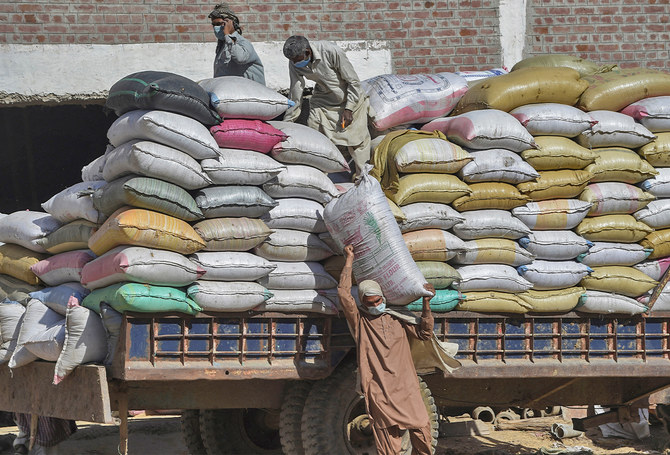

KARACHI: Pakistan is expected to lose a sizeable chunk of its coarse rice exports to the international market, but likely to maintain presence of its basmati in the Middle East, exporters and farmers said on Saturday, after catastrophic floods washed away an estimated 35 percent of the crop.
Pakistan is reeling from the impacts of climate change that have resulted in record rains and melting of glaciers, which have triggered massive floods since mid-June.
UN Secretary-General Antonio Guterres, who is currently visiting Pakistan, has said the South Asian country suffered around $30 billion in flood-related losses, calling for international support to deal with the disaster.
The deadly floods hit Pakistan’s two agricultural centers, the Sindh and Punjab provinces, where rice, a major staple across the world, was sown.
“Our initial estimates suggest that the rice crop has suffered around 35 percent damages, with Sindh taking a major hit,” Shahzad Ali Malik, chairman of Pakistan Hi-Tech Hybrid Seed Association (PHHSA) and founder of the Rice Exporters Association of Pakistan (REAP), told Arab News.
“The impact of crop damages on exports would be negative and they may decline by around 200,000 tons. The exact situation will be cleared once water recedes from rice fields.”
Malik, however, was confident that the damages would not impact the country’s rice exports to the Middle Eastern countries, which are major buyers of basmati.
“Saudi Arabia and other Middle Eastern countries are main markets of Pakistani basmati rice, of which a major chunk comes from Punjab that remained largely intact. But the export of coarse rice varieties to other destinations could suffer.”
In 2021, Pakistan exported 395,176 metric tons of rice, worth $277.5 million, to the Middle East, including 114,408 metric tons to Saudi Arabia and 203,939 metric tons to the United Arab Emirates, according to the official data.
But Pakistani exporters and growers fear huge setbacks in the export of non-basmati varieties to the international market, mainly African countries.
“Around 80 percent of rice exports come from the Sindh province, but more than 50 percent of it is estimated to have been washed away this year. Some of the rice-cultivating areas are still facing flood threat,” Nabi Bux Sathio, a senior vice president at the Sindh Chamber of Agriculture, told Arab News.
“Pakistan exported $2.5 billion worth of rice, including 80 percent coarse rice varieties, last fiscal year, out of which Sindh’s contribution was around $1.3 billion. Coarse rice has its major market is Africa and the basmati rice goes to the Gulf states.”
As per initial estimates, Sathio said, up to $800 million worth of rice crop had been washed away by the floods in Sindh alone.
In a briefing on Tuesday, Sindh Chief Minister Murad Ali Shah informed the province had suffered Rs344.2 billion ($1.5 billion) damages to various crops, including Rs54.50 billion ($238.5 million) to the rice crop.
Last year, Pakistan’s rice production was around 8 million tons, of which 4.5 million tons were exported and around 3.5 million tons were locally consumed, but the production and exports are expected to decline this year, according to rice exporters.
“After local crop reduction and setting aside grain for local consumption, I think it would be big achievement if we could export rice worth $1.7 billion,” Rafique Suleman, convener of the Pakistan Chambers of Commerce and Industry’s (FPCCI) standing committee on rice, told Arab News.
“However, the government data is still being awaited for a final assessment of the export potential.”
Pakistani exporters and growers expect the prices of rice to increase in the international market as other major rice exporting countries also suffer from the impacts of climate change.


