


LONDON: King Charles III was officially announced as Britain’s monarch Saturday, in a pomp-filled ceremony steeped in ancient tradition and political symbolism — and, for the first time, broadcast live.
Charles automatically became king when his mother, Queen Elizabeth II, died on Thursday, but the accession ceremony is a key constitutional and ceremonial step in introducing the new monarch to the country.

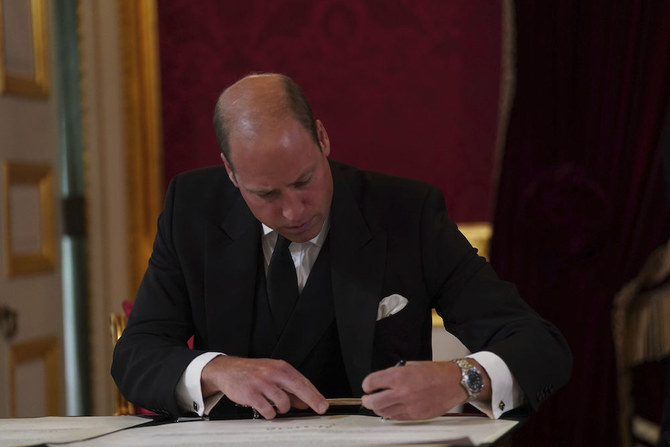
Scores of senior politicians past and present, including Prime Minister Liz Truss and five of her predecessors, gathered in the ornate state apartments at St. James’s Palace for the meeting of the Accession Council.
They met without Charles, officially confirming his title, King Charles III. The king joined them to make a personal declaration, vowing to follow his mother’s “inspiring example” as he took on the duties of monarch.
“I am deeply aware of this great inheritance and of the duties and heavy responsibilities of sovereignty which have now passed to me,” he said.
Speaking of his personal grief, he said: “I know how deeply you and the entire nation, and I think I may say the whole world, sympathize with me in this irreparable loss we have all suffered.”
The new king formally approved a series of orders — including one declaring the day of his mother’s funeral a public holiday. The date of the state funeral has not been announced, but it is expected to be around Sept 19.

This is the first time the accession ceremony has been held since 1952, when Queen Elizabeth II took the throne.
Charles was accompanied at the ceremony by his wife Camilla, the Queen Consort, and his eldest son Prince William. William is now heir to the throne and known by the title Charles long held, Prince of Wales.
The ceremony ended with a royal official publicly proclaiming King Charles III the monarch from a balcony at the palace — a relic of centuries past, when this would have been the first official confirmation the public had of their new sovereign.
Russian President Vladimir Putin has congratulated Britain’s new monarch King Charles III on the accession to the throne, the Russian embassy in London said on Twitter.
“Please accept my sincere congratulations on Your Accession to the throne,” the statement from Putin read.
“I wish Your Majesty success, good health and all the best,” it added.
David White, the Garter King of Arms, made the proclamation flanked by trumpeters in gold-trimmed robes before leading cheers — “hip, hip, hooray!” — for the new king.

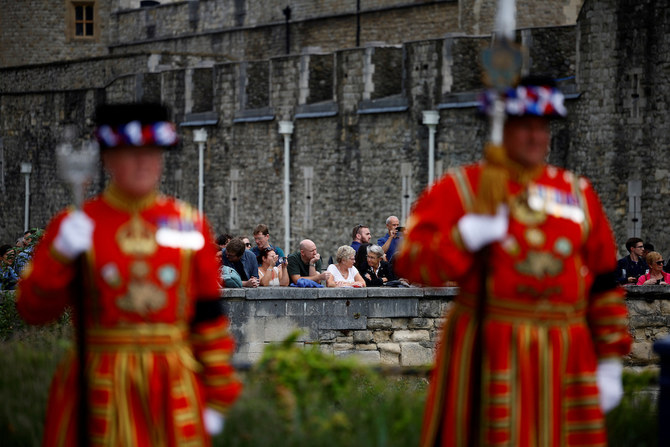
Gun salutes rang out in Hyde Park, at the Tower of London and at military sites around the UK as he announced the news, and scarlet-robed soldiers in the palace courtyard doffed their bearskin hats in a royal salute.
The proclamation will also be read out in the medieval City of London and at other locations across the UK.
Two days after the 96-year-old queen died at Balmoral Castle in Scotland following an unprecedented 70 years on the throne, people still came in their thousands to pay their respects outside Buckingham Palace in London. The scene was repeated at other royal residences across the UK and at British embassies around the world.
The monarch set the tone for his reign on Friday, vowing in a televised address to carry on the queen’s “lifelong service,” with his own modernizing stamp.
Charles looked to both the past — noting his mother’s unwavering “dedication and devotion as sovereign” — and the future, seeking to strike a reassuring note of constancy while signaling that his will be a 21st-century monarchy.
He reflected on how the country had changed dramatically during the queen’s reign into a society “of many cultures and many faiths,” and pledged to serve people in Britain and the 14 other countries where he is king “whatever may be your background or beliefs.”

He also tried to overcome a reputation for aloofness in his first hours as monarch, spending time shaking hands with some of the thousands who came to leave flowers and pay tribute to the queen at the gates of Buckingham Palace. He was greeted with shouts of “Well done, Charlie!” and “God save the king!” One woman gave him a kiss on the cheek.
Britain is holding a period of mourning for the queen, with days of carefully choreographed ceremonies marking the death of the only monarch most people have ever known.
In the next few days the queen’s body will be brought from Balmoral, first to Edinburgh and then to London, where she will lie in state before a funeral at Westminster Abbey.
In his speech, Charles struck a personal note, speaking of his sorrow at the loss of “my darling Mama.”
“Thank you for your love and devotion to our family and to the family of nations you have served so diligently all these years,” he said, ending with a quote from Shakespeare’s “Hamlet” — “May flights of angels sing thee to thy rest.’”