



QUETTA/ISLAMABAD: Pakistan Prime Minister Shehbaz Sharif on Friday assured a court of making all efforts to recover all “missing persons” in the country and reunite them with their families.
Cases of “enforced disappearances” of citizens have for years been a divisive issue in Pakistan, where militants have waged war against the state for decades. Families say people picked up by security forces often disappear for years, and are sometimes found dead, with no official explanation. Pakistani security agencies deny involvement.
The federal government announced in May it was setting up a seven-member committee to make policy on the issue, a day after the Islamabad High Court (IHC) said former and current Pakistani rulers needed to explain their alleged “tacit approval” of such disappearances.
In July, the court ordered the premier to ensure production of six missing individuals, including journalist Mudassar Naaru, at the next hearing on September 9 in a case relating to enforced disappearances, warning failure to do so would require him to appear in person and give an explanation.
On Friday, the prime minister appeared before the court, along with Law Minister Azam Nazeer Tarar and Attorney-General Ashtar Ausaf, to explain his position.
“I won’t come up with any excuse. I’ll try my best [to recover all the missing persons] as I am answerable to the country’s courts,” PM Sharif said at Friday’s hearing of the case.
He told Chief Justice Athar Minallah that a cabinet committee had been constituted on the court’s directives that had so far held at least six meetings on the issue.
“I will personally supervise all meetings of the committee and will submit a report in the court,” the premier said. “This report will be based on facts and conclusive evidence.”
The chief justice remarked the committee had been constituted in the past too, but no practical step was taken to resolve the issue.
“Mr. Prime Minister, missing persons is a big issue, and the state has not been responding the way it should,” Chief Justice Minallah said. “This state has a constitution, and there should be a civil supremacy as per the constitution.”
The chief justice said enforced disappearances were the biggest form of torture and the court had no option but to inquire the administration about the issue, describing the practice as a “deviation from the constitution.”
“You are responsible for national security of this country. This court trusts you, and you should find out its solution,” the top judge told the PM.
The law minister later sought more time from the court, saying the issue had been prevailing for the last 20 years, yet they were putting in their best to resolve it.
“We have to introduce reforms in the criminal justice system and that’s why we need at least 8 to 10 weeks to complete work on it,” Law Minister Tarar said.
At this, the court adjourned the hearing till November 14.
On Thursday, Pakistan’s Interior Minister Rana Sanaullah, who heads the committee on enforced disappearances, assured protesters in the southwestern Balochistan province the government was “serious” in resolving the issue in the coming days, after which families of missing people ended their sit-in in Quetta.
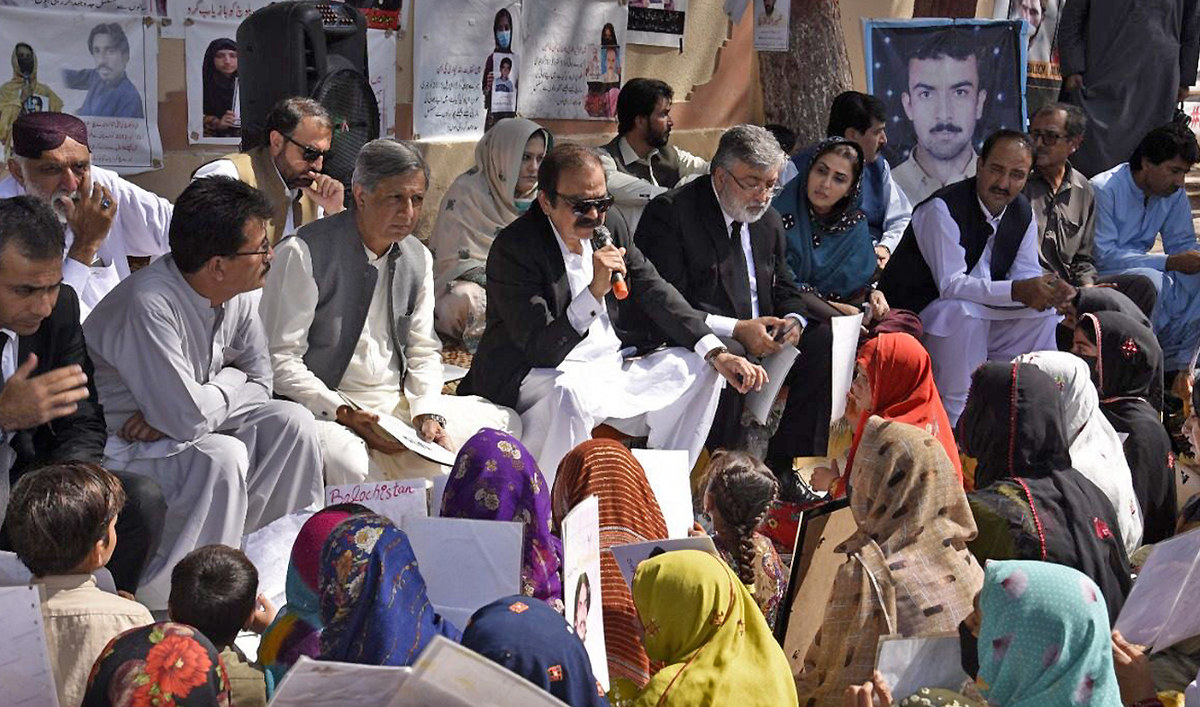
Pakistan’s Interior Minister Rana Sanaullah (center) speaks to the families of 'missing persons' in Quetta, Balochistan, on September 8, 2022. (Balochistan Government)
“There are hundreds of missing persons in Balochistan but we have just shared the list of 50 people whose families were sitting in the red zone of Quetta for the last 50 days,” Saeeda Baloch, 18, one of the protesters who was part of the Quetta sit-in, told Arab News on Friday.
Baloch’s has been looking for her father who went missing in the southern port city of Karachi on April 10, 2021. Despite heavy rains, she said, dozens of women and children held the sit-in in hope of finding a clue of their loved ones.
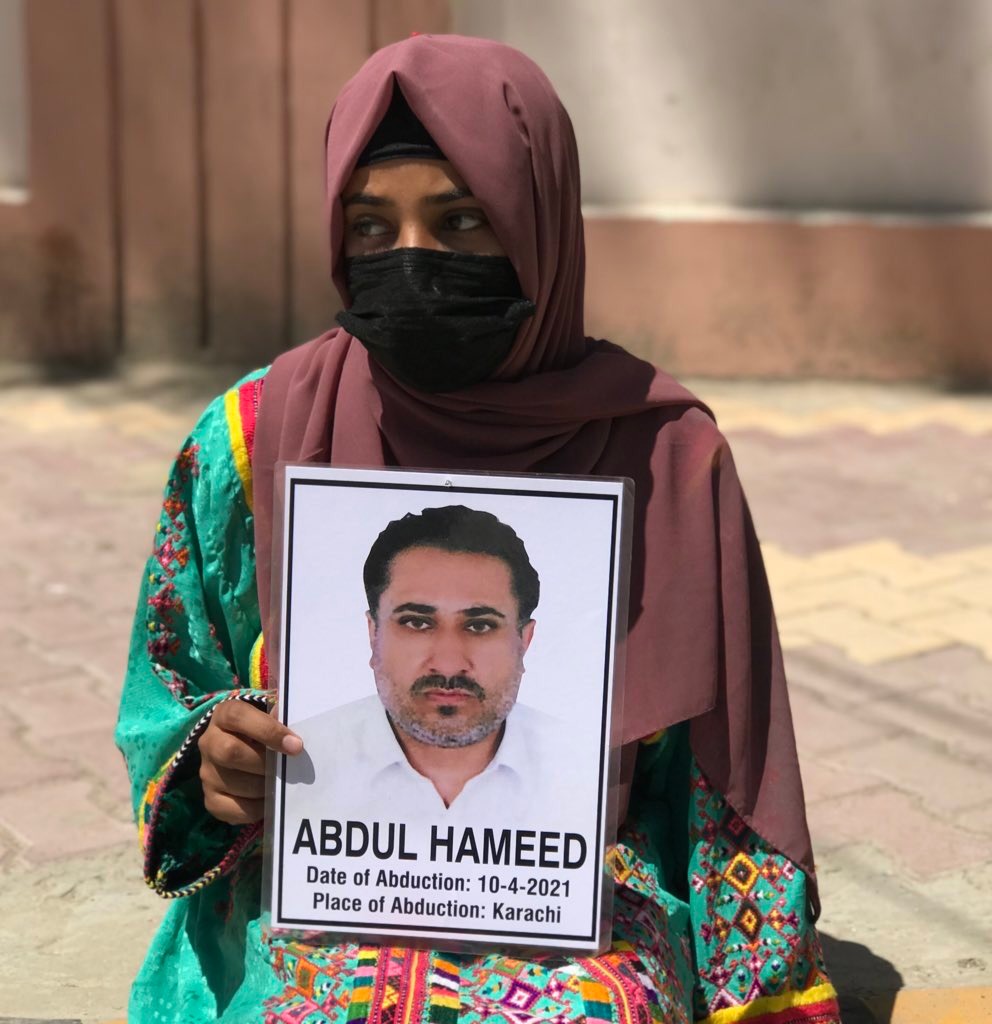
Saeeda Hameed, one of the protesters at Quetta sit-in, hold a placard of her missing father on September 7, 2022. (@saeeda_hameed/Twitter)
Baloch said the committee on missing persons visited their camp, where the interior minister assured them in writing that the government would share details of the whereabouts of their loved ones in three months.
“On the directives of the Prime Minister Muhammad Shehbaz Sharif, the committee has thoroughly negotiated with the families of missing persons,” Sanaullah told reporters in Quetta on Thursday.
“We have informed them regarding our serious efforts to address the missing persons issue in the better interest of Balochistan and Pakistan.”
The interior minister said they were thankful to the families of missing persons for calling off their protest.
At least 1,108 people were reported missing in Pakistan in 2021, according to the annual report of the Human Rights Commission of Pakistan (HRCP).
“There are two stakeholders in this most pestering issue of Pakistan. On one side, there are families of missing persons who blame the security agencies for abducting their loved ones and on the other side, there are the law enforcement agencies,” Sanaullah said.
“We have spoken with both sides, which can’t be aired on national media.”
The HRCP welcomed the meeting between the interior minister and families of forcibly disappeared persons, calling it a “positive development.”
“Still there is a need for concrete measures to resolve the matter of enforced disappearance and the perpetrators involved in violating human rights should be held responsible through a transparent and effective mechanism,” it added.


