



ISLAMABAD: United Nations Secretary-General (UNSG) Antonio Guterres assured Pakistan on Friday that the entire UN was at the service of the Pakistani people, as he arrived in Pakistan to inspect rescue and rehabilitation work and meet people affected by flash floods in the country.
The UN chief is in Pakistan for a two-day trip to seek the international community’s support for Pakistan, which has been reeling from catastrophic floods that have killed around 1,400 people and displaced hundreds of thousands.
Thousands of homes, farmlands and other critical infrastructure have been destroyed since mid-June when unusually heavy rains triggered flash floods across the country. The official figures estimated that erratic weather in the country has affected over 33 million people since June 14.
After meeting Prime Minister Shehbaz Sharif, the UN secretary-general visited the National Flood Response and Coordination Center (NFRCC) in Islamabad. Accompanied by PM Sharif, Guterres was given a detailed briefing about the flood situation and the rescue and relief activities in flood-affected areas.
“My voice is entirely at your service and the Pakistani people, rather, the whole UN system is at the service of the Pakistani people,” Guterres said at the NFRCC alongside PM Sharif.
“Our contribution is limited as we know it is just like a drop in the ocean, but we are totally committed to Pakistan,” he said, adding that it was the international community’s obligation to show massive support to Pakistan in these circumstances.
“I want to reassure you that we will do everything possible to mobilize the international community to support your country and to support all of you in this very dramatic situation,” the secretary-general said.
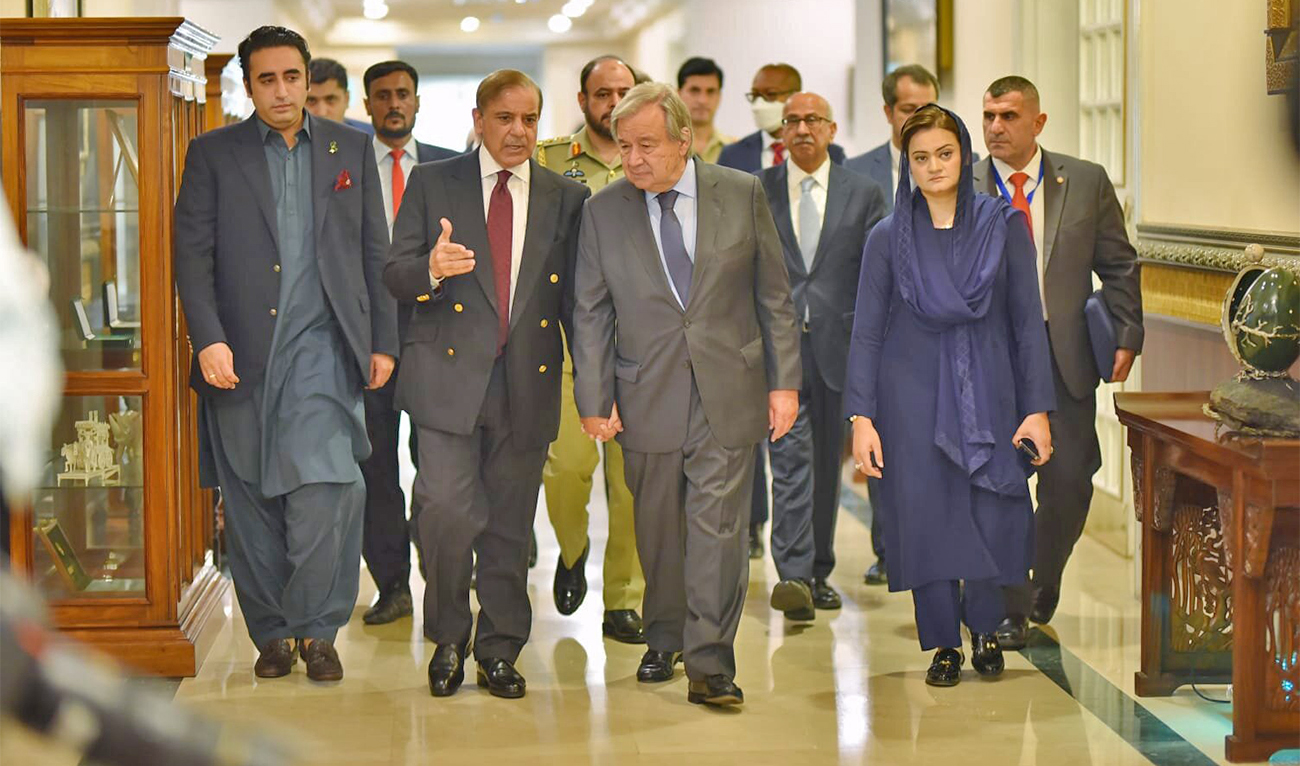
Pakistan's Prime Minister (second left) welcomes UN Secretary General Antonio Guterres (second right) upon his arrival at the Prime Minister Office in Islamabad, Pakistan, on September 9, 2022. (APP)
Guterres termed it an unprecedented disaster for Pakistan, adding that there is no recent memory of climate change-induced disasters that have struck the country on such a large scale.
“I have seen the families who have lost their loved ones, houses, crops, jobs, and everything they have and are in desperate conditions in the present circumstances,” he said.
“Humanity is in clear war with nature and nature is striking back, but nature is blind. It is not striking back on those that have contributed more to the war with nature,” the UN chief added.
He said though Pakistan’s contribution to global emissions is very small, the country remains one of the most vulnerable hotspots to the consequences of climate change.
“So, it is like nature is attacking the wrong side as it should be those who are more responsible for climate change and should have to face more challenges,” he added.
Pakistan is on the frontline when it comes to the impact of climate change, Guterres said, adding that it is absolutely essential that this fact should be recognized by the international community.
“Pakistan needs massive financial support to respond to this crisis that has posted estimated losses of $30 billion and counting,” he added.
Prime Minister Sharif thanked the UN chief for his visit and told him that every penny Islamabad receives from the inter-governmental organization or the international community would be spent transparently to alleviate people’s suffering.
Later, Pakistan's Foreign Minister Bilawal Bhutto-Zardari held a joint press conference with Guterres, during which he said the government is unable to procure the resources required by flood-affected people.
“The government of Pakistan is unable to get the resources required by these people, which are desperately needed by them," he said. "I cannot shelter 33 million people, I cannot provide food and clothing to these families. We don't have the infrastructure, this is just the rescue and relief phase."
Bhutto-Zardari said flood affectees were now suffering from water-borne diseases. "After the water recedes, we to rebuild their houses, roads, schools, hospitals and other infrastructure," he added.
Guterres said the two had discussed organizing a global [donors] conference with the Pakistani government. The conference, he said, would be used to generate support. This would be done after an assessment of expenses, required for not only rescue and relief but also rehabilitation and reconstruction, is finalized.
"We have identified 50 hotspots where your country is facing the impact of climate change," he said.


