DUBAI: Israel’s decision to absolve itself of responsibility for the shooting death of a veteran Al-Jazeera journalist drew criticism from international media on Thursday, marking a further deterioration of relations between the military and reporters covering the conflict.
The Foreign Press Association said the conclusions of the army’s long-awaited probe into the killing “raise major questions about the military’s actions that day and serious doubts about its stated commitment to protecting journalists in the future.”
The association represents international media covering Israel and the Palestinian territories, including The Associated Press. The AP also sits on the group’s board.
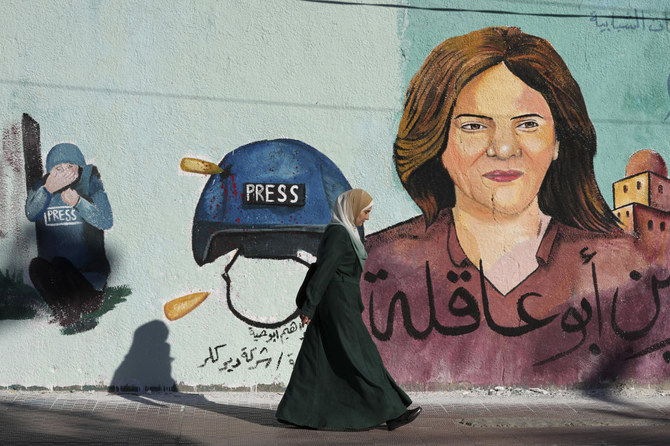
Shireen Abu Akleh, a Palestinian-American on-air correspondent, was shot in the head while covering an Israeli raid in the occupied West Bank on May 11.
Israel said Monday that there was a “high probability” that an Israeli soldier shot her, but portrayed the shooting as a mistake during a protracted firefight with Palestinian militants.
The military said no criminal probe would be launched, meaning that neither the soldier nor commanders will face any punishment. Israeli Prime Minister Yair Lapid later rebuffed US calls for Israel to review its controversial open-fire policies.
Several independent investigations, including one by the AP back in May, had concluded that Abu Akleh was likely shot by an Israeli soldier and cast doubt on the military’s version of events.
Video footage showed Abu Akleh and other journalists, all wearing helmets and vests that clearly identify them as media, slowly walking down a road, in the line of sight of a military convoy, during several quiet minutes before shots rang out.
The military has provided no evidence that Palestinian gunmen fired at the journalists or that any militants were nearby when she was killed.
In a briefing with reporters on Monday that turned heated at times, a senior military official said the soldier, who was inside an armored vehicle and firing through a telescopic scope, had limited visibility and misidentified Abu Akleh. According to the AP investigation, the armored vehicle was about 200 meters (yards) from Abu Akleh.
“According to the senior official, the soldier had limited visibility, yet opened fire directly toward clearly identified journalists without firing a single warning shot,” the press association’s statement said. “If this is normal operating procedure, how can the army fulfill its stated pledge to protect journalists and respect freedom of the press?”
The association called on Israel to publish the full results of its investigation, and to announce “concrete steps it is taking to ensure all its soldiers are made aware of the presence of journalists in the field and do not open fire at them.”
The Committee to Protect Journalists, which advocates for press freedom worldwide, also faulted the Israeli announcement, saying it “does not provide the answers — by any measure of transparency or accountability — that her family and colleagues deserve.”
The military did not immediately respond to a request for comment on the Foreign Press Association’s statement. It has repeatedly said it did not target Abu Akleh and that it is committed to press freedoms.
The shooting has further strained already tense relations between the military and reporters covering the harsh realities of Israel’s open-ended 55-year occupation of lands the Palestinians want for a future state.
Several Palestinian journalists have been wounded by Israeli fire over the years while covering the conflict. Two Palestinian journalists were shot and killed while filming violent protests along the Gaza frontier in 2018. A Reuters cameraman was killed by an Israeli shell in Gaza in 2008.
In November 2018, AP cameraman Rashed Rashid was covering a protest near the Gaza frontier when he was shot in the left ankle, apparently by Israeli fire. The military has never acknowledged the shooting.
Last year, Israeli soldiers held AP photographer Majdi Mohammed against his will during clashes in the occupied West Bank, in a dangerous location where Palestinian protesters were hurling stones and the troops were firing tear gas and rubber-coated bullets.
In response to critical coverage, Israel and supporters of its policies frequently accuse the media of bias. The military, meanwhile, has been known to circulate misleading information to advance its goals.
Immediately after Abu Akleh’s death, Israeli officials sent around video footage of Palestinian militants firing in an alleyway, suggesting they might have killed her. The officials backtracked hours later when it was revealed that the militants were hundreds of meters away with no line of sight to her position, something troops would have known in real time.
During last year’s Gaza war, the military was accused of circulating misleading reports among reporters suggesting that a ground invasion was under way in an attempt to lure Hamas militants into a trap. Some reporters were told outright an invasion had begun. The military blamed the incident on “internal miscommunication.”
On the following day, an Israel airstrike demolished a high-rise building housing the offices of the AP and Al-Jazeera after those inside were warned to evacuate. The military claimed the building housed Hamas militant infrastructure but has provided no evidence of that.
The AP was not aware of any Hamas presence in the building, and said the attack was “shocking and horrifying.” AP journalists continued to report from Gaza throughout the 11-day conflict, and the agency reopened a permanent Gaza office earlier this year.
Gaza’s militant Hamas rulers have also faced criticism from media outlets. After a recent round of heavy fighting between Israel and Islamic Jihad, another Palestinian militant group, Hamas issued guidelines to local reporters warning them against critical coverage. The guidelines were officially rescinded following a complaint by the FPA. Hamas officials say the guidelines were drawn up by a low-level worker without authorization.


![]()

Israel’s handling of reporter’s death angers media outlets
Short Url
https://arab.news/ccj2n
Israel’s handling of reporter’s death angers media outlets
- The Foreign Press Association said the conclusions of the army's long-awaited probe into the killing “raise major questions about the military’s actions”
- Israel said Monday that there was a “high probability" that an Israeli soldier shot her


Latest updates


© 2026 SAUDI RESEARCH & PUBLISHING COMPANY, All Rights Reserved And subject to Terms of Use Agreement.