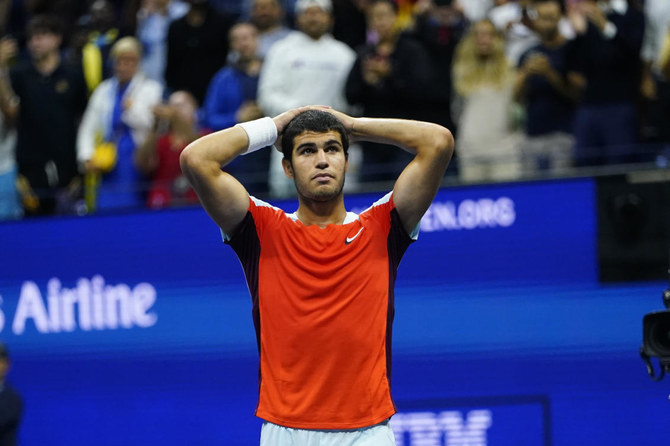
NEW YORK: This was a match that would not end. Should not end, one might say. Carlos Alcaraz and Jannik Sinner, two of the brightest young stars of men’s tennis, traded shots of the highest quality and countless momentum swings across five sterling sets for 5 hours, 15 minutes until Alcaraz finally won the last point at 2:50a.m. on Thursday, the latest finish in US Open history.
It was “only” a quarterfinal, no trophy at stake, yet was as taut a thriller as this year’s tournament has produced or, likely, will, a tour de force of big cuts on the full sprint and plenty of guts, concluding as a 6-3, 6-7 (7), 6-7 (0), 7-5, 6-3 victory for the No. 3-seeded Alcaraz, a 19-year-old from Spain.
“Honestly,” said Alcaraz, who saved a match point in the fourth set, “I still don’t know how I did it.”
He also used words such as “unbelievable” and “amazing.” No hyperbole there.
“This one will hurt for quite a while,” said No. 11 Sinner, a 21-year-old from Italy. “But tomorrow, I will wake up — or today, I will wake up — trying to somehow (take away) only the positives.”
Alcaraz reached his first Grand Slam semifinal and is the youngest man to get that far at the US Open since Pete Sampras won the title at 19 in 1990.
Alcaraz has a chance to move up to No. 1 in the rankings next week, and will face No. 22 Frances Tiafoe of the United States on Friday. The other men’s semifinal that day is No. 5 Casper Ruud of Norway vs. No. 27 Karen Khachanov of Russia.
This match began Wednesday evening at about 9:45 p.m. and easily surpassed the previous mark for latest time of finish at the US Open, which had been 2:26 a.m., shared by three matches.
Alcaraz has been working overtime in New York: His five-set victory over 2014 US Open champion Marin Cilic in the fourth round wrapped up at 2:23 a.m. on Tuesday.
“I always say you have to believe in yourself all the time,” Alcaraz said. “The hope is the last thing that you lose.”
After his much more mundane, three-set victory over Andrey Rublev in a quarterfinal that finished at about 4:45 p.m. on Wednesday, Tiafoe was rather prescient when asked about Alcaraz and Sinner.
“I just hope they play a marathon match, super-long match,” Tiafoe said with a smile, “and they get really tired come Friday.”
Not only did this one run late, it ran long: Only a 5-hour, 26-minute match between Stefan Edberg and Michael Chang in 1992 took more time at the US Open.
The clock already was past 2a.m. when Coco Gauff, the 18-year-old American who was the runner-up at the French Open and bowed out in the US Open quarterfinals on Tuesday, spoke for anyone paying attention to Alcaraz vs. Sinner when she tweeted: “this match is insane. I leave at 6am for the airport but I refuse to sleep and miss this. #Sinner #Alcaraz”
Still, even with thousands and thousands of empty seats, there were enough who remained on hand to make as much noise as a full house at times. Both players would wave their rackets or motion with their arms to encourage the fans to get even louder. And, naturally, the fans would oblige.
“Could have finished in three sets. Could have finished in four sets. Could have finished in five sets,” Sinner said. “We both wanted to win, for sure. We both tried our best.”
It was as back-and-forth as could be. The highlights were too many to list. Just one: Alcaraz won one point after extending a rally by wrapping his racket behind his back to make contact with the ball. One more: Alcaraz fell onto his backside, then sprung up to race to smack a backhand that won that point.
After taking the first set, Alcaraz held five set points in the second — but Sinner saved them all.
In the third, Alcaraz broke to lead 6-5 and served for that set — but Sinner broke to force a tiebreaker that he dominated.
In the fourth, it was Sinner who served for the match at 5-4, even coming within a point of victory there — but Alcaraz broke and wound up pushing what already was a masterpiece to a fifth.
And in the fifth, after another memorable shot — a running backhand passing winner that sailed just past Sinner’s outstretched arm — to earn a break point and a chance for a 5-3 lead, Alcaraz put a finger to his ear.
He would convert that chance, then serve it out. When the end did arrive, Alcaraz dropped to his back, his chest heaving, and covered his face with his hand.


Carlos Alcaraz tops Jannik Sinner in latest US Open finish ever
https://arab.news/n7mrt
Carlos Alcaraz tops Jannik Sinner in latest US Open finish ever

- Carlos Alcaraz reaches his first Grand Slam semifinal
- The youngest man to get that far at the US Open since Pete Sampras won the title at 19 in 1990


Aston Martin says its car risks giving drivers ‘nerve damage’ and can’t finish F1 season-opener
- Aston Martin has predicted it is unlikely to finish Formula 1’s season-opening Australian Grand Prix without its drivers risking suffering permanent nerve damage
MELBOURNE: Aston Martin has predicted it is unlikely to finish Formula 1’s season-opening Australian Grand Prix on Sunday without its drivers risking suffering permanent nerve damage.
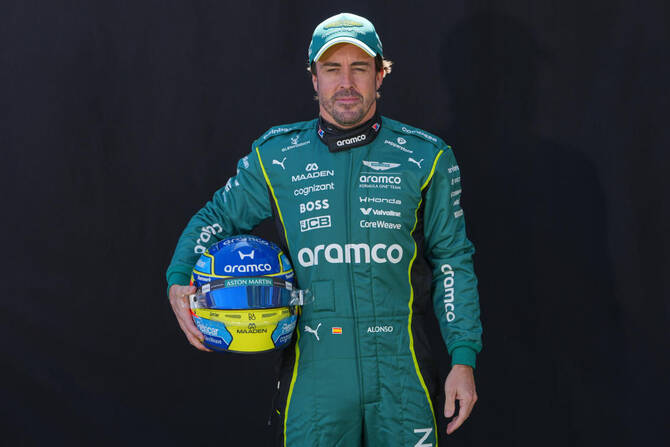
Adrian Newey, the F1 car design great who’s heading into his first race as Aston Martin’s team principal, said Thursday the team’s Honda power unit causes vibrations which could damage the hands of drivers Fernando Alonso and Lance Stroll. Neither will likely be able to tolerate even half of the 58-lap race distance, Newey added.
Aston Martin had a poor preseason, often slower even than new team Cadillac and it logged the fewest laps of all 11 teams.
“That vibration (transmitted from Honda’s power unit) into the chassis is causing a few reliability problems,” said Newey.
“Mirrors falling off the air, tail lights falling off, that sort of thing, which we are having to address. But, the much more significant problem with that is that that vibration is transmitted ultimately into the driver’s fingers.
“So Fernando is of the feeling that he can’t do more than 25 laps consecutively before he will risk permanent nerve damage into his hands. Lance is of the opinion that he can’t do more than 15 laps before that threshold.
“We are going to have to be very heavily restricted on how many laps we do in the race until we get on top of the source of the vibration — and to improve the vibration at source.”
Despite the long list of issues, Newey says the AMR26 car has tremendous potential as F1 starts a new era of regulations.
He argued the chassis is F1’s fifth-best behind the expected top-teams Mercedes, Ferrari, McLaren and Red Bull and that, following an aggressive development program, has the potential to run at the front at some point in 2026.
Alonso, though, is keeping the faith until Friday practice in Melbourne, where he believes fixes on the car might provide a sunnier outlook.
“For us, it’s just vibrating everything,” the two-time F1 champion said.
“But it’s not only for us. The car is struggling a little bit, so that’s why we have some issues, some reliability problems that made our days slightly short.
“Since (pre-season testing in) Bahrain, there were a couple of tests done and some of the solutions are implemented on the car now, so (I’m) curious to see what (happens) tomorrow (and) if we can improve.”
Its disappointing performance has been variously attributed to a compressed design time due to late arrival; Honda’s need to rebuild its research and development capabilities after leaving Red Bull, the challenge of producing a new in-house gearbox, and the team running a so-far unproven fuels partner in Aramco.
But it’s the side effects that will likely sideline its cars early in Sunday’s race at Albert Park.


