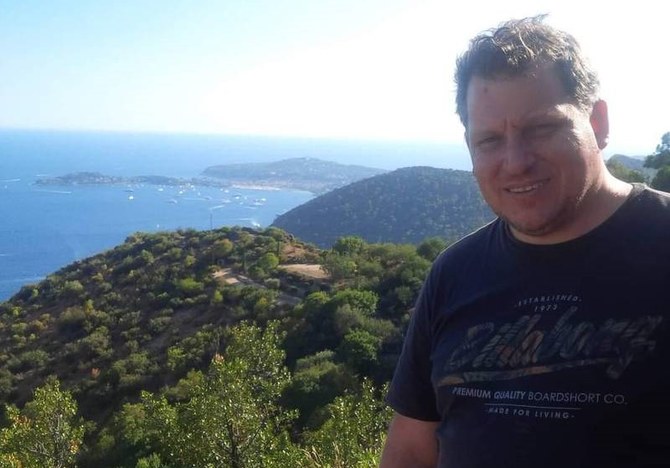

LONDON: The Australian government said it has “serious concerns” for the welfare of one of its citizens who is being held in a jail in Baghdad, The Guardian reported on Tuesday.
Photos of Robert Pether obtained by the newspaper show discolored skin and the engineer’s body covered in new moles, particularly on his back, which his doctors and family fear are cancerous.
The engineer, arrested and arbitrarily imprisoned in Baghdad in April last year over a business dispute between his architecture firm and Iraq’s government, is a skin cancer survivor.
His doctors say health services are not conducting proper tests and have botched the excision of two moles, exposing him to a severe risk of infection.
Pether’s wife has likened the situation to “watching his murder in slow motion” and says her husband has lost more than 40kg in custody.
“He looks like a different person completely,” she told The Guardian.
“The whites of his eyes are grey and he literally has two black eyes and patchy skin. His doctor was mortified. His skin is sagging off him and his bones are protruding,” she added.
In a letter to Australian embassy staff two weeks ago, the engineer’s doctor wrote: “Robert Pether is imprisoned in a 14ft cell with no windows and only one door with [up to] 21 other men.”
“To perform surgery on any patient and send them back into that environment is unconscionable,” the doctor said.
Australia’s Department of Foreign Affairs and Trade confirmed it holds “serious concerns” for Pether’s welfare. A spokesperson said the government was advocating for Pether “in the strongest possible terms.”
“Officials from the Australian Embassy in Baghdad are providing extensive consular support to Mr. Pether and his family, including visiting him in prison and working with Iraqi authorities to ensure Mr. Pether is able to access appropriate medical care,” a spokesperson said.
“The Australian government has consistently advocated for Mr. Pether in the strongest possible terms at the highest levels and we will continue to do so.”
Australia’s Prime Minister Anthony Albanese raised Pether’s case with his Iraqi counterpart Mustafa Al-Kadhimi in June.
His family says he is innocent and a UN working group has previously criticized his trial as compromised.
The UN Working Group on Arbitrary Detention released a report on Pether’s detention in March, finding it to be arbitrary and a breach of international law.
The report said that charges against him were changed half way through the trial and that he was denied a fair trial before being convicted of fraud and sentenced to five years in prison.
The UN group said it had received allegations that Pether “was exposed to extreme cold, threats of death, humiliation, and various forms of psychological abuse.”
The report also cited allegations that Pether had been “blindfolded, interrogated, screamed at, threatened, insulted and shown torture rooms.”