HONG KONG: Five Hong Kong unionists were found guilty of sedition on Wednesday for producing a series of illustrated children’s books that portrayed the city’s democracy supporters as sheep defending their village from wolves.
The convictions are latest using a colonial-era sedition offense which authorities have deployed alongside a new national security law to stamp out dissent.
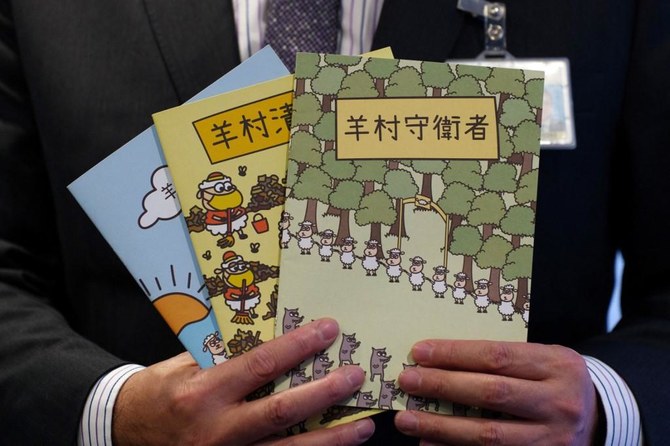
The prosecution focused on members of a speech therapists’ union who produced three illustrated e-books aimed at explaining Hong Kong’s democracy movement to children.
In one book, called “Defenders of the Sheep Village,” a group of wolves try to occupy a village of sheep, who fight back and drive their attackers away.
In another, the wolves are portrayed as dirty and bringing disease to the sheep’s village.
Lai Man-ling, Melody Yeung, Sidney Ng, Samuel Chan and Fong Tsz-ho, all founding members of the union, were charged with sedition and held in jail for more than a year ahead of their verdict.
After a two-month trial Kwok Wai-kin, a District Court judge handpicked by the government to try national security cases, found the five guilty of conspiring to spread seditious content.
“The seditious intention stems not merely from the words, but from the words with the proscribed effects intended to result in the mind of children,” Kwok wrote in his judgment.
During the trial prosecutors argued the books contained “anti-China sentiment” and were aimed at “inciting readers’ hatred against the mainland authorities.”
They also said the books were meant to encourage Hong Kongers to discriminate against “mainland Chinese people living in Hong Kong.”
The defense argued that the sedition offense was vaguely defined and that each reader should be allowed to make up their own mind about what the characters in the books represented.
They also warned that a guilty verdict would further criminalize political criticism and have a chilling effect on the society.
Until recently Hong Kong was a bastion of free expression within China and home to a vibrant and outspoken publishing industry.
But Beijing has unleashed a sweeping political crackdown on the city in response to huge and sometimes violent democracy protests three years ago.
Sedition, originally a law from the British colonial era, had not been used for decades.
But it has been embraced by police and prosecutors over the last two years, alongside the national security law which Beijing imposed on Hong Kong in 2020.
Since then the city’s once-popular democracy movement has been dismantled.
Most prominent local democracy activists either are in jail, are awaiting trial or have fled overseas.
Dozens of civil society groups, including multiple trade unions, have folded while a mainland-style censorship rule has been created for the film industry.
Books have been removed from libraries and curriculums rewritten with authorities ordered to instill patriotism into the city’s children.
Only people deemed “staunch patriots” are now allowed to run for office.
Even before the latest crackdown, publishing had become a key target for Chinese authorities.
In 2015, five Hong Kongers behind a bookstore that published salacious tomes on leaders of the Chinese Communist Party went missing, later reappearing in mainland custody.
The missing bookseller case was itself a partial catalyst for the 2019 democracy protests which initially began as a movement against a law allowing extraditions to the mainland’s party-controlled court system.


![]()


Hong Kong court convicts five of sedition over children’s books
Short Url
https://arab.news/n6nxx
Hong Kong court convicts five of sedition over children’s books
- Convictions used a colonial-era sedition offense which authorities have deployed alongside a new national security law to stamp out dissent


Zelensky wants to replace Ukraine’s defense minister
- President has offered the position to his current minister of digital transformation, who is aged just 34
- No explanation was given for his decision to replace Denys Shmygal
KYIV, Ukraine: Ukrainian President Volodymyr Zelensky on Friday said he intended to replace his defense minister and had offered the position to his current minister of digital transformation, who is aged just 34.
“I have decided to change the structure of the Ukrainian ministry of defense,” Zelensky said in his daily address broadcast on social media. “I have offered Mikhailo Fedorov the position of new Ukrainian defense minister.”
Fedorov, who has been digital transformation minister since 2019, is a relative political novice little-known to the Ukrainian public.
“Mykhailo is deeply involved in issues related to drones and is very effective in the digitalization of state services and processes,” Zelensky added.
Without explaining his decision to replace Denys Shmygal, the Ukrainian leader said he had proposed the incumbent “head another area of government work that is no less important for our stability.”
Zelensky had tapped Shmygal as defense minister just half a year ago, in July 2025.
Besides the turnover at the defense ministry, Zelensky also named Ukrainian military intelligence chief Kyrylo Budanov to head his presidential office.
Budanov replaces Andriy Yermak, who was among Ukraine’s most powerful people before being engulfed in a corruption scandal dogging some of Zelensky’s former allies.
“I have decided to change the structure of the Ukrainian ministry of defense,” Zelensky said in his daily address broadcast on social media. “I have offered Mikhailo Fedorov the position of new Ukrainian defense minister.”
Fedorov, who has been digital transformation minister since 2019, is a relative political novice little-known to the Ukrainian public.
“Mykhailo is deeply involved in issues related to drones and is very effective in the digitalization of state services and processes,” Zelensky added.
Without explaining his decision to replace Denys Shmygal, the Ukrainian leader said he had proposed the incumbent “head another area of government work that is no less important for our stability.”
Zelensky had tapped Shmygal as defense minister just half a year ago, in July 2025.
Besides the turnover at the defense ministry, Zelensky also named Ukrainian military intelligence chief Kyrylo Budanov to head his presidential office.
Budanov replaces Andriy Yermak, who was among Ukraine’s most powerful people before being engulfed in a corruption scandal dogging some of Zelensky’s former allies.
Latest updates


© 2026 SAUDI RESEARCH & PUBLISHING COMPANY, All Rights Reserved And subject to Terms of Use Agreement.