

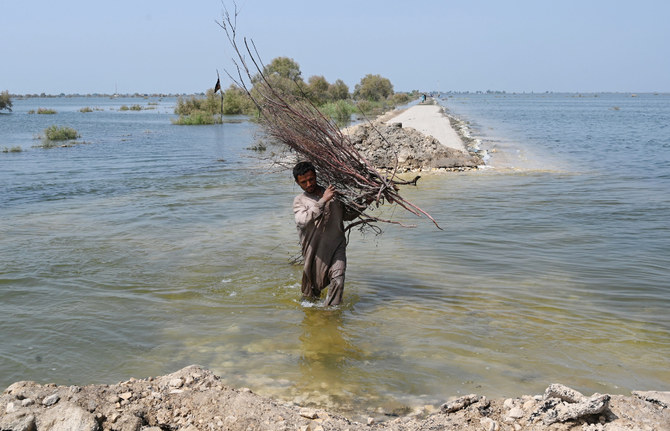

CHARSADDA, Pakistan: When the swollen Swat River shifted course in late August and roared into Naeem Ullah’s village in northwest Pakistan, it swept away his home and all 13 of his relatives’ houses too.
His sugarcane crop — planted on five hectares (12.4 acres) of leased land — also was wrecked, leaving the 40-year-old jobless, homeless and with few prospects of repaying the money he had borrowed to buy seed and fertilizer.
“I have to start my life from zero,” he told the Thomson Reuters Foundation in his village of Dagi Mukarram Khan, in Khyber Pakhtunkhwa province. “I have lost everything. I can only pray to Allah to give me the strength to face this biggest challenge of my life.”
Floodwaters, driven by months of relentless rain and by extreme spring heat that accelerated the melting of glaciers, have covered a third of Pakistan, an area larger than England and Wales combined, affecting 33 million people.
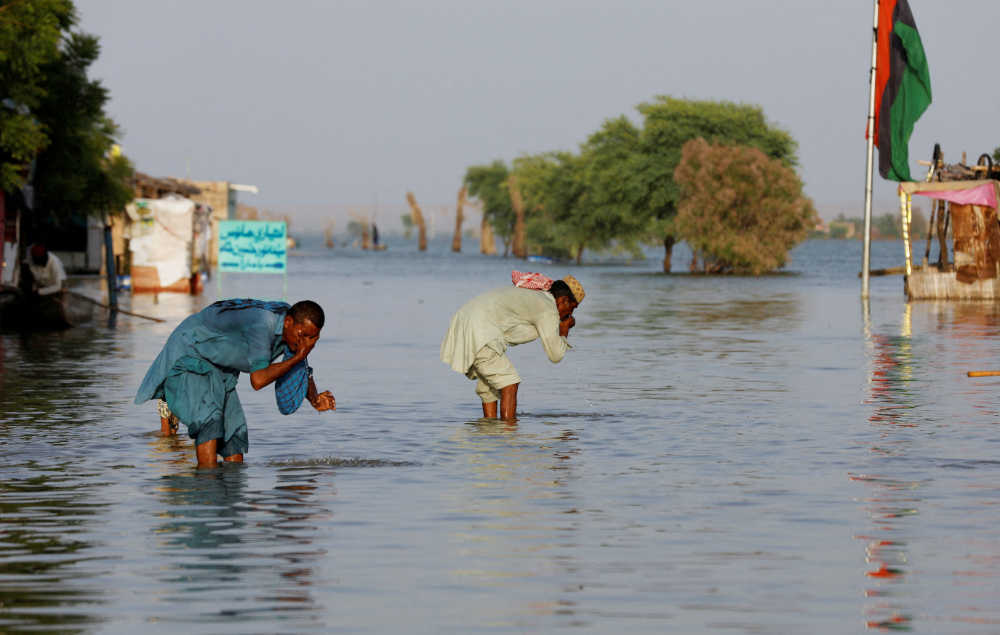
Men perform ablution with the flood water, following rains and floods during the monsoon season in Bajara village, at the banks of Manchar lake, in Sehwan, Pakistan September 6, 2022. (REUTERS)
More than 1,300 people have died, according to Pakistan’s National Disaster Management Authority, and the cost of the damage is estimated at $10 billion, with 1.6 million homes lost or damaged, 5,000 km (3,100 miles) of roads destroyed and over 700,000 livestock gone.
UN Secretary-General Antonio Guterres is scheduled to travel to hard-hit areas of the country this week to see the devastation from what he has termed “a monsoon on steroids.”
Across Pakistan, millions of families have lost their homes and belongings, crops, animals and even relatives, with many struggling just to find dry patches of land to erect tarpaulin shelters and keep themselves and their remaining livestock safe.
Key roads and bridges have been washed away, hampering aid efforts and forcing authorities in some places to deliver limited emergency help mainly by costly helicopter.
In Awaran district, in hard-hit southwest Balochistan province, floods in some areas still stretch toward the horizon, having destroyed many of the impoverished province’s mud homes.
Dilshad Baluch’s family saw their house washed away and a neighbor killed when his home collapsed, as floods swamped their village in July.
Downed power cables presented an electrocution threat amid the standing water, he said — and with bridges to Karachi impassable, the area’s major supply route remains cut off.
Helicopters have dropped parcels of rice and beans but “it’s far too little” and villagers cannot cook it without kitchens or dry firewood, Baluch said via a patchy telephone line interrupted by the wail of the village call to prayer.
“We are living on open ground,” noted the 21-year-old university student, home for the summer from his studies in Islamabad.
Many residents are angry, he added, “but most of them are just feeling helpless. There is no one to take care of them, and no one cares about them.”
HELP ARRIVING?
With Pakistan saddled by heavy debt and international humanitarian agencies overwhelmed by global demand for assistance, Pakistan’s families may have to fund much of the cost of recovery themselves.
Under existing Khyber Pakhtunkhwa provincial policy, farmers can receive compensation of 5,000 rupees ($23) per acre for damage to crops and orchards, with each family eligible for a maximum of 50,000 rupees, said Taimur Ali, media coordinator for the Khyber Pakhtunkhwa Provincial Disaster Management Authority.
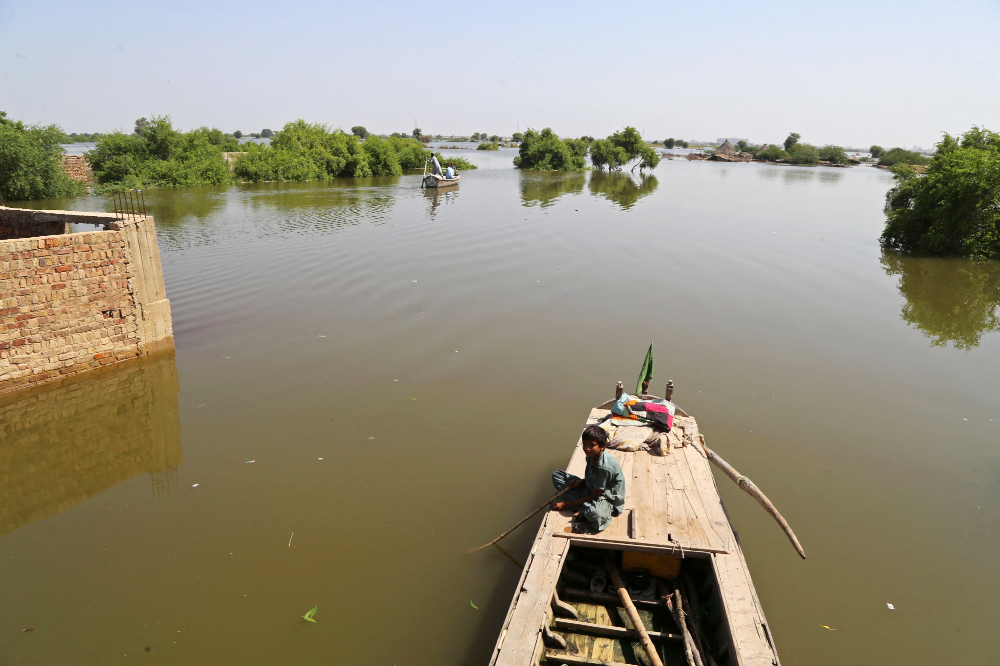
Men perform ablution with the flood water, following rains and floods during the monsoon season in Bajara village, at the banks of Manchar lake, in Sehwan, Pakistan September 6, 2022. (REUTERS)
That could potentially be raised after a fuller assessment of the damage, he added.
The provincial government also has announced it will provide up to $1,370 in compensation for each damaged home, and has distributed 1.75 billion rupees ($7.9 million) for rescue and relief efforts since the start of July, he said.
The International Monetary Fund last week agreed to release $1.1 billion in funding for cash-strapped Pakistan, with politicians saying the money would help keep the inflation-racked economy afloat.
But farmers, especially, are not sure the support on offer will be enough, as some say their fields have been devastated and the land will need to be restored before planting again.
Sher Alam, 47, of Mera Khel Sholgara village on the outskirts of Charsadda city, lost his sugarcane crop after heavy floods swept his land on Aug. 26.
He has already borrowed $450 to repay the lender who provided the seeds and fertilizer for this year’s ruined crop and is now seeking another $230 loan to pay for help to restore his farmland — something he will have to do in his spare time.
Alam, who has five children, said he had found a job at a private parking lot in Charsadda to make ends meet.
With his flattened crop now good only for animal feed rather than the lucrative sugar he expected, “I don’t know how I can survive,” he said, sitting under a tree in front of his home.
The United Nations’ Office for the Coordination of Humanitarian Affairs has said that about 2 million acres of crops have been spoiled by flooding in Pakistan, which could not only affect the economy but also put food security at risk.
Baluch, from Balochistan, said the crop and livestock losses were a huge worry for his community and the country.
“This is not only putting in danger people’s lives, it is putting in danger even their future,” he said.
As the price of remaining scarce supplies of fruit, vegetables and meat soar, the poorest in particular are struggling, he said.
“There are some people who have savings but most of the population, particularly in Balochistan... survive on daily work. But the work is affected by the floods, so they are not getting paid. They are suffering drastically,” the student said.
Floods also have contaminated most of the wells communities in his area rely on, he said, threatening a health disaster.
“People will be suffering, and too many people are going to die,” he predicted.
EARLY WARNING
Many of those hit by flooding said they had not been given adequate warning — or that repeated alerts over months of soaking rain had dampened their will to act.
Alam said his village had received no formal government notice of the late August flooding, but nearby villages had passed on a warning they received.
That, combined with social media alerts residents were seeing on their phones, gave his community about three hours to move some of their livestock and goods to safety, he said.
Ali, of the Khyber Pakhtunkhwa Provincial Disaster Management Authority, said flood monitors had been installed on five rivers and at two other locations in the province, which had helped provide early warning.
In response, as many as 180,000 people were relocated from the Charsadda region, he said.
Losses from this year’s floods are expected to be less in Khyber Pakhtunkhwa than during the devastating 2010 floods, in part because of lessons from the earlier disaster, he said.
Now, “we prepare winter and monsoon contingency plans every year and allocate funds to every district to cope with any disaster,” he explained.


