Fears grow for Arab migrants adrift off the coast of Italy

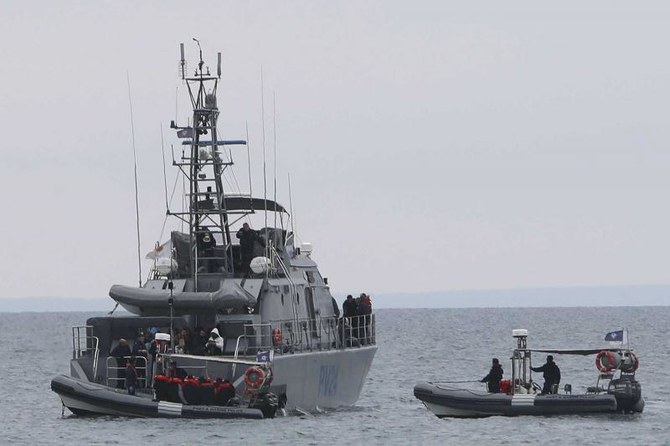
The fate of migrants on board a boat that set off from northern Lebanon over 10 days ago remains uncertain amid conflicting reports. (AP/File Photo)
Short Url
Updated 06 September 2022
Follow

Fears grow for Arab migrants adrift off the coast of Italy

  • Tripoli MP Ashraf Rifi called on the Italian authorities to rescue the migrants

BEIRUT: The fate of migrants on board a boat that set off from northern Lebanon over 10 days ago remains uncertain amid conflicting reports.

The boat, thought to be carrying about 70 Lebanese, Syrian and Palestinian migrants, is reportedly stranded near the coasts of Malta and Italy was in danger of sinking after its engine broke down. The captain of the boat is said to have abandoned the vessel three days ago on a rubber boat.

Tripoli MP Ashraf Rifi called on the Italian authorities to “rescue the migrants stuck in a primitive and broken boat off the Maltese and Italian coasts.”

Rifi urged the Lebanese Foreign Ministry and the country’s embassy in Rome to act quickly to avoid another tragedy at sea.

The boat set out from Arida beach on the border with Syria, at dawn on Aug. 27, headed for Italy. It evaded the Lebanese navy and the UN Interim Force in Lebanon, which patrol the country’s shores.

The passengers kept in touch with their families via a two-way radio. According to one of the migrants’ relatives, the Lebanese passengers are from the town of Benin in the Akkar region. Among the passengers are women and children.

Speaking on condition of anonymity, one relative said that he communicated with the migrants by radio and heard them screaming for help, but neither the Italian authorities nor the Greek coast guard responded to their calls for rescue.

According to the Associated Press, the 60 or so Lebanese and Syrian migrants on board told their relatives and volunteer groups by satellite phone earlier that they had been without food, water, and baby formula for the past several days and had urged European coast guards to rescue them.

A relative of one migrant onboard said his brother told him during their last call, on Monday night, that water was leaking into the boat and that they were drenched.

“The adults are handling the cold and lack of supplies, but the children are really struggling,” he said.

Typically, migrants pay $5,000 or more per person to smugglers to get them to Europe. Every week, the Lebanese army thwarts several such attempts. A few days ago, migrants were discovered on a bus late at night on the way to to one of the country’s northern beaches to board a boat. They had a few life jackets and other personal items. They admitted paying smugglers to transport them.

A tragedy that occurred earlier this year saw a boat sink off the coast of Tripoli and left over 30 people dead. Most of those who perished in the incident were women and children who were confined to the boat’s cabin.

Many attribute the reason for taking the sea and bearing its risks to the repercussions of the economic and living deterioration in Lebanon and the search for a better life.

Rashid Derbas, former Lebanese minister of social affairs and a resident of Tripoli, told Arab News: “According to a survey conducted in 2015 in cooperation with the Arab Towns Organization, the city of Tripoli was classified as the poorest city on the Mediterranean coast. Given the ongoing economic collapse, the facilities that used to generate resources for Tripoli and northern Lebanon have stopped, the population has doubled, and so have poverty rates.

“The northern coast of Lebanon is long and difficult to monitor in full, despite all the efforts made by the Lebanese army. It is thus easier to escape from there, and many smugglers lure people with promises to get them to Europe.

“They claim to offer them ‘a trip from hell to heaven,’ which is never the case. Victims sell everything they own and borrow money to pay these smugglers, who put them on death boats and flee with the cash.”


Tunisia’s famed blue-and-white village threatened after record rains

Updated 57 min 37 sec ago
Follow

Tunisia’s famed blue-and-white village threatened after record rains

  • The one-time home of French philosopher Michel Foucault and writer Andre Gide, the village is protected under Tunisian preservation law, pending a UNESCO decision on its bid for World Heritage status

SIDI BOU SAID, Tunisia: Perched on a hill overlooking Carthage, Tunisia’s famed blue-and-white village of Sidi Bou Said now faces the threat of landslides, after record rainfall tore through parts of its slopes.
Last week, Tunisia saw its heaviest downpour in more than 70 years. The storm killed at least five people, with others still missing.
Narrow streets of this village north of Tunis — famed for its pink bougainvillea and studded wooden doors — were cut off by fallen trees, rocks and thick clay. Even more worryingly for residents, parts of the hillside have broken loose.
“The situation is delicate” and “requires urgent intervention,” Mounir Riabi, the regional director of civil defense in Tunis, recently told AFP.
“Some homes are threatened by imminent danger,” he said.
Authorities have banned heavy vehicles from driving into the village and ordered some businesses and institutions to close, such as the Ennejma Ezzahra museum.

- Scared -

Fifty-year-old Maya, who did not give her full name, said she was forced to leave her century-old family villa after the storm.
“Everything happened very fast,” she recalled. “I was with my mother and, suddenly, extremely violent torrents poured down.”
“I saw a mass of mud rushing toward the house, then the electricity cut off. I was really scared.”
Her Moorish-style villa sustained significant damage.
One worker on site, Said Ben Farhat, said waterlogged earth sliding from the hillside destroyed part of a kitchen wall.
“Another rainstorm and it will be a catastrophe,” he said.
Shop owners said the ban on heavy vehicles was another blow to their businesses, as they usually rely on tourist buses to bring in traffic.
When President Kais Saied visited the village on Wednesday, vendors were heard shouting: “We want to work.”
One trader, Mohamed Fedi, told AFP afterwards there were “no more customers.”
“We have closed shop,” he said, adding that the shops provide a livelihood to some 200 families.

- Highly unstable -

Beyond its famous architecture, the village also bears historical and spiritual significance.
The village was named after a 12th-century Sufi saint, Abu Said Al-Baji, who had established a religious center there. His shrine still sits atop the hill.
The one-time home of French philosopher Michel Foucault and writer Andre Gide, the village is protected under Tunisian preservation law, pending a UNESCO decision on its bid for World Heritage status.
Experts say solutions to help preserve Sidi Bou Said could include restricting new development, building more retaining walls and improving drainage to prevent runoff from accumulating.
Chokri Yaich, a geologist speaking to Tunisian radio Mosaique FM, said climate change has made protecting the hill increasingly urgent, warning of more storms like last week’s.
The hill’s clay-rich soil loses up to two thirds of its cohesion when saturated with water, making it highly unstable, Yaich explained.
He also pointed to marine erosion and the growing weight of urbanization, saying that construction had increased by about 40 percent over the past three decades.
For now, authorities have yet to announce a protection plan, leaving home and shop owners anxious, as the weather remains unpredictable.