



RIYADH: Following the launch of Saudi Arabia’s Vision 2030 in 2016, the Kingdom is on its way to becoming the world’s biggest construction site with a total investment of SR4.13 trillion ($1.1 trillion) in infrastructure and real estate projects, according to global real estate consultancy Knight Frank.
The real estate firm projected that Riyadh’s population will reach 17 million by 2030, up from about 7.5 million today. The city has unveiled real estate projects worth $104 billion since the Kingdom’s National Transformation Plan launch in 2016.
“Vision 2030 has lit the embers of excitement across the Kingdom, and with NEOM positioned as a crown jewel in the transformative plans, people are eager to be part of history,” Faisal Durrani, partner and head of Middle East research, Knight Frank told Arab News.
Saudi Arabia will easily become the largest construction site in history, with planned construction projects in the Kingdom being over 555,000 residential units, over 275,000 hotel keys, over 4.3 million square meters of retail space, and over 6.1 million square meters of office space, Durrani said.
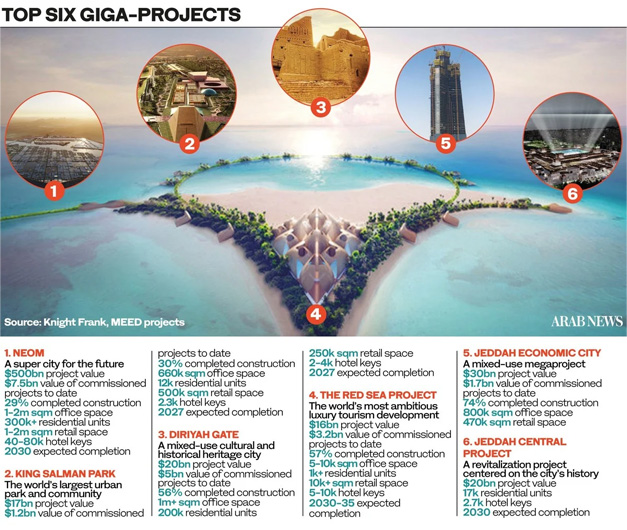
The consultancy firm is currently monitoring 15 giga-projects in the Kingdom, many of them new standalone supercities, said Harmen de Jong, partner and head of real estate, Strategy& Consulting in the Kingdom.
NEOM is expected to house 9 million residents across 300,000 new homes once completed, making it the largest giga-project announced to date, Jong added.
Among 1,000 Saudi households surveyed, Diriyah Gate came third in popularity as a place to own a home, behind NEOM and The Red Sea Project.
NEOM is radically redefining urban living in resource-poor regions, Durrani said. At the same time, sub-cities like the Octagon, Trojena and the Line will set new benchmarks for luxury living in the area.
Around 30 percent of Saudi homeowners are prepared to spend more than $800,000 on a second home at NEOM. “Developers have their work cut out to satisfy this pent-up demand,” Durrani added.
De Jong said that the construction progress of part of the projects stands at 29 percent, with only $7.5 billion of subprojects being commissioned.
Riyadh’s rebirth
Another head-turning giga-project is the $20 billion Diriyah Gate which will give Riyadh 20,000 homes when it is completed in 2027, creating a city-sized historic district.
Knight Frank estimated that about $2.3 billion had been spent on Diriyah Gate’s construction.
“Not to be outdone, Riyadh’s repositioning as a commercial nerve center of the Kingdom is well underway. And businesses from the world over are already clamoring to be at the center of the Middle East’s second and much-needed global hub,” Durrani said.
Durrani added that the planned development of 2.8 million square meters of world-class office space could not come at a better time with Grade A office occupancy levels hovering around 97 percent across the city.
According to Knight Frank, an international airport worth $147 billion is also set to open shortly. Nearly 74 percent of the $200 billion national infrastructure investment goes toward the new airport.
“The city is also attracting a huge number of internal migrants, and with readily available support to get on the housing ladder, house prices are rising rapidly and currently stand some 26 percent higher than this time last year,” he said.
Well-being hub
The Kingdom is also improving and providing world-class urban environments for its residents with the $500 million Riyadh Sports Boulevard and the $23 billion Green Riyadh, planting 7.5 million trees in the Saudi capital to transform it into a green, vibrant metropolis.
It also extends to the 19,000 hospital beds planned for $13.8 billion, of which $8.6 billion will be spent in Riyadh Province alone.
According to de Jong, over 80 new educational institutions are being constructed for $82 billion.
“What’s more, healthcare, education and well-being sit at the core of the transformative plans, which will contribute to an extraordinary evolution in the Kingdom’s physical realm, making it unrecognizable from what we see today by the end of the decade,” Durrani said.


