Pakistan mentions principle of non-interference while responding to UN report on Uyghur community

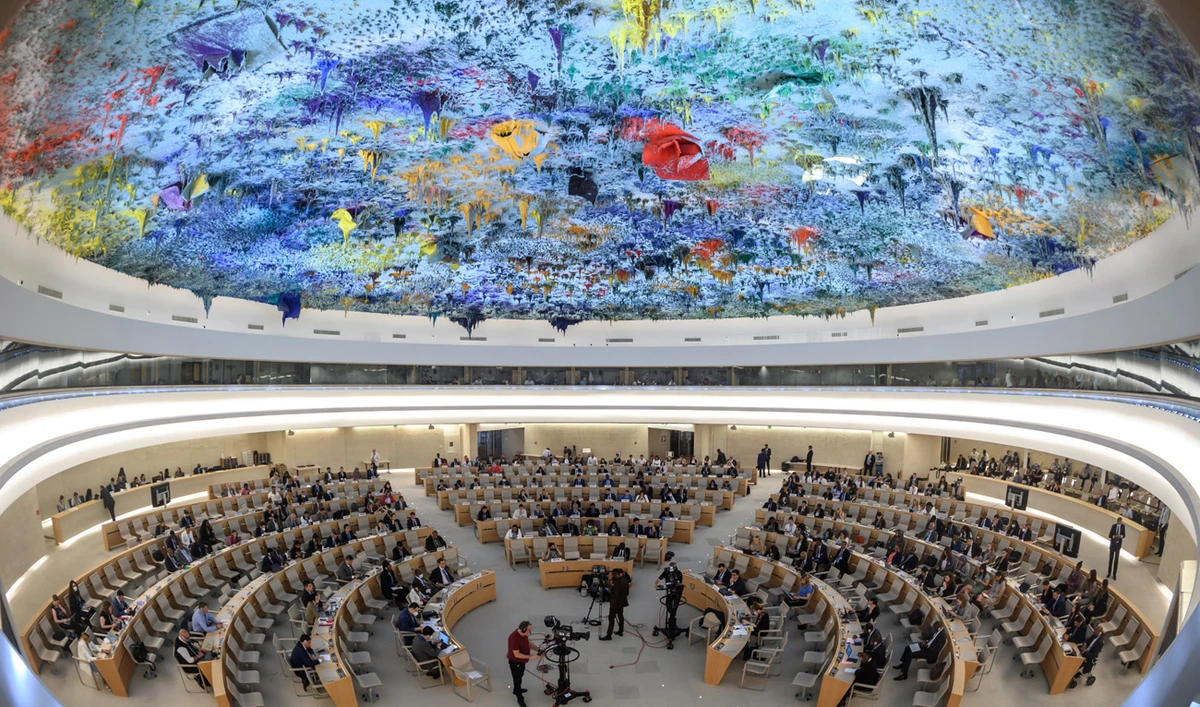
A photo shows a general view on the opening day of the 50th session of the UN Human Rights Council, in Geneva, on June 13, 2022. (AFP/File)
Short Url
Updated 06 September 2022
Follow

Pakistan mentions principle of non-interference while responding to UN report on Uyghur community

  • The UN report says China’s dealings with the Uyghur Muslim population of Xinjiang may constitute ‘crimes against humanity’
  • Pakistan says it respects UN ideals of ‘political independence, sovereignty and non-interference in internal affairs of states’

ISLAMABAD: Pakistan’s foreign office on Tuesday responded to a United Nations report on human rights in Xinjiang that was circulated by the world body toward the end of the last month, saying it believed in the principle of non-interference in the internal affairs of other country which was also enshrined in the UN Charter.

China has long been accused of committing rights violations against the Uyghur Muslim community in the northwestern Xinjiang region.

Several international media houses have reported in the past that the authorities in Beijing had detained hundreds of thousands of Uyghurs in the last couple of years on suspicion of religious extremism and sent them to “reeducation camps” to carry out its deradicalization program.

The United Nations Office of High Commissioner for Human Rights (OHCHR) issued a report on August 31 after visiting Xinjiang in May, calling the allegations of torture, forced medical treatment and adverse conditions of detention “credible.”

It also maintained at the end of the document that the Chinese dealings with the Uyghur community in Xinjiang “may constitute international crimes, in particular crimes against humanity.”

Responding to media queries about the report, the foreign office said on Tuesday it was its “consistent position that non-politicization, universality, objectivity, dialogue and constructive engagement should be the main tools to promote universal respect for human rights.”

“As a responsible member of the United Nations with strong commitment to multilateralism, Pakistan believes in the principles of the UN Charter including respect for political independence, sovereignty and non-interference in internal affairs of states,” it added.

It also praised China for lifting over 700 million people out of poverty in the last 35 years, saying the leadership in Beijing helped improve the lives of these people and made it possible for them to enjoy fundamental human rights.

“Pakistan supports China’s efforts for socio-economic development, harmony and peace and stability in Xinjiang,” the foreign office added.

The country’s official statement on the issue also appreciated Beijing’s constructive engagement with the UN human rights system as well as the general secretariat of the Organization of Islamic Cooperation (OIC), adding the visits by the former high commissioner of human rights and OIC delegation to China were evidence of that.

“Pakistan reaffirms its abiding commitment to advance all human rights universally in accordance with the principles of the UN Charter,” it added.

Pakistan’s top military commander hails Saudi defense pact as ‘historic’ at scholars’ conference

Updated 5 sec ago
Follow

Pakistan’s top military commander hails Saudi defense pact as ‘historic’ at scholars’ conference

  • Asim Munir says Pakistan has a unique bond with the Kingdom, citing the ‘honor’ of helping safeguard the holy sites
  • He says only the state can declare jihad, urging religious scholars to counter extremist narratives and promote unity

ISLAMABAD: Chief of Defense Staff Field Marshal Asim Munir on Wednesday described the country’s joint security pact with Saudi Arabia as a “historic” milestone, telling a gathering of religious scholars that Pakistan and the kingdom share a deep strategic relationship.

Signed in September, the Strategic Mutual Defense Agreement has solidified decades of Saudi–Pakistan defense cooperation, covering intelligence-sharing, counterterrorism and regional stability.

The two nations have long coordinated on defense matters, with Pakistani military personnel deployed in the Kingdom.

“The defense agreement [with Saudi Arabia] is historic,” he said in an address to the conference in the federal capital.

The top military commander said Pakistan regarded its connection with the Kingdom as unique.

“Among all Muslim countries, Allah has given Pakistan the honor of helping safeguard the Haramain,” he continued, referring to the two holiest sites of Islam in Makkah and Madinah.

Munir used his speech to warn against extremism, saying that under the Islamic framework, only the state could declare jihad, a pointed reference to groups such as the Tehreek-e-Taliban Pakistan (TTP), which claims to act in the name of religion while carrying out attacks on civilians and security forces.

“When nations abandon knowledge and the pen, disorder takes hold,” he said, urging the religious scholars to help keep society unified and to “broaden the nation’s vision.”

Munir also criticized India, describing “terrorism” as “India’s habit, not Pakistan’s.”

His remarks came months after a four-day military confrontation in May, during which the two nuclear-armed neighbors exchanged artillery and missile fire and deployed drones and fighter jets.

India blamed Pakistan for a militant attack in Indian-administered Kashmir before launching a missile attack. Islamabad denied involvement and called for an international probe.

Pakistan claimed it had shot down six Indian fighter jets before a US-brokered ceasefire took effect.

“We do not hide when confronting the enemy,” Munir said. “We challenge openly.”