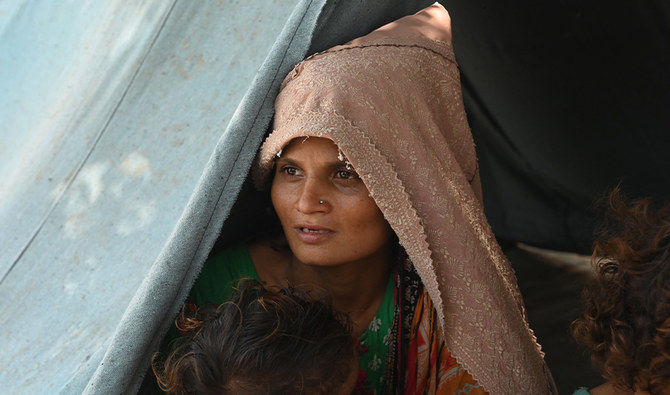
Fazilpur, Pakistan: With a swollen belly, aching feet and her four-year-old daughter in tow, Fahmidah Bibi keeps an eye out for a doctor who is rumored to be due a visit at the campsite she now calls home, after being forced to flee her village because of flooding.
The camp, in the grounds of a small railway station on the outskirts of Fazilpur in Pakistan’s Punjab province, is the only high ground in a landscape of water, and accommodates around 500 people.
They include Fahmidah, 40, who arrived with her five children just over a week ago, along with her husband’s relatives.
“I need a doctor or a midwife. What if something happens to my child?” Fahmidah — nine months pregnant and due any day — told AFP at the weekend.
More than 33 million people in Pakistan have been affected by the flooding, brought on by record monsoon rains that have also caused at least 1,300 deaths, according to government data.
The United Nations Population Fund said Saturday at least 128,000 pregnant women in flood-hit areas urgently need care — with 42,000 expected to give birth in the next three months.
Fahmidah’s last visit to a doctor was a month ago, and according to her report — which she keeps close along with a prescription for medicine she cannot afford — her baby is in breech position.
She sleeps in the open, sharing a traditional wooden charpoy bed with her five children, aged four to 12.
The sprawling makeshift station campsite is home to at least five other pregnant women.
They all complain of a lack of women doctors and midwives to help them.
Most of the women have resisted being examined by volunteer male doctors who have visited with aid convoys. In conservative Pakistan, it is often deemed inappropriate for women to consult male doctors, especially for gynaecological issues.
Desperate for attention, Fahmidah tried striking out across flooded fields to reach the city for help, but slipped and fell multiple times and eventually gave up.
She pales at the thought of giving birth at the campsite, where stranded villagers and their livestock live side-by-side without sanitation.
The buzzing of flies and mosquitoes is incessant, as is the stench from the surrounding murky brown water, filled with rotting vegetation and excrement.
“I have nothing prepared for when the baby comes,” Fahmidah said.
“I don’t even have swaddling clothes. It was all washed away in the flood.”
Like Fahmidah, five-months pregnant Saira Bibi is desperate for a doctor — she has been experiencing shooting pain along the side of her belly.
Just 25 years old, Saira already has four daughters, but is under pressure from her husband and his family to produce a son. He has threatened to get another wife if she fails him again.
“I had a son after four daughters, but he died,” she told AFP, adding that she subsequently underwent fertility treatment for ten months to get pregnant again.
Now, her desperate situation has put her chances of carrying this pregnancy to term in jeopardy.
While Saira prays to successfully deliver a healthy boy, Fahmidah already knows she will be giving birth to a son.
She has decided to name him Ali Raza, and hopes that he will grow up to be an important government officer and take her on a pilgrimage.
“I know he will take his mother to Makkah,” she says.


![]()

Pregnant women caught in Pakistan floods desperate for aid
Short Url
https://arab.news/4zqur
Pregnant women caught in Pakistan floods desperate for aid
- A UN agency says about 42,000 women in flood-hit areas are expected to give birth in the next three months
- Many of these women have resisted being examined by male doctors who have visited with aid convoys
Latest updates



© 2026 SAUDI RESEARCH & PUBLISHING COMPANY, All Rights Reserved And subject to Terms of Use Agreement.