

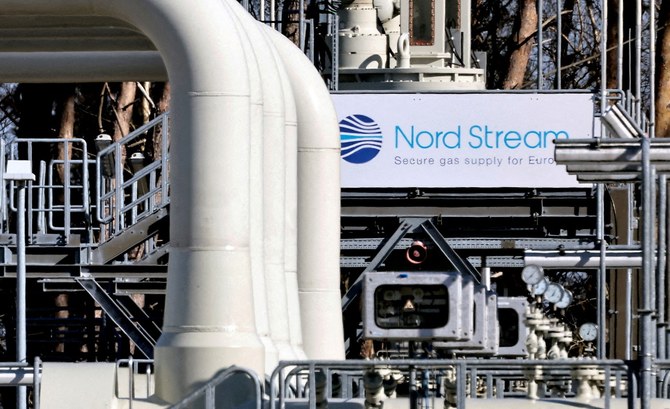

LONDON: European gas buyers already grappling with record-high prices face further pain when the markets open on Monday after Russia said one of its main supply pipelines to Europe would remain shut indefinitely, sparking fears over energy rationing.
Lower gas flows from Russia ahead of and following its February invasion of Ukraine have already pushed up European prices by nearly 400 percent over the past year, sending electricity costs soaring.
Europe has accused Russia of weaponizing energy supplies in what Moscow has called an “economic war” with the West over the fallout from the Ukraine conflict, while Moscow blames Western sanctions and technical issues for supply disruptions.
The Nord Stream pipeline, which runs under the Baltic Sea to Germany, historically supplied around a third of the gas exported from Russia to Europe, but was already running at just 20 percent of capacity before flows were halted last week for maintenance.
Expectations were high Russia’s state-controlled energy giant Gazprom would restart flows at 20 percent after the latest stoppage, leading benchmark Dutch TTF gas prices to fall back around 40 percent from Aug. 26’s record high to close at just over €200 per MWh on Friday.
But after Russia scrapped a Saturday deadline for flows to resume, saying it had discovered a fault during maintenance, prices are likely to surge again, analysts said.
“On Friday... the market was already pricing in Nord Stream 1 (NS1) flows coming back,” Energy Aspects gas analyst Leon Izbicki said. “We expect a significantly stronger open for the TTF on Monday.”
Sky-high power costs linked to surging gas prices have already forced some energy-hungry industries, including fertilizer and aluminum makers, to scale back production, and led EU governments to pump billions into schemes to help households.
The impact of the latest cut would depend on Europe’s ability to attract gas from other sources, Jacob Mandel, a senior associate for commodities at Aurora Energy Research, said.
“Supply is hard to come by, and it becomes harder and harder to replace every bit of gas that doesn’t come from Russia,” he said.
Following Russia’s invasion of Ukraine Europe rapidly launched plans to cut its dependence on Russian fuels, switching to alternative suppliers of gas and other fuels and pushing faster deployment of clean energy supplies.
Germany has begun developing liquefied natural gas terminals to enable it to receive gas from global suppliers and move away from Russian gas imports.
“There’s plenty of scope to replace that (Russian) gas with LNG imports for now, but when the weather turns cold and demand starts to pick up in the winter in Europe and Asia, there’s only so much LNG out there that Europe can import,” Mandel said.
Klaus Mueller, president of the Federal Network Agency energy regulator, said in August that even if Germany’s gas stores were 100 percent full, they would be empty in 2.5 months if Russian gas flows were halted completely.
Europe last week met early a target to fill its gas stocks by 80 percent by November. EU stocks are currently 81 percent full, according to Gas Infrastructure Europe data, with Germany’s stores at 85 percent full.
Izbicki said prices would need to reach an average of €400 per MWh between September 2022 and end-October 2023 to encourage enough sellers to send gas to storage for the EU to meet its targets for next year ahead of winter 2023.


