‘Wow Grape’ meme of Pakistani school in Jeddah set for flood relief NFT auction

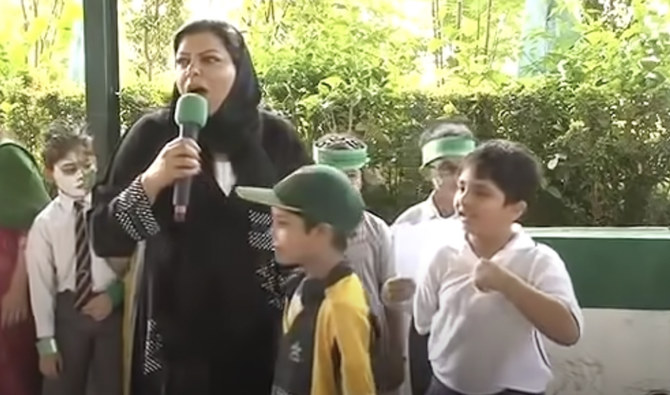
In this screenshot, Sehar Kamran, dressed in black, was handing microphones to children at the Pakistan International School Jeddah during an event in 2010. (Photo courtesy: Ammar Yasir/Youtube) 
Short Url
Updated 03 September 2022
Follow

‘Wow Grape’ meme of Pakistani school in Jeddah set for flood relief NFT auction

  • World-famous meme will go up for auction on Sept. 30
  • Meme owner and former headteacher Sehar Kamran says the rehabilitation of flooding survivors will be Pakistan’s next leading issue

KARACHI: The viral “Wow Grape” meme that originated from a Pakistani school in Saudi Arabia will be auctioned as a Non-Fungible Token (NFT) at the end of September, as its owner pledged to donate proceeds for survivors of the devastating floods that have ravaged the South Asian country.

The meme, which shot to Internet fame in 2020, came from a clip taken during an event in 2010 at the Pakistan International School Jeddah, which showed students pledging their allegiance to Pakistan by speaking to a microphone held by the school’s then-principal, Sehar Kamran, who at one point sounded like she had responded by saying “grape,” when she had said “great.”

Kamran, a former Pakistani parliamentarian, told Arab News on Friday that she decided to auction the popular meme as an NFT in the wake of the widespread devastation caused by historic monsoon rains and melting glaciers in Pakistan, which has killed at least 1,208 people, submerged one-third of the country, and affected 33 million people.

“I decided to go for the auction. I will contribute exactly what will be my share to this cause, to rehabilitate the people,” Kamran told Arab News on Friday.

“I see devastation in front of me. I belong to Sindh and the magnitude of the destruction caused by the floods is so high so we have to take care of our areas.”

Most of the country’s south, particularly the Sindh and Balochistan provinces, has been most affected by the unprecedented floods, which Planning Minister Ahsan Iqbal said was costing Pakistan more than $10 billion in damages.

Kamran said the rehabilitation of the flood survivors will become Pakistan’s next main focus after the conclusion of relief efforts.

The former headteacher said that turning the meme into an NFT will also raise awareness about the trendy digital assets.

The “Wow Grape” meme had over 63 million combined views on video-sharing platform TikTok, where it had initially gained traction in 2020.

“Memes have a specific cultural value when it comes to the Internet because they are really native to the Internet,” Zain Naqvi, co-founder of content and storytelling platform Alter, told Arab News.

“I think it’s a great step overall if more memes from Pakistan, or South Asia in general, or other emerging economies are up for sale because it helps the creators.”

As NFTs are still relatively new in Pakistan, the country still has some way to go when it comes to the legislation surrounding digital assets.

“Speaking of its legalization, there is still a gray area when it comes to Pakistan. We can look at nations such as (in) the Middle East. The UAE is doing some amazing initiatives when it comes to (the) owning of digital assets,” he said.

With Kamran’s consent, the “Wow Grape” NFT auction on Sept. 30 will be conducted in collaboration with the software development company Maqssoft.

​​“A large portion of global wealth now lies with cryptocurrency owners. We wanted to leverage our technical expertise in the field and connections with international NFT investors to tap into this segment and play our role in raising funds for rehabilitation efforts,” Maqssoft co-founderm Mohammed Abubakar Mourigem told Arab News.

“We also hope to motivate other people that even with limited resources, you can come up with out-of-the-box solutions and use technology to do good in society.”


Coast Guard is pursuing another tanker helping Venezuela skirt sanctions, US official says

Updated 4 sec ago
Follow

Coast Guard is pursuing another tanker helping Venezuela skirt sanctions, US official says

  • US oil companies dominated Venezuela’s petroleum industry until the country’s leaders moved to nationalize the sector, first in the 1970s and again in the 21st century under Maduro and his predecessor, Hugo Chávez

WEST PALM BEACH, Florida: The US Coast Guard on Sunday was pursuing another sanctioned oil tanker in the Caribbean Sea as the Trump administration appeared to be intensifying its targeting of such vessels connected to the Venezuelan government.
The pursuit of the tanker, which was confirmed by a US official briefed on the operation, comes after the US administration announced Saturday it had seized a tanker for the second time in less than two weeks.
The official, who was not authorized to comment publicly about the ongoing operation and spoke on the condition of anonymity, said Sunday’s pursuit involved “a sanctioned dark fleet vessel that is part of Venezuela’s illegal sanctions evasion.”
The official said the vessel was flying a false flag and under a judicial seizure order.
The Pentagon and Department of Homeland Security, which oversees the US Coast Guard, deferred questions about the operation to the White House, which did not offer comment on the operation.
Saturday’s predawn seizure of a Panama-flagged vessel called Centuries targeted what the White House described as a “falsely flagged vessel operating as part of the Venezuelan shadow fleet to traffic stolen oil.”
The Coast Guard, with assistance from the Navy, seized a sanctioned tanker called Skipper on Dec. 10, another part of the shadow fleet of tankers that the US says operates on the fringes of the law to move sanctioned cargo. It was not even flying a nation’s flag when it was seized by the Coast Guard.
President Donald Trump, after that first seizure, said that the US would carry out a “blockade” of Venezuela. It all comes as Trump has ratcheted up his rhetoric toward Venezuelan President Nicolás Maduro.
This past week Trump demanded that Venezuela return assets that it seized from US oil companies years ago, justifying anew his announcement of a “blockade” against oil tankers traveling to or from the South American country that face American sanctions.
Trump cited the lost US investments in Venezuela when asked about his newest tactic in a pressure campaign against Maduro, suggesting the Republican administration’s moves are at least somewhat motivated by disputes over oil investments, along with accusations of drug trafficking. Some sanctioned tankers already are diverting away from Venezuela.
US oil companies dominated Venezuela’s petroleum industry until the country’s leaders moved to nationalize the sector, first in the 1970s and again in the 21st century under Maduro and his predecessor, Hugo Chávez. Compensation offered by Venezuela was deemed insufficient, and in 2014, an international arbitration panel ordered the country’s socialist government to pay $1.6 billion to ExxonMobil.
Maduro said in a message Sunday on Telegram that Venezuela has spent months “denouncing, challenging and defeating a campaign of aggression that goes from psychological terrorism to corsairs attacking oil tankers.”
He added: “We are ready to accelerate the pace of our deep revolution!”
Sen. Rand Paul, R-Kentucky, who has been critical of Trump’s Venezuela policy, called the tanker seizures a “provocation and a prelude to war.”
“Look, at any point in time, there are 20, 30 governments around the world that we don’t like that are either socialist or communist or have human rights violations,” Paul said on ABC’s’ “This Week.” ”But it isn’t the job of the American soldier to be the policeman of the world.”
The targeting of tankers comes as Trump has ordered the Defense Department to carry out a series of attacks on vessels in the Caribbean and eastern Pacific Ocean that his administration alleges are smuggling fentanyl and other illegal drugs into the United States and beyond.
At least 104 people have been killed in 28 known strikes since early September. The strikes have faced scrutiny from US lawmakers and human rights activists, who say the administration has offered scant evidence that its targets are indeed drug smugglers and that the fatal strikes amount to extrajudicial killings.
Trump has repeatedly said Maduro’s days in power are numbered. White House chief of staff Susie Wiles said in an interview with Vanity Fair published last week that Trump “wants to keep on blowing boats up until Maduro cries uncle.”
Sen. Tim Kaine, D-Virginia, told NBC’s “Meet the Press” on Sunday that Trump’s use of military to mount pressure on Maduro runs contrary to Trump’s pledge to keep the United States out of unnecessary wars.
Democrats have been pressing Trump to seek congressional authorization for the military action in the Caribbean.
“We should be using sanctions and other tools at our disposal to punish this dictator who is violating the human rights of his civilians and has run the Venezuelan economy into the ground,” Kaine said. “But I’ll tell you, we should not be waging war against Venezuela. We definitely should not be waging war without a vote of Congress.