

Judges in Houthi-held Sanaa on strike after killing of colleague

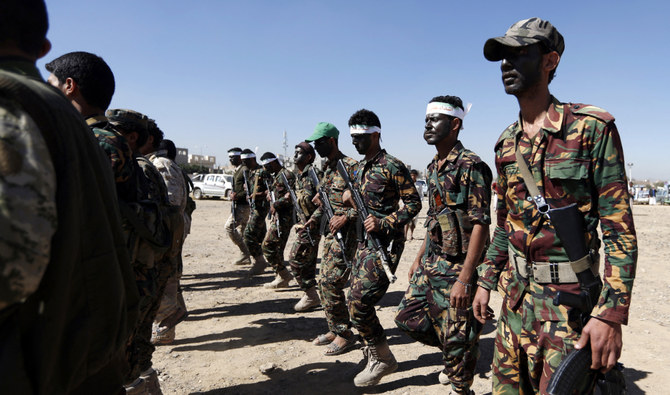
Houthi fighters take part in a gathering in the capital Sanaa. (AFP)
Short Url
Updated 03 September 2022
Follow

Judges in Houthi-held Sanaa on strike after killing of colleague

  • The Yemeni government has accused the Houthis of the killing, saying that Hamran had previously ruled against the militia’s looting of both public and private lands and other properties
  • UN experts said in a new report that nearly 2,000 children recruited by Yemen’s Houthi rebels died on the battlefield between January 2020 and May 2021

AL-MUKALLA: Courts in Houthi-held Sanaa were paralyzed on Saturday as Yemen’s judges went on strike in an attempt to force the Iran-backed militia to charge those involved in the killing of a senior judge last week, residents said.

Khaled Al-Kamal, a Sanaa-based lawyer who visited three courts on Saturday, told Arab News that they were empty as judges and administrative workers refused to work in a rare protest against the killing, as well as low and unpaid salaries and meddling by powerful Houthi figures.

“Strong efforts are being made to resume work at the courts,” Al-Kamal said.

Judge Mohammed Hamran, a 63-year-old Supreme Court judge in Sanaa, was kidnapped from outside his home on Al-Asbahi street and found dead days later.

The Yemeni government has accused the Houthis of the killing, saying that Hamran had previously ruled against the militia’s looting of both public and private lands and other properties.

The murder has spurred the Yemen Courts Club, an umbrella group for judges around the nation, to declare a temporary suspension of court operations until the Houthis bring the murderers to justice.

The club also accused a Houthi-affiliated journalist, Mohammed Al-Emad, who runs Al-Hawiah TV, of inciting the public to kill the judge by alleging that he was corrupt. They have asked for the channel to be closed down and for charges to be brought against Al-Emad.

The judges also demanded an end to meddling in the judicial system, as well as payment of judges’ salaries, which have not been paid for more than a year.

“The (judicial) authority and its men have not been granted their legitimate right to financial sufficiency. Nor has their dignity, blood, and prestige been respected,” the club said in a statement.

The Houthi security establishment claimed on Friday that they had arrested the men who executed the judge, citing “private” land disputes between the judge and the killers as the reason behind the killing.

But Yemeni officials believe that the Houthis are purging judges who disobey their commands and those who refuse to support their seizure of both public and private lands.

On Thursday, Abdullah Mohammed Al-Kibsi, a former lawmaker and a security official loyal to the Houthis, was gunned down outside his house in Sanaa. The Houthis claimed to have apprehended the murderers and blamed the killing on a family dispute.

Yemenis questioned the Houthis’ claims and pointed to escalating internal rivalry and violence between various Houthi factions, particularly the Hashemite Houthi families from Saada and those who were born and brought up in Sanaa. Al-Kibsi came from a Sanaa-based Hashemite family.

Separately, the Houthis bombarded the western entrance of the densely populated city of Taiz on Saturday for the sixth day in a row, despite local and international calls for a de-escalation.

Several shells fired by the Houthis from positions outside Taiz landed in the Al-Dhabab area —the site of the only road between Taiz and Aden — according to residents. Since last Sunday, the Houthis have been shelling Al-Dhabab in an attempt to seize control of the main road.

Saturday’s shelling occurred just hours after government troops repelled a Houthi attack on their positions in the same area.

The United Nations special envoy for Yemen and a number of other Western envoys condemned the Houthis’ military escalation in Taiz and urged the militia to abide by the UN-brokered truce.


Why did Xi hold back-to-back calls with Putin, Trump?

Updated 4 sec ago
Follow

Why did Xi hold back-to-back calls with Putin, Trump?

BEIJING: China’s leader Xi Jinping held back-to-back calls with Russia’s Vladimir Putin and US President Donald Trump this week, timing analysts said on Thursday was rare and significant as Beijing positions itself as a stable global power.
Here is what to know about the talks:
Why on the same day?
Xi’s video call with Putin on Wednesday afternoon was followed just hours later by a phone call with Trump.
“The timing of the call is rare and interesting. It is not common for Xi to have two calls with Putin and Trump,” George Chen, a partner at The Asia Group wrote in an online commentary.
Xi and Putin spoke for 1.5 hours, according to the Kremlin’s foreign policy aide, while Trump said they had a “long and thorough” conversation.
“It does demonstrate that Xi can hold court and easily pick up the phone to speak with the two ‘strong’ leaders of the world,” said Dylan Loh, an associate professor at Singapore’s Nanyang Technological University.
Russia and the United States are two of the “most consequential” countries to China, Loh said, though he cautioned that the timing could have been “a simple scheduling issue.”
What was discussed?
Trump said he and Xi discussed trade, Russia’s war in Ukraine and Iran.
He also said that China had committed to increasing soybean purchases from the United States to 20 million tons in the current season.
The call confirmed that “in spite of what’s happened around the world, there is going to be a short-term tactical stabilization of US-China relations,” Loh said.
The purchase of soybeans, he said, is a “low-hanging fruit.”
On Taiwan, however, Xi warned Washington to exercise caution in arms sales to the self-ruled island, which Beijing claims as its own territory and has vowed to retake by force if necessary.
Taiwan’s Deputy Foreign Minister Chen Ming-chi told AFP that “we don’t worry too much about this whole telephone communication.”
“In fact, we believe that it will contribute to stabilize the situation,” he said.
Meanwhile, Xi and Putin hailed the strengthening of Chinese-Russian ties as they try to present a united front against the West.
The two countries have drawn closer since Russia’s 2022 invasion of Ukraine, which left Moscow diplomatically isolated.
The calls took place as Russian, Ukrainian and US negotiators met in Abu Dhabi for a new round of talks on ending the almost four-year war.
Putin and Xi discussed their “opinions” on the United States, and “special attention was given to the tense situation in Iran,” the Kremlin said.
How important were the talks?
Xi is seeking to position himself as equidistant from Putin and Trump, Ho said.
“China is trying to seek international maneuver space to ensure that whatever happens globally, it does not get fenced into a corner,” he told AFP.
Domestically, China is reeling from a recent corruption probe into Zhang Youxia, a top military general in the People’s Liberation Army, which sent shockwaves through defense observers.
Analysts said that while Zhang’s investigation would likely not have been discussed with Putin and Trump, the timing of the calls could be a way for Xi to project confidence domestically.
Faced with uncertain and fragile domestic conditions, the “two-timing” calls were “probably for domestic posturing to demonstrate Xi’s political standing in the global theater,” Ho said.
What do the calls mean for ties?
Putin accepted invitations during the call to visit China in the first half of 2026, according to the Kremlin, while Trump said he was looking forward to his previously announced trip to Beijing in April.
Putin will also attend the APEC regional summit hosted by Xi in November.
The calls follow a slew of recent meetings between Xi and various leaders, as he seeks to present China as a stable alternative to Washington.
Some analysts cautioned that China-Russia relations “are not ironclad” while both Beijing and the mercurial Trump administration could yet make unattainable demands of each other.
Neither the US nor China will fully commit to Russia, as “both are primarily focused on stabilising their bilateral relationship,” said Yue Su at the Economist Intelligence Unit.
“Meaningful Chinese cooperation would likely require a very attractive deal from the US in exchange.”