

Saudi-Indonesian integration system for migrant workers will improve relations, say officials

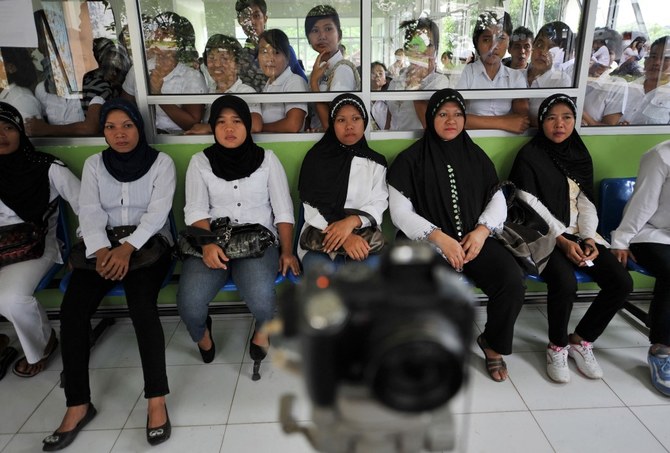
Indonesian workers willing to work overseas wait to be photographed for their identity card at a recruitment office in Jakarta. (File/AFP)
Short Url
Updated 03 September 2022
Follow

Saudi-Indonesian integration system for migrant workers will improve relations, say officials

  • Indonesian and Saudi officials have been working on establishing an integrated placement system between the two countries
  • They renewed a technical arrangement agreement last month to speed up this process 

JAKARTA: The integration of a placement system for Indonesian migrant workers in Saudi Arabia will help lift a ban by Jakarta, improve protection of the group, and boost bilateral relations, officials from the Southeast Asian country have said.

Indonesian and Saudi officials have been working on establishing an integrated placement system between the two countries and renewed a technical arrangement agreement last month to speed up this process.  

Jakarta had placed a permanent ban on sending new domestic helpers to the Middle East in 2015 following a temporary suspension, although hundreds of workers still left for jobs in the wealthier region in the years since.  

Eko Hartono, Indonesia’s consul general in Jeddah, told Arab News that the one-channel system would help to lift the moratorium while also boosting relations between the archipelago nation and the Kingdom.

“This will definitely elevate relations, especially labor relations,” Hartono said. “The system integration is important because it will guarantee the fulfillment of the rights of Indonesian migrant workers working in Saudi Arabia. Once the system integration is complete and done, it can pave the way to lift the moratorium.”

Suhartono, a director general at Indonesia’s Manpower Ministry, told Arab News that officials were expecting the integration process to conclude before the end of this year.

“We estimate (it will be ready) by November 2022 at the latest,” Suhartono said. “The system is one of the instruments for both governments to monitor and evaluate, while also controlling recruitment, placement, and protection of Indonesian migrant workers to Saudi Arabia.”

Indonesia is also hoping to increase the placement of Indonesian migrant workers in the formal sector, Suhartono added, while also improving relations in other aspects of labor such as training, mutual recognition arrangements, and joint labor inspection.

Jakarta-based advocacy group Migrant Care said the Indonesian government should ensure a thorough evaluation of existing arrangements between Jakarta and Riyadh. It also called for a renewal of bilateral agreements related to migrant workers.

“The moratorium has been in place for quite some time,” Migrant Care director Anis Hidayah told Arab News.

“We have new laws, Saudi also has new regulations and new political context, which will serve as context between our two countries and affect what we want to push for. The most important thing is to have a thorough evaluation.”


Bangladesh’s religio-political party open to unity govt

Updated 01 January 2026
Follow

Bangladesh’s religio-political party open to unity govt

  • Opinion polls suggest that Jamaat-e-Islami will finish a close second to the Bangladesh Nationalist Party in the first election it has contested in nearly 17 years

DHAKA: A once-banned Bangladeshi religio-political party, poised for its strongest electoral showing in February’s parliamentary vote, is open to joining a unity government and has held talks with several parties, its chief said.

Opinion polls suggest that Jamaat-e-Islami will finish a close second to the Bangladesh Nationalist Party in the first election it has contested in nearly 17 years as it marks a return to mainstream politics in the predominantly Muslim nation of 175 million.

Jamaat last held power between 2001 and 2006 as a junior coalition partner with the BNP and is open to working with it again.

“We want to see a stable nation for at least five years. If the parties come together, we’ll run the government together,” Jamaat chief Shafiqur Rahman said in an interview at his office in a residential area in Dhaka, ‌days after the ‌party created a buzz by securing a tie-up with a Gen-Z party.

Rahman said anti-corruption must be a shared agenda for any unity government.

The prime minister will come from the party winning the most seats in the Feb. 12 election, he added. If Jamaat wins the most seats, the party will decide whether he himself would be a candidate, Rahman said.

The party’s resurgence follows the ousting of long-time Prime Minister Sheikh Hasina in a youth-led uprising in August 2024. 

Rahman said Hasina’s continued stay in India after fleeing Dhaka was a concern, as ties between the two countries have hit their lowest point in decades since her downfall.

Asked about Jamaat’s historical closeness to Pakistan, Rahman said: “We maintain relations in a balanced way with all.”

He said any government that includes Jamaat would “not feel comfortable” with President Mohammed Shahabuddin, who was elected unopposed with the Awami League’s backing in 2023.