

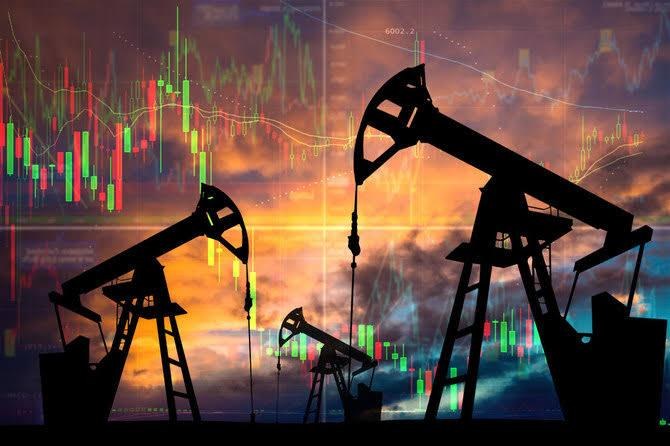
Oil gains ahead of OPEC+ meet but fears of slower demand weigh on market

(Shutterstock)
Short Url
Updated 02 September 2022
Follow

Oil gains ahead of OPEC+ meet but fears of slower demand weigh on market

SINGAPORE: Oil prices climbed on Friday on bets that OPEC+ will discuss output cuts at a meeting on Sept. 5, though benchmarks were on track for a steep weekly decline as fears of China’s COVID-19 curbs and weak global growth weighed on the market.

Brent crude futures rose $1.68, or 1.8 percent, to $94.04 a barrel at 0330 GMT, while US West Texas Intermediate (WTI) crude futures jumped $1.66, or 1.9 percent, to $88.27 a barrel.

Both benchmark contracts slid 3 percent in the previous session to two-week lows. Brent was headed for a weekly drop of nearly 7 percent, and WTI was on track to fall about 5 percent for the week.

The Organization of the Petroleum Exporting Countries and allies, together called OPEC+, are due to meet on Sept. 5 against a backdrop of sliding prices and falling demand, even as top producer Saudi Arabia says supply remains tight.

ANZ commodities analyst Daniel Hynes said it might be a bridge too far for OPEC+ to agree to cut output but that top producer Saudi Arabia will likely highlight what it sees as a disconnect between current prices and tight supply fundamentals.

“They will certainly try to talk up the market as much as possible to better reflect what they see as a tight market, which is exposed to further supply side issues,” he said.

OPEC+ this week slashed its demand outlook, now forecasting demand to lag supply by 400,000 barrels per day (bpd) in 2022, but it expects a market deficit of 300,000 bpd in its base case for 2023.

“We expect the group to leave output targets unchanged. Their own numbers show a tighter-than-expected market and they would probably also want some more clarity on Iranian supply before making any big changes to output policy,” said Warren Patterson, head of commodity research at ING.

Meanwhile, investors remain worried about the impact of the latest COVID-19 curbs in China. The city of Chengdu on Thursday ordered a lockdown that has hit manufacturers like Volvo .

“Oil prices have been facing a confluence of headwinds lately, with recent virus lockdowns in China coming after its lacklustre PMI readings pointing to a lower-for-longer growth picture and puts demand outlook at risk,” said Yeap Jun Rong, market strategist at IG.

Data showed Chinese factory activity in August contracted for the first time in three months amid weakening demand, while power shortages and COVID-19 outbreaks disrupted production.


Saudi investment pipeline active as reforms advance, says Pakistan minister

Updated 08 February 2026
Follow

Saudi investment pipeline active as reforms advance, says Pakistan minister

ALULA: Pakistan’s Finance Minister Mohammed Aurangzeb described Saudi Arabia as a “longstanding partner” and emphasized the importance of sustainable, mutually beneficial cooperation, particularly in key economic sectors.

Speaking to Arab News on the sidelines of the AlUla Conference for Emerging Market Economies, Aurangzeb said the relationship between Pakistan and Saudi Arabia remains resilient despite global geopolitical tensions.

“The Kingdom has been a longstanding partner of Pakistan for the longest time, and we are very grateful for how we have been supported through thick and thin, through rough patches and, even now that we have achieved macroeconomic stability, I think we are now well positioned for growth.”

Aurangzeb said the partnership has facilitated investment across several sectors, including minerals and mining, information technology, agriculture, and tourism. He cited an active pipeline of Saudi investments, including Wafi’s entry into Pakistan’s downstream oil and gas sector.

“The Kingdom has been very public about their appetite for the country, and the sectors are minerals and mining, IT, agriculture, tourism; and there are already investments which have come in. For example, Wafi came in (in terms of downstream oil and gas stations). There’s a very active pipeline.”

He said private sector activity is driving growth in these areas, while government-to-government cooperation is focused mainly on infrastructure development.

Acknowledging longstanding investor concerns related to bureaucracy and delays, Aurangzeb said Pakistan has made progress over the past two years through structural reforms and fiscal discipline, alongside efforts to improve the business environment.

“The last two years we have worked very hard in terms of structural reforms, in terms of what I call getting the basic hygiene right, in terms of the fiscal situation, the current economic situation (…) in terms of all those areas of getting the basic hygiene in a good place.”

Aurangzeb highlighted mining and refining as key areas of engagement, including discussions around the Reko Diq project, while stressing that talks with Saudi investors extend beyond individual ventures.

“From my perspective, it’s not just about one mine, the discussions will continue with the Saudi investors on a number of these areas.”

He also pointed to growing cooperation in the IT sector, particularly in artificial intelligence, noting that several Pakistani tech firms are already in discussions with Saudi counterparts or have established offices in the Kingdom.

Referring to recent talks with Saudi Minister of Economy and Planning Faisal Alibrahim, Aurangzeb said Pakistan’s large freelance workforce presents opportunities for deeper collaboration, provided skills development keeps pace with demand.

“I was just with (Saudi) minister of economy and planning, and he was specifically referring to the Pakistani tech talent, and he is absolutely right. We have the third-largest freelancer population in the world, and what we need to do is to ensure that we upscale, rescale, upgrade them.”

Aurangzeb also cited opportunities to benefit from Saudi Arabia’s experience in the energy sector and noted continued cooperation in defense production.

Looking ahead, he said Pakistan aims to recalibrate its relationship with Saudi Arabia toward trade and investment rather than reliance on aid.

“Our prime minister has been very clear that we want to move this entire discussion as we go forward from aid and support to trade and investment.”