

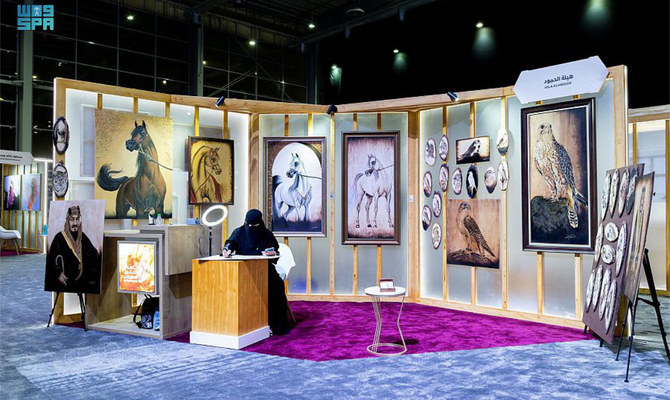
Fine arts take visitors to new heights at Saudi falcons exhibit

Image: SPA
Short Url
Updated 02 September 2022
Follow

Fine arts take visitors to new heights at Saudi falcons exhibit

RIYADH: The International Saudi Falcons and Hunting Exhibition brought together various schools of fine arts, showcasing realism, abstract art, caricatures and sculptures created by local and international artists.

Organized by the Saudi Falcons Club at its headquarters in Malham, north of Riyadh, the annual exhibition was opened on Aug. 25 and will continue until Sept. 3.

Artist Haila Al-Hamoud attracted attention with her artworks, where she uses a pyrography electric pen to burn masterpieces onto a wooden canvas.

Al-Hamoud said that the exhibition was a vital opportunity for Saudi artists to meet different people from around the world who were interested in their work.

She added that it was wonderful to integrate arts into major events with large turnouts, which contributes to raising the level of cultural awareness in the community, especially since the art section at the exhibition included various artistic disciplines.

Lebanese artist Rania Al-Atrash said that she was inspired by the desert environment, which was reflected in her artwork, noting that the wildlife in Saudi Arabia and the Arab Gulf states motivated her to explore its secrets and aesthetics, combining Arab authenticity and the purity of nature.

She stressed that the eye of the falcon often inspires artists because it shows strength, sharpness and pride, not to mention the falcon’s swift movements, all of which allow artists to create aesthetic, detailed paintings.

Al-Atrash expressed her admiration at how each section at the exhibition was carefully organized, noting that everything included was related to falconry, hunting and safaris in an attractive and engaging style.


Riyadh emerges as Gulf evacuation hub for wealthy amid regional escalation

Updated 6 sec ago
Follow

Riyadh emerges as Gulf evacuation hub for wealthy amid regional escalation

  • Saudi capital’s King Khalid International Airport is among the few major airports in the region still operating normally after Iranian missile and drone strikes

RIYADH: Riyadh has become a principal evacuation hub for wealthy residents and senior executives seeking to leave the Gulf amid escalating regional tensions, according to a report by Semafor.

The Saudi capital’s King Khalid International Airport is among the few major airports in the region still operating normally after Iranian missile and drone strikes targeted cities including Dubai and Abu Dhabi over the weekend, as well as locations in Qatar and Bahrain.

With airspace closures elsewhere, stranded executives and high-net-worth individuals have been travelling overland to Riyadh, in some cases undertaking a roughly 10-hour journey from Dubai, in order to board private or commercial flights out of the region.

Citing people familiar with the arrangements, Semafor reported that private security firms have been hiring fleets of SUVs to transport clients to the Saudi capital before arranging chartered aircraft departures.

Those being evacuated include senior figures at global financial institutions as well as affluent individuals who had been in the Gulf for business or leisure.

The surge in demand has sharply increased costs.

Ameerh Naran, chief executive of private jet brokerage Vimana Private, told Semafor that Riyadh is currently “the only real option” for those seeking to exit the region, with private jet charters from the Saudi capital to Europe reaching as much as $350,000.

Alternative routes have narrowed. Security providers initially explored using Oman as an exit corridor, but that option became unviable after reported Iranian strikes on the country’s port infrastructure and a tanker, leaving Riyadh as the most accessible transit point, the report said.

Riyadh’s role marks a notable shift in regional risk perception. In previous years, security concerns — including cross-border Houthi attacks during the Yemen conflict and earlier periods of regional instability — had led many expatriates and business leaders to favour other Gulf cities as transit hubs.

However, Saudi Arabia’s more flexible visa regime, which now allows many nationalities to obtain visas on arrival, combined with the kingdom’s ability so far to keep its airspace open, has reinforced its position as a temporary gateway out of the region.

While some schools have moved to remote learning and certain companies have advised staff to work from home, Semafor reported that daily life in Riyadh has largely continued uninterrupted compared with other Gulf cities that have faced direct attacks.