KUALA LUMPUR: Rosmah Mansor, the wife of Malaysia’s ex-premier Najib Razak, was found guilty of graft Thursday, just over a week after her husband began serving a 12-year jail term.
“The accused is found guilty of all three charges,” High Court Judge Mohamed Zaini Mazlan said as Rosmah sat quietly in the dock.
The judge added that her defense was “bare denial and unsubstantiated.”
The Kuala Lumpur court began mitigation on Thursday afternoon, ahead of sentencing.
Even after that, Rosmah will not go straight to jail, pending what could be a lengthy appeals process.
Prosecutors said Rosmah had sought a 187.5 million-ringgit ($41.8 million) bribe and received 6.5 million ringgit for helping a company secure a solar power project for rural schools in the Malaysian part of Borneo during her husband’s rule.
She still faces 17 other charges involving tax evasion and money laundering.
The 70-year-old has long been reviled by Malaysians for her reportedly vast collection of designer handbags, clothing and jewelry, acquired on jet-set overseas shopping trips.
Born the only child of two teachers in the country’s south, Rosmah rose to become one of Malaysia’s most influential people.
She made headlines a decade ago for setting up a new unit under the prime minister’s office known as “FLOM,” an acronym for First Lady of Malaysia. The full-fledged department, which set critics’ tongues wagging, was tasked with handling Rosmah’s operational needs.
Her love for luxury, and in particular Hermes Birkin bags, came under the spotlight after 2018 raids in which police confiscated more than 500 handbags and 12,000 pieces of jewelry estimated to be worth $270 million.
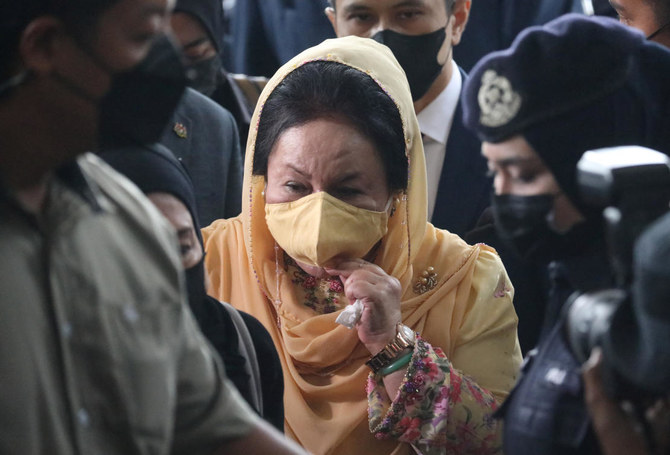
On Thursday, dressed in a peach-colored traditional Malay dress and scarf with a floral print and matching face mask, Rosmah arrived in court escorted by police.
Her son and daughter also attended the court proceedings.
Her disgraced husband Najib was sent to prison nine days ago for an initial batch of charges linked to the multi-billion-dollar financial scandal at state fund 1MDB that brought down his government in 2018.
He is currently on trial over four additional charges. He faces a maximum of 20 years in jail for abuse of power and up to 15 years for money laundering, if convicted.
Rosmah’s reputation had contributed to accusations that the ousted ruling establishment had lost touch with economically struggling and middle-class Malaysians.
The 1MDB scandal sparked investigations in the United States, Switzerland and Singapore, whose financial systems were believed to have been used to launder the money.
The US Justice Department has said more than $4.5 billion was stolen from 1MDB between 2009 and 2015 by high-level officials at the fund and their associates.


![]()

Rosmah Mansor, wife of Malaysia’s former leader Najib Razak, convicted of corruption
Short Url
https://arab.news/yt4gh
Rosmah Mansor, wife of Malaysia’s former leader Najib Razak, convicted of corruption
- But Rosmah Mansor will not go straight to jail, pending what could be a lengthy appeals process
- She still faces 17 other charges involving tax evasion and money laundering


Latest updates


© 2026 SAUDI RESEARCH & PUBLISHING COMPANY, All Rights Reserved And subject to Terms of Use Agreement.