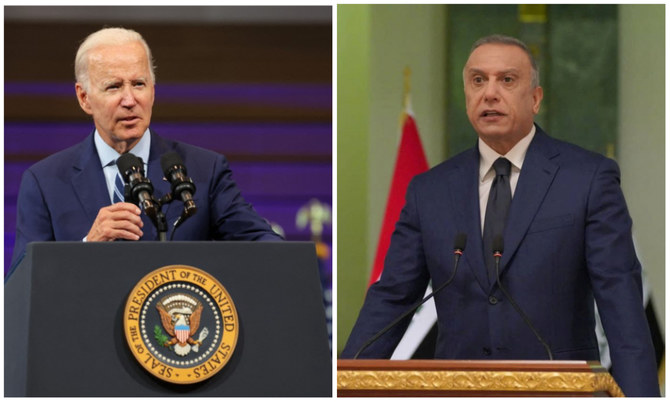
Biden holds talk with Iraq PM after recent violence

US President Joe Biden held a call on Wednesday with Iraq’s caretaker prime minister Mustafa Al-Kadhimi on Wednesday. (File/Reuters/AFP)
Short Url
Updated 31 August 2022
Follow

Biden holds talk with Iraq PM after recent violence

  • The president commended Al-Kadhimi’s personal leadership during escalating tensions and violence
  • Two leaders agreed to stay in touch in the coming weeks

WASHINGTON: US President Joe Biden held a call on Wednesday with Iraq’s caretaker prime minister, Mustafa Al-Kadhimi, after violence this week in Baghdad, the White House said.
“The President commended Prime Minister Kadhimi’s personal leadership during escalating tensions and violence over a 24-hour period earlier this week,” the White House said in a statement after their call, adding the two leaders agreed to stay in touch in the coming weeks.
Baghdad saw its worst fighting for years this week as rival Shiite Muslim groups battled in the capital after powerful cleric Moqtada Al-Sadr announced he was leaving politics.
Sadr said his decision was prompted by the failure of other Shiite leaders and parties to reform Iraq’s governing system. The United States had described the unrest as disturbing.
The violence cooled after Sadr ordered his followers on Tuesday to end their protests in central Baghdad. Apologising to Iraqis after 22 people were killed in clashes between an armed group loyal to him and rival Shiite Muslim factions backed by Iran, Sadr condemned the fighting and gave his own followers orders to disperse.
Biden and the Iraq prime minister “welcomed the return of security to the streets” and called on local leaders to engage in dialogue in line with Iraq’s constitution, the White House said.
The recent clashes followed 10 months of political deadlock since parliamentary elections, and President Barham Salih has warned that the crisis is not over, calling for early elections.
The White House said that Biden “praised the performance of the Iraqi Security Forces and extended condolences to the families of those killed in the recent fighting.” The White House readout did not mention Sadr by name.


Sudan hospital welcomes first patients after war forced it shut

Women walk outside Bahri Teaching Hospital after it resumed services in the Sudanese capital Khartoum on January 18, 2026. (AFP)
Updated 5 sec ago
Follow

Sudan hospital welcomes first patients after war forced it shut

  • The Bahri Teaching Hospital, which, before the conflict, treated around 800 patients a day in its emergency department, was repeatedly attacked and looted

KHARTOUM: At a freshly renovated hospital in Khartoum, the medical team is beaming: Nearly three years after it was wrecked and looted in the early days of Sudan’s war, the facility has welcomed its first patients.
The Bahri Teaching Hospital in the capital’s north was stormed by the paramilitary Rapid Support Forces in April 2023, soon after fighting broke out between the RSF and Sudan’s army.
Bahri remained a war zone until an army counteroffensive pushed through Khartoum last year, recapturing the area from the RSF in March.

FASTFACT

Around 40 of Khartoum’s 120 hospitals, shut during the war, have resumed operations, according to the Sudan Doctors’ Network, a local medical group.

“We never thought the hospital would reopen,” said Dr. Ali Mohammed Ali, delighted to be back in his old surgical ward.
“It was completely destroyed; there was nothing left,” he said. “We had to start from scratch.”
Ali fled north from Khartoum in the early days of the war, working in a makeshift medical camp with “no gloves, no instruments, and no disinfectant.”
According to the World Health Organization, the conflict has forced the shutdown of more than two-thirds of Sudan’s health facilities and caused a world record number of deaths from attacks on health care infrastructure.
Tens of thousands of people have been killed across Sudan since the war began, while 11 million have been left displaced, triggering the world’s largest hunger crisis.
But with the RSF now driven out of Khartoum, Sudan’s government is gradually returning, and the devastated city is starting to rebuild.
Around 40 of Khartoum’s 120 hospitals, shut during the war, have resumed operations, according to the Sudan Doctors’ Network, a local medical group.
The Bahri Teaching Hospital, which, before the conflict, treated around 800 patients a day in its emergency department, was repeatedly attacked and looted.
“All the equipment was stolen,” said director Galal Mostafa, adding that about 70 percent of its buildings were damaged and the power system was destroyed.
“We were fortunate to receive two transformers just days ago,” said Salah Al-Hajj, the hospital’s chief executive.
During the first five days of fighting, Al-Hajj — an affable man with a sharp grey moustache — was trapped inside one wing of the hospital.
“We couldn’t leave because of the heavy gunfire,” he said, saying that anyone “who stepped outside risked being detained and beaten” by the RSF.
Patients were rushed to 
safety in dangerous transfers to hospitals away from the fighting across the Nile.
“Vehicles had to take very complicated routes to evacuate patients safely, avoiding shells and bullets,” Al-Hajj said. On April 15, 2023, as the first shots rang out in the capital, RSF fighters seized Ali on his way into surgery.
They held him for two weeks at Soba, an RSF-run detention center in southern Khartoum whose former inmates have shared testimony of torture and inhumane conditions.
“When I was released, the country was in ruins,” he said.
Hospitals were “destroyed, streets devastated, and homes looted. There was nothing left.”
Almost three years on, taxis now drop patients at the hospital’s entrance, while new ambulances sit parked in a courtyard that until recently was strewn with rubble and overgrown weeds.
Inside, refurbished corridors smell of fresh paint.
The renovations and new equipment were funded by the Sudanese American Physicians Association and Islamic Relief USA at a cost of more than $2 million, according to the association.
Services have resumed in newly fitted emergency, surgical, obstetrics, and gynaecology rooms.
Doctors, nurses, and administrators hustle through the halls, the administrators fretting over covering salaries and running costs.
“Now it’s much better than before the war,” said Hassan Alsahir, a 25-year-old intern in the emergency department.
“It wasn’t this clean before, and we were short on beds — sometimes patients had to sleep on the floor.”
On its first day reopened, the hospital received a patient from the Kordofan region — the war’s current major battleground — for urgent surgery.
“The operation went well,” said Ali.