

Pakistan’s foreign minister says satisfied by international response as monsoon deaths reach 1,191

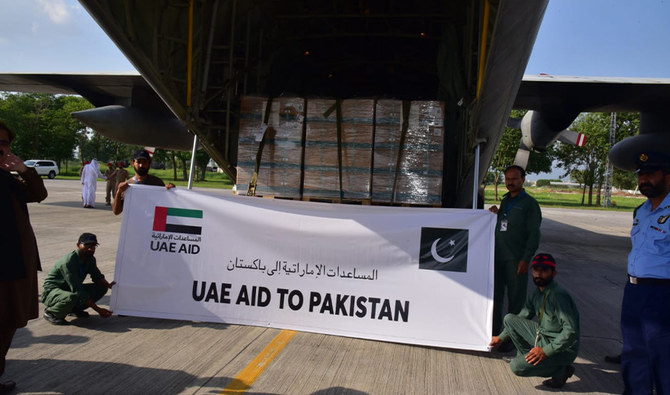
Worker carrying a flag of UAE aid to Pakistan in front of a plane from UAE carrying relief assistance for flood-ravaged Pakistan in Rawalpindi on Aug 31, 2022. (Foreign Office)
Short Url
Updated 31 August 2022
Follow

Pakistan’s foreign minister says satisfied by international response as monsoon deaths reach 1,191

  • Diplomats from over 20 countries visit flood-hit areas to witness devastation caused by monsoon rains, floods
  • Pakistan Army postpones defense day ceremony on September 6 in view of the tragic situation in the country

ISLAMABAD: Pakistan’s foreign minister Bilawal Bhutto-Zardari said on Wednesday he was satisfied by the international response to all the devastation caused by the monsoon season, as the national death toll from recent rains and floods reached 1,191 and the government took diplomats from over 20 countries to areas affected by the climate disaster.
The unprecedented rains, floods and landslides have also caused significant infrastructure damage across Pakistan where 33 million people have suffered since the beginning of the monsoon season in June.
According to senior government functionaries, the country has almost completed rescue and relief work, though they have warned the rehabilitation efforts would take more effort.
The United Nations and Pakistan also issued a flash appeal on Tuesday for $160 million to help the South Asian state deal with catastrophic floods that have displaced a large number of people and destroyed livelihoods.
“Foreign Minister Bilawal Bhutto Zardari has expressed satisfaction over international response to the UN Flash appeal to help flood affected people,” reported Radio Pakistan.
The foreign minister made the statement while taking diplomats from more than 20 countries and representatives of international organizations to flood-hit regions of Sindh, Balochistan and Khyber Pakhtunkhwa provinces to give them first-hand knowledge of all the devastation caused by monsoon rains and floods.
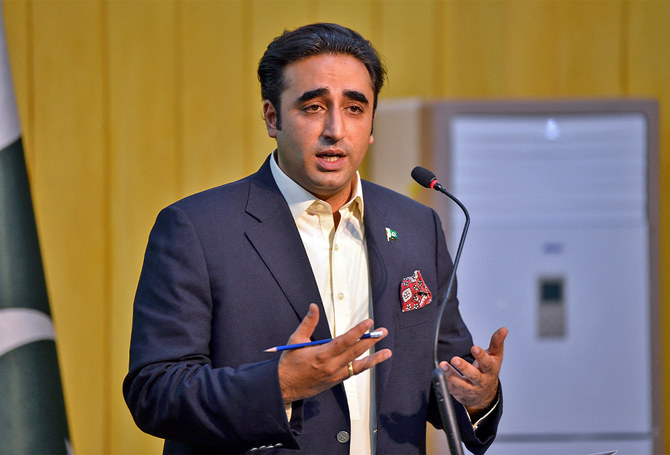


Pakistan's Foreign Minister Bilawal Bhutto Zardari speaks during a joint press conference in Islamabad, Pakistan, on June 7, 2022. (AFP/File)

“At the Sukkur airport, an NDMA [National Disaster Management Authority] briefing was given to diplomats and representatives of international organizations regarding the flood induced disaster,” the foreign office of Pakistan said in a statement, adding that Bhutto-Zardari informed them about the immense scale of the tragedy.
Prime Minister Shehbaz Sharif also visited the northwestern Khyber Pakhtunkhwa province on Wednesday and announced a grant of Rs10 billion for flood-affected people.
Meanwhile, the Pakistani military announced to postpone a defense day ceremony, which was scheduled to be held at the army’s general headquarters (GHQ), in view of the tragic situation in the country.
“In solidarity with the flood affected people of Pakistan, central ceremony at GHQ to commemorate Defense & Martyrs Day on 6 September has been postponed,” the military’s media wing, ISPR, said in a Twitter post. “Pakistan Armed Forces shall continue serving our brothers and sisters struck by unprecedented floods.”

The Asian Development Bank (ADB) also approved a $3 million grant on Wednesday to support Pakistan’s emergency relief efforts amid widespread floods across the country.
The bank said in an official statement the grant would help fund the immediate purchase of food supplies, tents, and other relief goods to support flood victims across the country.
“ADB stands with the people of Pakistan during these difficult times,” said its director general for Central and West Asia Yevgeniy Zhukov. “We are committed to working with the government and other development partners to help Pakistan overcome the devastating impact of this natural disaster and provide immediate relief to affected families.”


At UNSC, Pakistan warns competition for critical minerals could fuel global conflict

Updated 06 March 2026
Follow

At UNSC, Pakistan warns competition for critical minerals could fuel global conflict

  • The demand for critical minerals has surged worldwide due to rapid expansion of electric vehicles, advanced electronics and clean energy technologies
  • Pakistan’s representative says all partnerships in critical minerals sector must be ‘cooperative and not exploitative’ and respect national ownership

ISLAMABAD: Ambassador Asim Iftikhar Ahmad, Pakistan’s permanent representative to the United Nations (UN), has warned that intensifying global competition over critical minerals could become a new driver of global conflict, urging stronger international cooperation and equitable access to resources vital for the world’s energy transition.

The warning comes as demand for critical minerals and rare earth elements surges worldwide due to the rapid expansion of electric vehicles, advanced electronics and clean energy technologies, with governments and companies increasingly competing to secure supply chains while raising concerns that this may lead to geopolitical rivalries in the coming years.

Speaking at a Security Council briefing on ‘Energy, Critical Minerals, and Security,’ Ahmad said experience showed that the risks of instability increased where mineral wealth intersected with weak governance, entrenched poverty and external interference.

“Access to affordable, reliable and sustainable energy is essential for development, stability and prosperity. The global transition toward renewable energy, electric mobility, battery storage and digital infrastructure has sharply increased the demand for critical minerals,” he said.

“This upsurge has generated new geopolitical and geo-economic pressures. If not managed responsibly, competition over natural resources can affect supply chains, aggravate tensions, undermine sovereignty and contribute to instability.”

In several conflict-affected settings, he noted, illicit extraction, trafficking networks and opaque financial flows have fueled armed conflict and violence, weakened state institutions and deprived populations of legitimate revenues.

“The scramble for natural resources and its linkage to conflict and instability is therefore not new,” Ahmad told UNSC members at the briefing. “Pakistan believes that natural resources must serve as instruments of economic development and shared prosperity, and not coercion or conflict.”

He urged the world to reaffirm the right of peoples to permanent sovereignty over their natural resources, saying all partnerships in the critical minerals sector must be cooperative and not exploitative, respect national ownership, ensure transparent contractual arrangements and align with host countries’ development strategies.

“In order to prevent the exploitation of mineral-producing countries and regions, particularly in fragile and conflict-affected settings, support their capacity-building for strengthening domestic regulatory institutions, combating illicit financial flows, ensuring environmental safeguards, and promoting equitable benefit-sharing with local communities,” he asked member states.

“Promote equitable participation in global value chains. Developing countries must be enabled to move beyond extraction toward processing, refining and downstream manufacturing. Technology transfer, skills development and responsible investment are essential to avoid perpetuating structural imbalances.”