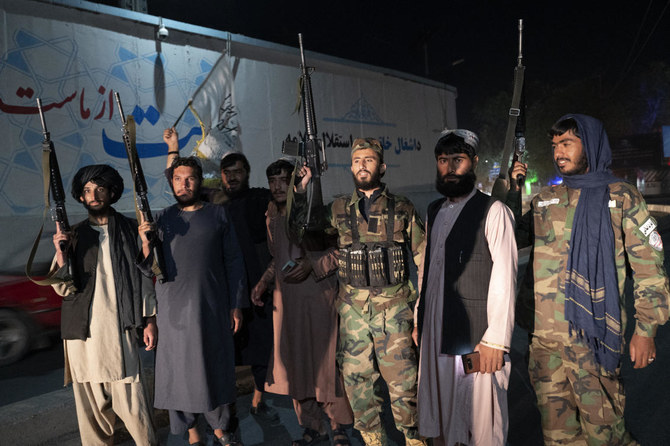
KABUL: The Taliban declared Wednesday a national holiday and decorated the capital with colored lights to celebrate the first anniversary of the withdrawal of US-led troops from Afghanistan.
The country’s new rulers — not formally recognized by any other nation — have reimposed their harsh version of Islamic law on the impoverished country, with women squeezed out of public life.
But despite the restrictions, and a deepening humanitarian crisis, many Afghans say they are glad the foreign force that prompted the Taliban insurgency left after a brutal 20-year war.
“We are happy that Allah got rid of the infidels from our country, and the Islamic Emirate has been established,” said Zalmai, a resident of Kabul.
“Happy Independence Day,” tweeted government spokesman Zabihullah Mujahid.
In a separate statement, the government said the day marked “the country’s freedom from American occupation.”
“So many mujhahideen have been wounded (over the years), so many children became orphans and so many women become widows.”
The authorities held an official celebration at Bagram air base, which US forces used to launch air strikes against the Taliban.
Foreign media outlets were not allowed to attend the event.
Kabul was quiet on Wednesday morning with a few Taliban fighters driving around the city and most residents staying indoors after the government declared a national holiday.
The plane carrying the last US troops took off from Kabul just a minute before midnight on August 31 last year.
That departure ended America’s longest war, which began in the wake of the September 11, 2001 attacks in New York.
Some 66,000 Afghan troops and 48,000 civilians were killed in the conflict, but it was the deaths of US service members — 2,461 in total — that became too much for the American public to bear.
“The burden of the war in Afghanistan, however, went beyond Americans,” the US military said Tuesday.
More than 3,500 troops from other NATO countries were also killed.
Two weeks before the end of last year’s withdrawal, the Taliban seized power following a lightning offensive against government forces.
Banners celebrating victories against three empires — the former Soviet Union and Britain also lost wars in Afghanistan — flew in Kabul on Wednesday.
Hundreds of white Taliban flags bearing the Islamic proclamation of faith flew from lamposts and government buildings, while squares in the capital were decorated with lights.
On Tuesday night, the skies above Kabul were lit up with fireworks and celebratory gunfire from crowds of Taliban fighters.
In Massoud Square, near the former US embassy, armed fighters carrying Taliban flags chanted “Death to America.” Others drove around the city honking their horns.
Taliban social media accounts posted videos and pictures of newly trained troops — many flaunting equipment the US military left behind during its chaotic withdrawal.
“This is how you troll a superpower after humiliating them and forcing them to withdraw from your country,” read a tweet with a photo of a giant Taliban flag now painted on the wall of the former US embassy.
Despite the Taliban’s pride in taking over, Afghanistan’s 38 million people face a desperate humanitarian crisis — aggravated after billions of dollars in assets were frozen and foreign aid dried up.
Hardships for ordinary Afghans, especially women, have increased.
The Taliban have shut secondary girls’ schools in many provinces and barred women from many government jobs.
They have also ordered women to fully cover up in public — ideally with an all-encompassing burqa.
“Women are mentally disturbed because they have no career, no education, and no basic rights,” said Zulal, a former government employee in the city of Herat who lost her job after the arrival of the Taliban.
“Girls are particularly distressed after their schools were closed. You can see it on their faces.”
Taliban spokesman Mujahid last week claimed there had been “major achievements” in the past year.
“Afghans are no more being killed in war, foreign forces have withdrawn, and security has improved,” he told reporters.


![]()

Taliban celebrate anniversary of foreign troop withdrawal
Short Url
https://arab.news/23anj
Taliban celebrate anniversary of foreign troop withdrawal
- The government said the day marked “the country’s freedom from American occupation”
- Foreign media outlets were not allowed to attend the event


Latest updates


© 2026 SAUDI RESEARCH & PUBLISHING COMPANY, All Rights Reserved And subject to Terms of Use Agreement.