

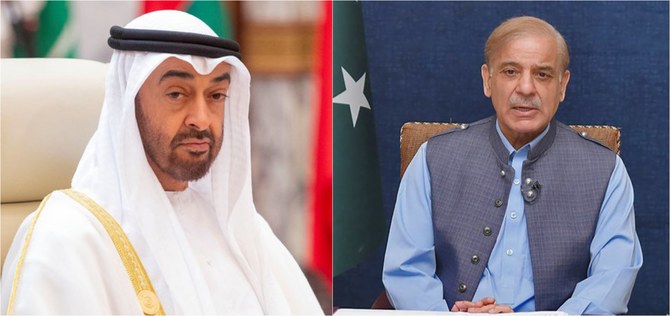
Pakistan PM calls UAE president, expresses gratitude for timely aid

This combination of photos shows Pakistani Prime Minister Shehbaz Sharif (L) and President of the United Arab Emirates, Sheikh Mohamed bin Zayed Al Nahyan. (REUTERS/ Government of Pakistan)
Short Url
Updated 31 August 2022
Follow

Pakistan PM calls UAE president, expresses gratitude for timely aid

  • Development came hours after a flight from UAE carrying flood relief goods landed in Pakistan 
  • Pakistan, UN have also launched ‘flash appeal’ to seek international aid for relief, rehabilitation 

ISLAMABAD: Pakistani Prime Minister Shehbaz Sharif on Tuesday telephoned Emirati President Sheikh Mohamed bin Zayed and expressed his gratitude for the timely humanitarian assistance provided by the United Arab Emirates (UAE) after floods killed more than 1,100 people and caused huge infrastructural losses to the South Asian country, the PM Office said. 

Pakistani authorities have declared a national emergency and urged the international community for help after monsoon rains and floods left around 33 million people homeless, killing 1,136 since the beginning of the season in June. 

The prime minister briefed the UAE president on the latest flood situation in Pakistan, which has affected people in all provinces of the country. 

“The Prime Minister once again expressed his deep gratitude for the timely humanitarian assistance and support provided by the United Arab Emirates, and lauded the work being carried out by the Emirates Red Crescent and Khalifa bin Zayed Foundation in flood-hit areas,” the PM Office said in a statement. 

“His Highness Sheikh Mohamed bin Zayed expressed firm solidarity with the people of Pakistan in tackling the natural calamity and offered all possible assistance to the affectees in this difficult time.” 

The development came hours after a flight from the UAE carrying flood relief assistance landed at the Noor Khan Air Base in Rawalpindi, the Pakistani foreign office said. 

More flights carrying relief goods from the UAE and China were scheduled to land in Pakistan on Tuesday. 

Pakistan received the first aid flight from the UAE on Sunday. However, the country’s information minister Marriyum Aurangzeb said the Arab country would send 15 more planes carrying relief goods for flood-affected people in Pakistan. 

“The relief aid includes shelter materials, humanitarian needs, food and medical parcels for those affected by torrential rains and floods, with the aim of contributing to supporting efforts to alleviate the suffering of the affected people,” UAE’s official news agency, WAM, had said on Monday. 

Chinese Foreign Ministry Spokesperson Zhao Lijian announced on Monday China would provide additional humanitarian aid, including 25,000 tents, to flood-ravaged Pakistan. 

Prime Minister Shehbaz Sharif thanked China’s President Xi Jinping and Premier Li Keqiang for providing financial assistance to the people of Pakistan. 

“This flood is like no other in terms of its intensity & spread,” Sharif said in a Twitter post. “China has been there for us at the most difficult times & we greatly value its support.” 


Pakistan’s planning minister Ahsan Iqbal also told Reuters in an interview on Monday that the recent floods in the country had caused significant damage to infrastructure which could cost the country over $10 billion. 

“I think it is going to be huge,” he said. “So far, (a) very early, preliminary estimate is that it is big, it is higher than $10 billion.” 

“People have actually lost their complete livelihood,” Iqbal added. 

The country’s army chief General Qamar Javed Bajwa on Tuesday visited Swat, a scenic district of Khyber Pakhtunkhwa province, where the army has for days been evacuating tourists stranded in massive floods that washed away roads and key infrastructure in several areas. 

The army chief “will meet stranded local residents and tourists who were struck in Kumrat / Kalam due to rains / flash floods,” the military’ media wing, ISPR, said in a statement released earlier today. 

“Women, children, foreigners and other people are being evacuated through Pakistan Army aviation helicopters to Kanju Cantt Swat,” it added. 

Pakistan’s permanent representative to the UN, Ambassador Munir Akram, briefed Secretary General António Guterres on the recent floods and told him about their devastating impact on the lives of people. 

“Expressing his deep sympathy with the people & the Government of Pakistan in this hour of need, the UN Secretary General @antonioguterres assured full support & solidarity of the @UN system,” Akram said in a Twitter post. 


Pakistan beefs up security in Karachi, Islamabad and Skardu as Khamenei protests kill 24

Updated 8 sec ago
Follow

Pakistan beefs up security in Karachi, Islamabad and Skardu as Khamenei protests kill 24

  • At least 14 killed in northern Gilgit-Baltistan region, 10 in Karachi during Sunday’s clashes between protesters, law enforcers
  • Police close off roads leading to key government buildings in Islamabad, US consulate in Karachi with army deployed in Skardu

ISLAMABAD/GILGIT: Authorities beefed up security by deploying additional police contingents and sealing off most roads leading to government buildings in Islamabad, Karachi and Skardu on Monday after violent protests in the aftermath of Iranian Supreme Leader Ayatollah Ali Khamenei’s killing led to the deaths of at least 24 people in Pakistan. 

At least 10 people were killed and 73 others sustained injuries on Sunday in clashes with law enforcement outside the US consulate in Karachi. Hundreds of protesters had gathered outside the consulate, with videos showing angry crowds armed with sticks as they smashed doors and windows.

In Islamabad, protesters entered the Red Zone which houses key government and diplomatic offices in the capital, prompting authorities to fire tear gas to disperse them. Similarly, people gathered outside the press club in the northwestern city of Peshawar to protest Khamenei’s killing as well.

Skardu in Pakistan’s northern Gilgit-Baltistan (GB) region saw violent clashes on Sunday as well, as protesters set fire to and vandalized several buildings, including United Nations (UN) regional offices. Clashes with law enforcers caused the deaths of at least 14 people in the region, among them a soldier, a senior official told Arab News.

“Seven protesters were killed in Gilgit and seven in Skardu,” GB Caretaker Information Minister Ghulam Abbas confirmed. “One was soldier martyred in Skardu while the injured there were around 50.”

The minister said the station house officer and deputy superintendent of police in Skardu were also injured, along with two soldiers, while 10 properties were damaged in the clashes. He said police have registered complaints against the culprits for the violence. 

“Schools are closed on Monday and courts’ activities will also be closed,” Abbas said. “A curfew has also been imposed for three days initially in Skardu and Gilgit cities from Mar. 2 to Mar. 4.”

The flare-up also prompted authorities to call in the army in Skardu under Article 245 of the Pakistani constitution, state media reported on Sunday.

Meanwhile, Islamabad Traffic Police said entry into the Red Zone area will remain open for people only through the Margalla Road and another route through Marriott Hotel.

“All other entry points leading toward the Red Zone will remain closed,” it said in its advisory. 

A spokesperson for the Karachi Traffic Police said in a press release that the MT Khan Road, from PIDC road to the Mai Kolachi Road railway crossing, will remain closed on Monday for general traffic due to security reasons.

The US consulate, which was the scene of clashes between protesters and police, is located on Mai Kolachi Road near MT Khan and PIDC. 

“The general public is requested to cooperate with law enforcement agencies and traffic police to avoid inconvenience and difficulties,” the Karachi Traffic Police spokesperson said. 

MIDDLE EAST TENSIONS

The violence on Sunday came hours after Iranian authorities confirmed Khamenei was killed in coordinated strikes carried out by the US and Israel, dramatically escalating tensions in the Middle East and triggering protests in several countries.

According to US officials, the operation targeted Revolutionary Guard command facilities, air defense systems, missile and drone launch sites, and military airfields. The US military said it suffered no casualties and reported minimal damage to its bases despite what it described as “hundreds of Iranian missile and drone attacks.”

Iran retaliated by launching missiles and drones toward Israel and targeting US military installations in Bahrain, Kuwait, Qatar and the UAE. The Emirati government said its air defense systems intercepted dozens of Iranian missiles and drones, but debris from the interceptions caused material damage in Abu Dhabi and Dubai, and at least one civilian, a Pakistani national, was killed. It issued rare emergency alerts urging residents to seek shelter, underscoring how the conflict has rippled far beyond Iran’s borders.

The Israeli military said dozens of Iranian missiles were fired toward Israeli territory, many of which were intercepted. Israel’s Magen David Adom rescue service said a woman in the Tel Aviv area died after being wounded in a missile strike.