

Attacks on major Iraqi gasfield drive out US contractors

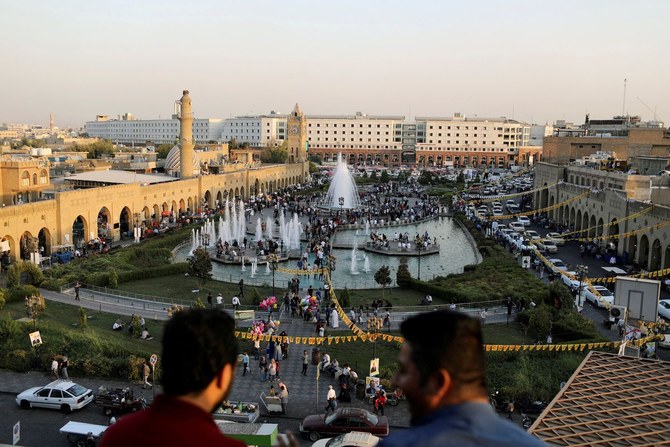
A general view of the old city of Irbil, Iraq in 2018. (Reuters)
Short Url
Updated 30 August 2022
Follow

Attacks on major Iraqi gasfield drive out US contractors

  • Khor Mors’ expansion plans to double production in a region desperately in need of more gas to generate electricity and end power blackouts

IRBIL: A series of rocket attacks on a gasfield in northern Iraq has sent the US contractors working on its expansion packing, dealing a blow to the Kurdish region’s hopes of boosting its revenues and offering a small alternative to Russian gas.
The project to expand the Khor Mor field operated by Pearl Consortium, majority-owned by Abu Dhabi’s Dana Gas and its affiliate Crescent Petroleum, was suspended at the end of June after three rocket attacks.
Workers from Texan company Exterran Corp. returned last month to resume work but two more rockets hit the site on July 25, forcing the company to leave again with no return date planned, industry and Kurdish government sources said.
Khor Mor is one of the biggest gasfields in Iraq and the expansion plan aims to double production in a region desperately in need of more gas to generate electricity and end almost daily power blackouts.
There was no serious damage from the attacks and existing operations have not been disrupted but the expansion has been suspended until security in the area is ensured, the sources said.
The expansion project is partly funded through a $250 million financing agreement with the US International Development Finance corporation.
Exterran is the third contractor to demobilize since attacks started targeting the field on June 21, with two Turkish subcontractors, Havatek and Biltek, having already halted work.
Dana Gas declined to comment. Exterran, Havatek and Biltek did not respond to requests for comment.

UNCERTAIN FUTURE
Last year, the Kurdish government signed a contract with domestic energy company KAR Group to build a pipeline from Khor Mor via the regional capital Irbil to the city of Dohuk, close to the Turkish border, running parallel to an existing pipeline.
Delays could cost the debt-ridden Kurdistan Regional Government (KRG) a sizeable penalty and will leave Kurdish gas export plans on hold.
If the infrastructure is not ready by a May 2023 take-or-pay deadline, the Kurdish government will have to pay Dana Gas $40 million a month until it is ready, the government source said.
“More than that is the reputational damage because added security threats add another layer of risks that could impact the cost of capital and insurance,” Ali Al-Saffar, Middle East and North Africa program manager at the International Energy Agency, said.
The KRG did not respond to a request for comment.
Dana Gas has the rights to exploit two of the biggest gas fields in Iraq, Khor Mor and Chemchemal, which produce about 450 million cubic feet of gas a day. It plans to more than double production to up to 1 billion cubic feet per day in the next few years, enough to cover domestic needs.
With 16 trillion cubic feet of proven reserves, output could then potentially ramp up to 1.5 billion cubic feet a day, leaving a sizeable quantity for exports to Turkey and Europe, government and industry sources said.
Dana Gas supplies about 80 percent of the region’s gas feedstock, according to an industry source.
However, the region’s gas export plan could threaten Iran’s place as a major supplier of gas to Iraq and Turkey at a time when its economy is still reeling from international sanctions.
In March, Iran’s Islamic Revolutionary Guards Corp. (IRGC) fired a dozen ballistic missiles at Irbil in an assault, which appeared to target the region’s plans to supply gas to Turkey and Europe, officials have said.
While no group has claimed responsibility for the five attacks on Khor Mor since June, Kurdish officials, diplomats, industry sources and energy experts said they believed they were carried out by Iranian-backed militias.
Iran’s foreign ministry did not respond to a request for comment.
However, two diplomats based in Iraq said they believed that rivalry within the Patriotic Union of Kurdistan (PUK), the party that controls the land where the field is located, led one side to retaliate for being excluded from the expansion project.
A PUK official, who spoke on condition of anonymity, dismissed this version of events.

NO MAN’S LAND
The Khor Mor field is close to a no man’s land between the Iraqi army, Kurdish forces and Shiite militias, from where the first three rocket attacks were launched.
Because of a lack of agreement over territorial control, there are areas neither the Iraqi army nor Kurdish forces can enter, leaving a security vacuum where militias are active.
But the last two attacks with larger rockets came from areas closer to the city of Kirkuk, which lies under the control of the federal government.
“Khor Mor has a lot of potential and can help the Kurds,” said a Kurdish official. “We get attacked from all sides. The future is very uncertain.”
The setback to the gas plan comes at a time when the oil sector, the region’s financial lifeline, is also in trouble.
Oil reserves are getting depleted at more than double the global average and a Federal Supreme Court ruling in February that deemed the legal foundations of the Kurdistan region’s oil and gas sector to be unconstitutional, forced some foreign oil companies to leave.
Exterran has halted work for security reasons, rather than the ruling, industry and government sources said.
Further delays in investment in the sector will weigh heavily on the KRG, which faces an economic crisis in a region already struggling within an unstable Iraq.
KRG’s debt currently stands at about $38 billion, according to a government official, and parliamentarian Karwan Gaznay, who is a member of the region’s oil and gas committee, said oil exports accounted for 85 percent of Iraqi Kurdistan’s budget.
Delayed payment of public sector salaries, poor public services and corruption have fueled often violent protests over the past two years against the political parties that run the region.
Widespread economic hardship among young Kurds was also one of the main factors behind the migrant crisis on the Belarus-European Union border that began in 2021.


Israeli measures in West Bank seek to ‘assassinate Palestinian state’: Saudi UN envoy

Updated 19 February 2026
Follow

Israeli measures in West Bank seek to ‘assassinate Palestinian state’: Saudi UN envoy

  • Kingdom ‘strongly condemns decision to convert lands to state property,’ Abdulaziz Alwasil tells Security Council
  • ‘There’s no doubt that these violations undermine efforts to achieve peace and stability in the region’

NEW YORK: Saudi Arabia on Wednesday strongly condemned Israel’s “unlawful coercive measures” in the occupied West Bank, telling the UN Security Council that the actions amount to an attempt to “assassinate the Palestinian state” and undermine prospects for peace.

Speaking at a ministerial-level council meeting chaired by British Foreign Secretary Yvette Cooper, Saudi Arabia’s UN Ambassador Abdulaziz Alwasil said Riyadh rejects Israeli moves to expand settlements, seize land and alter the status of the Occupied Territories.

Israeli authorities “continue to gravely violate the rights of the Palestinian people” in the West Bank, he said.

“We meet today, more than two years after the Israeli aggression against the Gaza Strip, and at a moment where we also witness a new chapter of suffering and violations committed by the Israeli occupation,” Alwasil added.

Recent coercive measures aimed at imposing “Israeli dominance over the West Bank, expanding settlement activity, escalating settlers terrorism, practicing forced displacement against the Palestinian people and seizing their land … reflects Israel’s persistence in its attempt to assassinate the Palestinian state,” he said.

Israel’s adherence to a ceasefire agreement and halting its “illegal policies and seizure of land” have become “urgent matters that can’t be further delayed,” Alwasil added, calling for an end to “ongoing violations associated with annexation of lands belonging to unarmed Palestinians in the West Bank.”

Alwasil said 85 states have denounced the measures, and Saudi Arabia “strongly condemns the decision of the Israeli occupying authorities to convert lands in the West Bank to what it calls state property as part of schemes that aim to impose a new legal and administrative reality in the occupied West Bank.”

He added: “There’s no doubt that these violations undermine efforts to achieve peace and stability in the region.”

Alwasil reiterated that “Israel has no sovereignty” over the Occupied Territories, and expressed Riyadh’s “absolute rejection of these illegal measures which constitute a grave violation of international law, particularly Security Council resolution 2334.”

He added that “these actions are an aggression on the inherent right of the brotherly Palestinian people to establish their independent state on the June 4, 1967 borders with East Jerusalem as its capital,” and that the measures aim to “alter the demographic composition and the character and the status” of the Occupied Territories.

He cited the 2024 advisory opinion by the International Court of Justice, saying it is “clear and explicit” in affirming that “Israel’s policies and practices in the occupied Palestinian territory and its continued presence there is considered unlawful.”

He added: “It stressed that Israeli occupation must end and that it is invalid to annex occupied Palestinian territories.”

Alwasil also condemned the seizure and demolition of a compound belonging to the UN Relief and Works Agency for Palestine Refugees in the Near East in East Jerusalem and the cutting of electricity to its facilities, including schools and health centers.

“This is an unprecedented violation of international humanitarian law aimed at undermining the status of Palestinian refugees” in the Occupied Territories, he said.

With the advent of the Muslim holy month of Ramadan, he called for protecting humanitarian organizations and ensuring that they can carry out their duties “without hindrance.”

He said: “We strongly condemn practices that target humanitarian workers throughout the Palestinian territories. UNRWA isn’t a terrorist organization, and such claims are unacceptable.”

Alwasil added: “The international community must come together to provide protection for UNRWA under international humanitarian law.”

He said that in response to an invitation from US President Donald Trump, Saudi Arabia will “participate constructively and actively” in an inaugural meeting of the Board of Peace scheduled for Thursday in Washington, DC.

“We value the efforts of President Trump and his administration and the attention that they have devoted to ending the war and achieving peace in the Gaza Strip,” Alwasil added.

The Kingdom has signed the instrument of accession to the Board of Peace “in support of its efforts as a transitional body in accordance with a comprehensive plan to end the conflict in Gaza that was adopted by the Security Council by virtue of resolution 2803,” he said.

“This track aims to establish a permanent ceasefire, support the reconstruction of Gaza, and push forth a just and lasting peace based on the Palestinian people’s right to self-determination and the establishment of their independent state.”

Alwasil called for opening crossings to allow humanitarian aid into Gaza and enabling “Palestinian and international committees to administer” the enclave “with no conditions to ensure the management of the daily affairs” of its population while preserving “the institutional and geographic linkages between the West Bank and the Gaza Strip in a manner that would guarantee the unity of Palestinian land.”

Riyadh rejects “any attempt to divide or undermine the integrity of Palestinian lands,” he said. “The only path to achieving a just and comprehensive peace requires establishing a permanent ceasefire, preventing displacement and annexation, ensuring Israel’s full withdrawal from the Gaza Strip, and supporting the reconstruction.”