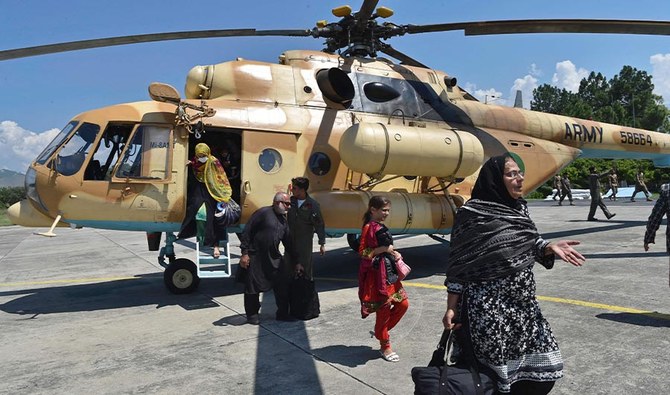
'Second life': helicopters rescue the stranded from Pakistan valleys

Stranded local tourists disembark from a Pakistan army helicopter after they were rescued by army from the flood-hit tourist areas in Saidu Sharif, the capital of Swat valley in the Khyber Pakhtunkhwa province on August 30, 2022. (AFP)
Short Url
Updated 25 September 2022
Follow

'Second life': helicopters rescue the stranded from Pakistan valleys

  • Unprecedented rain in the Swat Valley turned rivers into raging torrents that washed away roads and bridges 
  • The stunning Swat Valley, known locally as the “Pakistani Switzerland,” is a popular tourist spot 

Saidu Sharif: Up to 200,000 people are stranded in remote Pakistan valleys after the unrelenting floods of the past week — with helicopters the only way of reaching them.
Unprecedented rain in the Swat Valley turned rivers into raging torrents that washed away roads and bridges, cutting off tourists and residents from nearby towns, even as the water receded.
Army and government helicopter missions have rescued hundreds of panicked tourists and locals — some urgently needing medical help.
“It feels like I have got a second life,” said tourist Yasmin Akram, a diabetic who was airlifted to Saidu Sharif’s airfield from the Kalam valley with her 12-year-old daughter and husband.
The traffic police officer watched in despair as the hotel they fled in the middle of the night was swallowed by the Swat river, taking with it a young boy.
“I witnessed this all with my own eyes,” she said. “Since then I haven’t slept.”
Her husband, dazed from exhaustion, said he ran out of medication for his kidney condition after Kalam was cut off.
“When I arrived here it was like being given a new life,” said Muhammad Akram, an official with the Punjab government.
Their two adult sons were left behind, with priority given to the sick, women and children.
The stunning Swat Valley, known locally as the “Pakistani Switzerland,” is a popular tourist spot because of its majestic mountains, lakes and rivers.
The deeply conservative area came to notoriety in the mid-2000s, when it saw the rise of a powerful local chapter of the Pakistani Taliban.
In 2012, following a military operation to displace the Taliban, then-schoolgirl Malala Yousafzai — now a Nobel peace laureate — was shot and left for dead by militants in Swat’s main town, Mingora.


Junaid Khan, the deputy commissioner for Swat, told AFP that stricken tourists have made up the majority of evacuations.
Government officials and doctors have been airlifted into the valleys to identify those most in need of rescue.
Locals are willing to stay behind if food and medical supplies are guaranteed, said Khan.
Thousands of food aid packages have already been delivered — some dropped from the back of a helicopter when crowds of people reaching for the aircraft made it impossible to land.
“We’ve reached areas that no other organizations and aid groups have been able to,” Khan said at Saidu Sharif’s airfield, where some of the rescue missions are being coordinated.
Locals are hurrying to create makeshift landing pads for the helicopters — with the first established on grounds surrounding a mosque in Mankyel.
It could be days before roads leading to the mountains and valleys are repaired.
“The challenges are immense but the hope is very high in this region which has seen the worst of terrorism, militancy, earthquakes and floods,” said Khan.
So far 21 deaths have been reported in the area’s valleys — mostly as a result of collapsed houses — but a handful of people were washed away by floods.
A helicopter supplied by the provincial government’s chief minister — not built for rescue missions — has helped to pull more than 350 people from villages, carrying up to double the recommended number of passengers.
Army helicopters have collected hundreds more. 


Sri Lanka seal gritty T20 win over Pakistan to level series

Updated 11 January 2026
Follow

Sri Lanka seal gritty T20 win over Pakistan to level series

  • In a contest trimmed to 12 overs a side, Sri Lanka scored 160 runs before choking Pakistan to 146-8
  • The series saw the visitors clinch the opener by six wickets before rain washed out the second game

Dambulla: Sri Lanka eked out a hard fought 14-run victory over Pakistan in the third T20 at rain-hit Dambulla on Sunday, easing their batting jitters and squaring the three-match series 1-1.

The series, a warm-up for the T20 World Cup with Pakistan set to play all their matches in Sri Lanka due to political tensions with nuclear-armed neighbors India, saw the visitors clinch the opener by six wickets before rain washed out the second game.

“We were a bit worried about our batting and I’m glad we addressed that today,” said Wanindu Hasaranga, who walked away with both Player of the Match and Player of the Series honors.

“The bowlers did a good job too. The ball was wet and it wasn’t easy. We tried to bowl wide and slow and asked them to take risks.”

Hasaranga took four wickets in the game and in the process completed 150 wickets in T20Is.

In a contest trimmed to 12 overs a side, Sri Lanka muscled their way to a competitive 160 before choking Pakistan to 146-8.

Having been bowled out inside 20 overs in the series opener, Sri Lanka needed a statement with the bat and duly ticked every box after being put in.

The top order laid the platform and the middle order applied the finishing touches.

Wicket-keeper Kusal Mendis made hay under the Power Play, blasting 30 off 16 balls while Dhananjaya de Silva (22 off 15) and Charith Asalanka (21 off 13) kept the scoreboard ticking.

Skipper Dasun Shanaka then swung the momentum decisively, clubbing 34 off just nine deliveries, peppered with five towering sixes.

The sixth-wicket stand between Shanaka and Janith Liyanage produced 52 runs in just 15 balls and proved the turning point, shifting the game firmly Sri Lanka’s way.

Pakistan came out swinging in reply, racing to 50 in just 19 balls with captain Salman Agha hammering 45 off 12 balls, including five fours and three sixes.

But once the field spread, Sri Lanka tightened the screws, applied the choke and forced the asking rate to spiral.

“It was a good game of cricket,” Agha said.

“We conceded too many runs, but our batting effort was good. Unfortunately, we fell short. We know we are going to play all our World Cup games in Sri Lanka and it’s important that we played in similar conditions,” he added.