

After bailout deal, experts urge asking IMF for fiscal space as floods ravage Pakistan

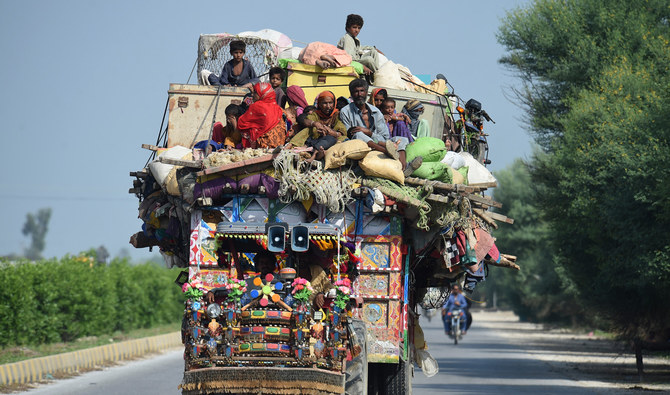
Displaced people sit on a tractor with their belongings as they make their way to reach safer place camp after fleeing from their flood hit homes following heavy monsoon rains in Shikarpur of Sindh province on August 30, 2022. (AFP)
Short Url
Updated 25 September 2022
Follow

After bailout deal, experts urge asking IMF for fiscal space as floods ravage Pakistan

  • The international lending agency approved an immediate disbursement of $1.1 billion to Pakistan on Monday
  • Experts say the government should seek financial concessions to spend more on rescue and relief activities

KARACHI: Pakistan’s financial experts said on Tuesday the government should discuss the recent floods and their impact with the International Monetary Fund (IMF) to create fiscal space for itself to spend on relief and rehabilitation activities after the global lender approved an immediate disbursement of $1.1 billion to the country.

The IMF decision was taken in an executive board meeting in Washington on Monday, bringing its financial assistance to Pakistan under a bailout package signed in 2019 to about $3.9 billion.

The revival of the loan program has come at a time when Pakistan is witnessing its worst floods triggered by torrential monsoon rains that have killed over 1,100 people and destroyed large infrastructure and farmlands.

“It is important to ask the IMF for an adjuster to be able to spend on rescue and relief efforts in the wake of the floods,” Dr. Khaqan Najeeb, a former adviser to the ministry of finance, told Arab News. “Pakistan can also seek some money under the rapid financing instrument available with the fund which we also tapped previously [during the COVID-19 pandemic].”

“The IMF is the best anchor for Pakistan, considering the country’s balance of payment challenges and the uncomfortable position of $7.8 billion in the central bank’s reserves which can barely cover over a month of imports,” he continued.

The delayed IMF approval resulted in disorderly movements in Pakistan’s currency and stock markets.

“We can hope that the revival of the IMF program will give confidence to the jittery markets and that the worst dollar credit crunch that Pakistan faced over the last couple of months is now over,” Najeeb said.

Pakistan’s stock market, which recently displayed a bearish trend, gained more than 400 points after opening on Tuesday. The rupee also appreciated against the dollar in the early trade.

“All eyes are now on global oil prices and local political situation,” Muhammad Sohail, chief executive officer of Toplines Securities, told Arab News.

“We believe that after the IMF endorsement, more dollar funding for Pakistan is likely from bilateral and multilateral agencies along with other sources which will support the foreign exchange reserves,” he continued. “This will also bring stability to the national currency which had recently been under pressure due to uncertainty surrounding the IMF program, especially after the differences between federal and provincial administrations.”

The IMF acknowledged on Monday that Pakistan was at a difficult economic juncture, though it continued to insist on the implementation of tough structural reforms.

“Accelerating structural reforms to strengthen governance, including of state-owned enterprises, and improve the business environment would support sustainable growth,” Antoinette Sayeh, deputy managing director and acting chair of the lending agency, said in statement.

“Reforms that create a fair-and-level playing field for business, investment, and trade necessary for job creation and the development of a strong private sector are essential,” she added.


Pakistan to promote mineral sector at Saudi forum this month with 13 companies

Updated 02 January 2026
Follow

Pakistan to promote mineral sector at Saudi forum this month with 13 companies

  • Delegation will take part in the Future Minerals Forum in Riyadh from Jan. 13-15
  • Petroleum minister will lead Pakistan, participate in a 90-minute country session

ISLAMABAD: Around 13 Pakistani state-owned and private companies will attend the Future Minerals Forum (FMF) in Saudi Arabia from Jan. 13 to 15, an official statement said on Friday, as the country seeks to ramp up global engagement to develop its mineral resources.

The FMF is an international conference and investment platform for the mining sector, hosted by mineral-rich countries to attract global investors, companies and governments.

Petroleum Minister Ali Pervaiz Malik confirmed Pakistan’s participation in a meeting with the Saudi envoy, Nawaf bin Said Al-Malki.

Pakistan hosts one of the world’s largest copper-gold zones. The Reko Diq mine in southwestern Balochistan, with an estimated 5.9 billion tons of ore, is partly owned by Barrick Gold, which calls it one of the world’s largest underdeveloped copper-gold deposits. Its development is expected to boost Pakistan’s struggling economy.

“Upon an invitation of the Government of the Kingdom of Saudi Arabia, the Federal Minister informed the Ambassador that Pakistan will fully participate in the upcoming Future Minerals Forum (FMF), scheduled to be held in Riyadh later this month,” Pakistan’s Press Information Department (PID) said in an official statement.

The Pakistani minister will lead his country’s delegation at the FMF and take part in a 90-minute country showcase session titled “Unleashing Potential: Accelerating Pakistan’s Mineral Revolution” along with local and foreign investors.

Pakistan will also establish a dedicated pavilion to highlight the vast potential of its rich geological landscape to the global mineral community.

The Saudi envoy welcomed Pakistan’s decision to participate in the forum and discussed enhancing bilateral cooperation in the minerals and energy sectors during the meeting.

According to the statement, he highlighted the potential for cooperation between Saudi Arabia and Pakistan in the minerals and energy sectors, expressing confidence that the FMF would provide a platform to expand collaboration.
Pakistan’s mineral sector, despite its rich reserves of salt, copper, gold and coal, contributes only 3.2 percent to the country’s GDP and just 0.1 percent to global mineral exports.

However, many countries, including the United States, have shown interest in Pakistan’s underdeveloped mineral sector, particularly in copper, gold and other critical resources.

In October, Pakistan dispatched its first-ever shipment of rare earth and critical minerals to the United States, according to a Chicago-based US public relations firm’s report.