

OIC issues support for flood victims in Pakistan, Afghanistan, Sudan

1 / 5
Rescue workers use a boat to drop children back home after school in a flood hit area following heavy monsoon rains in Dera Ghazi Khan district in Punjab province on August 29, 2022. (AFP)
2 / 5
3 / 5
4 / 5
5 / 5
Short Url
Updated 30 August 2022
Follow

OIC issues support for flood victims in Pakistan, Afghanistan, Sudan

  • The commission added that it is also distressed by the reports of a prolonged debilitating drought in Somalia, which has caused displacement of around 1 million people and exposed 7 million to imminent hunger, exacerbating the humanitarian crisis

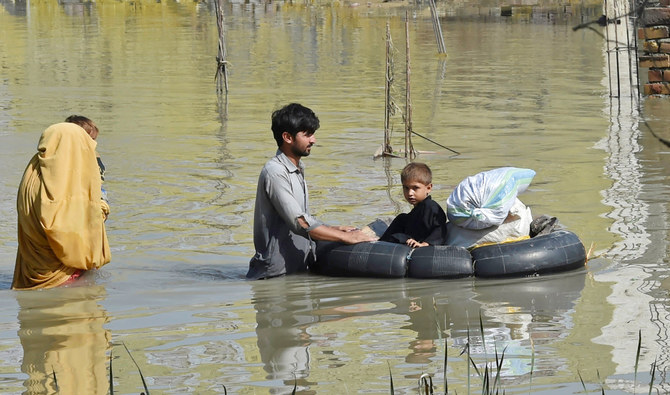
JEDDAH: The Independent Permanent Human Rights Commission (IPHRC) of the Organisation of Islamic Cooperation has announced that it deeply regrets the loss of precious lives and destruction of infrastructure and livelihoods due to ongoing calamitous flooding across Pakistan, Afghanistan and Sudan.

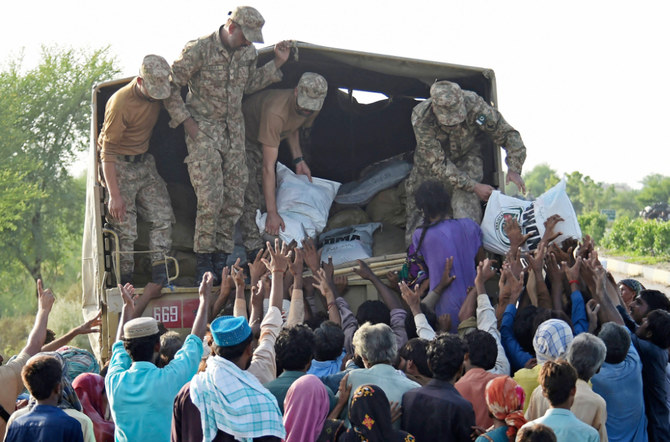
The humanitarian situation is expected to worsen as communities and infrastructure will struggle to cope with ongoing heavy rainfall and its devastating aftermath due to imminent food shortages and the spread of waterborne diseases, the commission said.

The commission added that it is also distressed by the reports of a prolonged debilitating drought in Somalia, which has caused displacement of around 1 million people and exposed 7 million to imminent hunger, exacerbating the humanitarian crisis.

The commission highlighted that, in recent decades, climate change and environmental degradation has adversely affected millions of people and ecosystems, natural resources and infrastructure upon which they depend.

Several OIC member states are highly vulnerable to environmental changes. The IPHRC said that the situation is particularly alarming in low-income developing countries, where it could represent an existential threat for many communities who are at the forefront of experiencing severe impacts of climate change.

The commission said that the mitigation of climate change effects and urgent protection of vulnerable communities is crucial to ensuring fundamental rights to life, health, food and an adequate standard of living in the affected areas.


Northern Borders rock art reveals ancient life

Updated 58 min 29 sec ago
Follow

Northern Borders rock art reveals ancient life

  • Among the most notable remains are stone structures scattered northwest of Arar
  • Evidence ranges from the Neolithic era to Islamic times, forming a chronological record

JEDDAH: Saudi Arabia’s Northern Borders region contains numerous archaeological sites, reflecting a long history of human settlement dating back to early periods, the Saudi Press Agency reported.
Among the most notable remains are stone structures scattered northwest of Arar.
Varying in shape, size and design, specialists believe these structures date to the end of the Neolithic period and the beginning of subsequent eras. They are thought to have been used as stone tombs to preserve the remains of the dead.
Evidence ranges from the Neolithic era to Islamic times, forming a chronological record that highlights the diversity of communities that once lived in the region and how they interacted with their natural environment over centuries.
Ajab Al-Otaibi, director general of antiquities at the Heritage Commission, said the stone structures and rock art sites in the Northern Borders region represent an integral part of Saudi Arabia’s national cultural heritage and serve as an important resource for archaeological studies and scientific research.
He highlighted the importance of surveys, documentation and protection efforts to preserve these cultural landmarks as a historical legacy for future generations.
The region is also home to several important rock art sites, such as Shu’ayb Hamer, which features a wide and diverse collection of drawings carved on natural rock surfaces, marking it as a key site that documented early human activity in the area.
The artworks depict scenes of hunting, horsemanship, dancing, daily life and social rituals. They were created using a variety of artistic styles, most notably framed and abstract forms, and produced through different techniques including incizing and pecking, both direct and indirect.
The carvings portray human figures and a range of animals, including camels, horses and gazelles, as well as some wild and predatory species that have long since disappeared.
These images provide insight into the richness of the natural environment in earlier periods and help researchers understand the evolving relationship between humans and their surroundings.