

Saudi Arabia’s food and beverage sector books 6.3% growth in H1 2022: Monsha’at

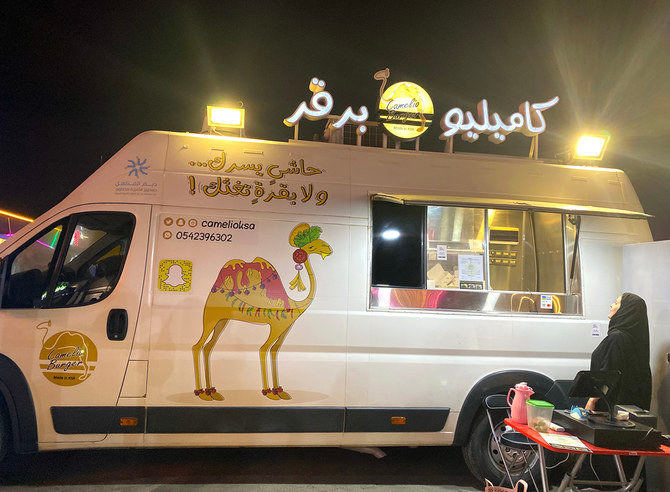
Monsha’at attributes the growth to a new generation of entrepreneurs entering the F&B industry with diverse ideas like food trucks, cafes, pop-up dining, restaurants and food delivery businesses. (File)
Short Url
Updated 29 August 2022
Follow

Saudi Arabia’s food and beverage sector books 6.3% growth in H1 2022: Monsha’at

  • Foodics, one of Saudi Arabia’s leading startups in the F&B space, spearheaded the investment growth in the second quarter of 2022

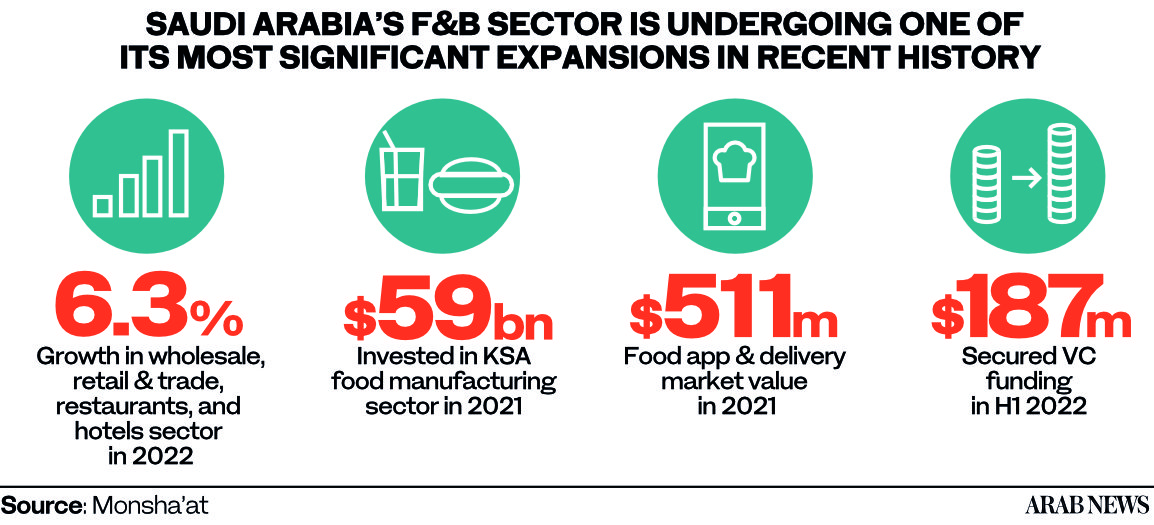
CAIRO: Saudi Arabia’s food and beverage sector increased 6.3 percent in the first half of 2022, according to the Kingdom’s Small and Medium Enterprises Authority, also known as Monsha’at.

Small and medium enterprises have made the sector even more attractive for investors, as $187 million were invested in the Kingdom’s F&B startups in the first half of 2022, according to research firm MAGNiTT’s Saudi Arabia Venture Capital report.

Foodics, one of Saudi Arabia’s leading startups in the F&B space, spearheaded the investment growth in the second quarter of 2022, raising $170 million in April from Saudi, Dutch and Indian investors.

The food app and delivery markets are also seeing huge growth as they were valued at $511 million in 2021 and are expected to grow by 10 percent annually through 2026.

The Kingdom has been betting big on diversifying its economy. With the rise of an entrepreneurial generation, the government aims to attract 100 million visitors annually through the F&B sector by 2030. 
In the second quarter of 2022, some of the leading international restaurant chains in the US, UK and UAE have entered the Saudi market, such as New York-based Black Tap, London’s AOK Kitchen, and Double Like Burger and Lobster from the UAE.

Monsha’at attributes the growth to a new generation of entrepreneurs entering the F&B industry with diverse ideas like food trucks, cafes, pop-up dining, restaurants and food delivery businesses.

Besides the diversity in ideas, there has been an increase in women consumers with the end of gender-segregated dining, a rise in large sporting events, and Monsha’at’s support for burgeoning enterprises.

“We were fortunate to get an enormous amount of help from Monsha’at. Waiving our Ministry of Labor fees made a tremendous difference in allowing us to hire and expand exactly when the company needed to,” founder of Saudi-based startup Falak Foods, Bakr Alhozaimi, said in a statement.

Bandr bin Abdullah Alobied, deputy governor for strategy at Monsha’at, said in a statement that despite being one of the most competitive industries, F&B is booming in the Kingdom because of good disposable income, a diverse palate and new cultural outlets.

“In the past quarter alone, we have seen new German, Greek, Italian, French, American, British and Emirati restaurants, cafes, concepts and chains open across Saudi Arabia.

“Blessed with a young and highly educated population that has come of age with greater exposure to the world, people are experimenting with new culinary traditions, not to mention a wide array of high-quality new cafes,” Alobied added.

Moreover, the Kingdom has also seen vast growth in the coffee sector as the Saudi government declared 2022 the Year of Saudi Coffee.

Cultivating rich Arabica beans, the Kingdom has planted over 400,000 trees in over 2,500 plantations in the three coffee-producing cities, Jazan, Al Baha and Aseer.

The Jazan province alone has over 330km of coastline, 1,985 coffee farms and 340,000 coffee trees. It grows 2,040 tons of green coffee beans per year.

Recognized as one of the Kingdom’s national treasures, the Khawlani coffee bean has seen a 70 percent increase in production over recent years.

A Public Investment Fund company, the Saudi Coffee Co., is also joining in to boost growth as it plans to invest $319 million in sustainable coffee production over the next 10 years.


Saudi Arabia leads outcome-based education to prepare future-ready generations: Harvard Business Review

A Harvard sign is seen at the Harvard University campus in Boston, Massachusetts, on May 27, 2025. (AFP)
Updated 10 February 2026
Follow

Saudi Arabia leads outcome-based education to prepare future-ready generations: Harvard Business Review

  • The Riyadh-based school group developed a strategy that links every classroom activity to measurable student competencies, aiming to graduate learners equipped for the digital economy and real-world contexts

RIYADH: Saudi Arabia’s education system is undergoing a sweeping transformation aligned with Vision 2030, shifting from traditional, input-focused methods to outcome-based education designed to equip students with future-ready skills, Harvard Business Review Arabic reported.

The transformation is being adopted and spearheaded by institutions such as Al-Nobala Private Schools, which introduced the Kingdom’s first national “learning outcomes framework,” aimed at preparing a generation of leaders and innovators for an AI-driven future, the report said.

Al-Nobala has leveraged international expertise to localize advanced learning methodologies.

The Riyadh-based school group developed a strategy that links every classroom activity to measurable student competencies, aiming to graduate learners equipped for the digital economy and real-world contexts. The school’s group approach combines traditional values with 21st-century skills such as critical thinking, communication, innovation and digital fluency.

According to the report, the shift addresses the growing gap between outdated models built for low-tech, resource-constrained environments and today’s dynamic world, where learners must navigate real-time information, virtual platforms, and smart technologies.

“This is not just about teaching content, it’s about creating impact,” the report noted, citing how Al-Nobala’s model prepares students to thrive in an AI-driven world while aligning with national priorities.

The report noted that Saudi Arabia’s Ministry of Education has paved the way for this shift by transitioning from a centralized controller to a strategic enabler, allowing schools such as Al-Nobala to tailor their curriculum to meet evolving market and societal needs. This is part of the long-term goal to place the Kingdom among the top 20 global education systems.

Al-Nobala’s work, the report stated, has succeeded in serving the broader national effort to link education outcomes directly to labor market demands, helping to fulfill the Vision 2030 pillar of building a vibrant society with a thriving economy driven by knowledge and innovation.

Last February, Yousef bin Abdullah Al-Benyan, Saudi Arabia’s minister of education, said that the Kingdom was making “an unprecedented investment in education,” with spending aligned to the needs of growth and development. He said that in 2025, education received the second-largest share of the state budget, totaling $53.5 billion.