

Monsoon claims 28 more lives in Pakistan, takes national death toll to 1,061

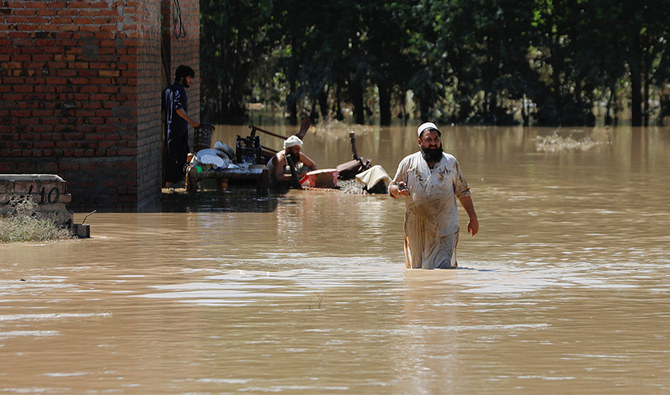
A man wades through flood waters trying to salvage his belongings following rains and floods during the monsoon season in Charsadda, Pakistan August 28, 2022. (REUTERS)
Short Url
Updated 25 September 2022
Follow

Monsoon claims 28 more lives in Pakistan, takes national death toll to 1,061

  • Prime Minister Shehbaz Sharif is scheduled to review relief work in flood-affected areas of Khyber Pakhtunkhwa
  • Army chief General Qamar Javed Bajwa requests affluent citizens for help, says rehabilitation work can take ‘years’

ISLAMABAD: At least 1,061 people have lost their lives in monsoon rains and floods in Pakistan since the beginning of the season in June, said the latest situation report circulated by the National Disaster Management Authority (NDMA) on Sunday, after 28 more people were killed across the country due to the harsh weather conditions.

The Pakistani authorities rescued dozens of tourists stranded in Swat and Kohistan divisions, though many more were still reported to be waiting for help in various areas of Khyber Pakhtunkhwa (KP) province where floods have destroyed hotels, roads and other infrastructure.

While Pakistan’s southern provinces of Sindh and Balochistan have experienced maximum devastation during the monsoon season, KP has also witnessed severe destruction since Friday.

Prime Minister Shehbaz Sharif is scheduled to visit the northwestern KP province on Monday to evaluate the situation in flood-affected places like Nowshera and Charsadda.

“The prime minister will also interact with flood victims after reviewing relief work in the area,” said a statement released by his office. “He will also go to the site of Mohmand Dam where he will receive comprehensive briefing on the project.”

According to the NDMA, more than two million acres of cultivated crops have been wiped out, 3,457.5 kilometers of roads destroyed, and 157 bridges washed away in different parts of Pakistan due to the monsoon rains and floods.

The army chief, General Qamar Javed Bajwa, who visited his troops performing relief activities in flood-affected areas of Khairpur in Sindh on Saturday, urged affluent citizens and expatriate Pakistanis to step forward and help the flood victims.

“Given the magnitude of the floods, the rehabilitation work may take years,” he said in a recorded message.

The army chief maintained that rescue and relief operation was almost over in the flood-hit areas, adding that the rehabilitation work would take greater effort.

The Pakistan Meteorological Department expects dry weather in much of the country for the next 24 hours, though there may be some rain in northern parts of Balochistan along with DG Khan, DI Khan and Rawalpindi divisions.


Macroeconomic instability, inconsistent policies hinder FDI in Pakistan— economists, OICCI

Updated 4 sec ago
Follow

Macroeconomic instability, inconsistent policies hinder FDI in Pakistan— economists, OICCI

  • Pakistan’s foreign direct investment fell 26 percent to $748 million from $1.01 billion a year earlier — data
  • Foreign investors also avoid Pakistan due to its repeated reliance on loans from the IMF, say economists

KARACHI: Despite being the fifth-largest consumer market in the world, Pakistan has failed to attract its “due share” of foreign direct investment (FDI) due to inconsistent policies, regional conflicts and macroeconomic stability, economists and a senior official of the Overseas Investors Chamber of Commerce and Industry (OICCI) said this week. 

Prime Minister Shehbaz Sharif has pursued economic diplomacy recently, traveling frequently to the China, Saudi Arabia, the UAE and other countries. However, these efforts have yet to translate into sustained inflows, as Pakistan has attracted a mere $3 billion in annual FDI over the past two decades, according to the SBP’s data.

Pakistan’s FDI fell 26 percent to $748 million from $1.01 billion a year earlier, extending the downward trend from $2.5 billion recorded in FY25 and $2.3 billion in FY24.

“Pakistan has not been able to attract its due share of the foreign direct investment,” OICCI Secretary General Abdul Aleem said on Friday.
 
The OICCI represents over 200 multinational companies operating in Pakistan, which have collectively reinvested $23 billion over the decade to 2023, according to the group’s website.

“One of the reasons that Pakistan has not been able to attract as much FDI as it should is also a situation in a region where there are conflicts.”

Aleem was referring to Pakistan’s recent border skirmishes with Afghanistan and its four-day military conflict with India in May this year. 

Portfolio investment has also been far from impressive, rising to $160 million in July–Oct in FY26 from $97.2 million a year earlier. Portfolio investment reflects how much money foreigners invest in or withdraw from a country’s stock market.

Last month, Karachi-based market research firm Topline Securities reported that Pakistan had lost around $4 billion in portfolio investments over the past decade.

Arab News reached out to Pakistan’s finance adviser Khurram Schehzad and Jamil Ahmad Qureshi, the secretary-general of the Special Investment Facilitation Council but they were not immediately available for comment. 

Finance Minister Muhammad Aurangzeb told Arab News last month that Pakistan was now better positioned to seek foreign investment due to early signs of macroeconomic stabilization after a prolonged crisis.

‘GREATER CLARITY, CONTINUITY’

Sana Tawfik, head of research at Arif Habib Limited, said Pakistan could see more sustained foreign investment flows through consistent reforms and “clear policies.”

“But foreign investors look for greater clarity and continuity before committing large and long-term capital,” she noted. 

Pakistan’s former finance adviser, Khaqan Najeeb, agreed. He said macroeconomic instability and policy shifts complicate business planning.

“Infrastructure gaps and regulatory hurdles further soften investor confidence,” Najeeb said, noting that Pakistan’s net FDI was hovering around the $1.5-2 billion mark, far below the country’s potential. 

Najeeb pointed out that Islamabad’s repeated reliance on bailouts from the International Monetary Fund (IMF) is also a major reason why foreign investors avoid Pakistan’s debt-burdened yet resilient economy.

Pakistan has secured at least 26 loans from the IMF since joining the organization in 1950, according to the Fund’s website. Pakistan secured a $7 billion bailout program from the global lender last year and is expecting a $1.2 billion tranche after the Executive Board’s meeting next week.

“I think chronic macroeconomic instability, currency volatility, reserves positions going down, going back to the IMF so many times have played a role in this,” he said. 

He said Pakistan’s FDI inflows had remained “modest” due to its recurring balance of payments pressures, noting that periodic IMF programs create “uncertainty for long-term investors.”

Aleem said he was working with the government to streamline Pakistan’s tax structure and ease of doing business, noting that foreign investors often had concerns about the South Asian country’s “slow” legal system.

“It is not enough to say improvements have been made internally,” he said. 

“You have to stand up internationally and at the right forums, share transparently what is good and what is not good in the country.”