

Taliban accuses Pakistan of allowing US drones to use its airspace 

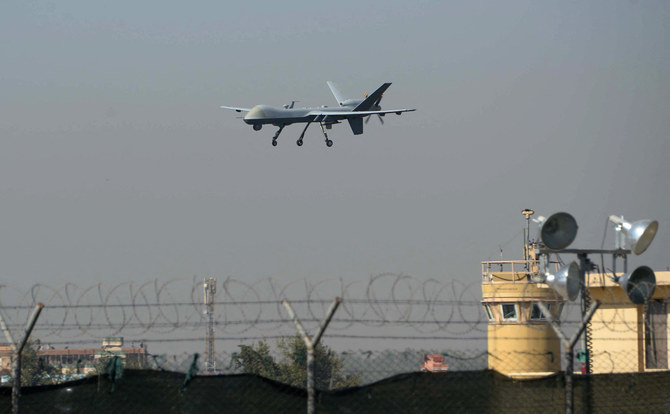
US drone aircraft lands at Afghanistan's Jalalabad Airport where a US C-130 military transport plane crashed in Jalalabad on October 2, 2015. (AFP/ File)
Short Url
Updated 28 August 2022
Follow

Taliban accuses Pakistan of allowing US drones to use its airspace 

  • Pakistan has denied advanced knowledge of drone strike in Kabul that killed Al-Qaeda leader Ayman Al-Zawahiri 
  • The statement by the Afghan acting defense minister could exacerbate tension between the neighboring nations 

KABUL: The Taliban’s acting defense minister on Sunday said Pakistan had allowed American drones to use its airspace to access Afghanistan, a charge Pakistan has recently denied following a US air strike in Kabul. 

Acting Minister of Defense Mullah Mohammad Yaqoob told reporters at a news conference in Kabul that American drones have been entering Afghanistan via Pakistan. 

“According to our information the drones are entering through Pakistan to Afghanistan, they use Pakistan’s airspace, we ask Pakistan, don’t use your airspace against us,” he said. 
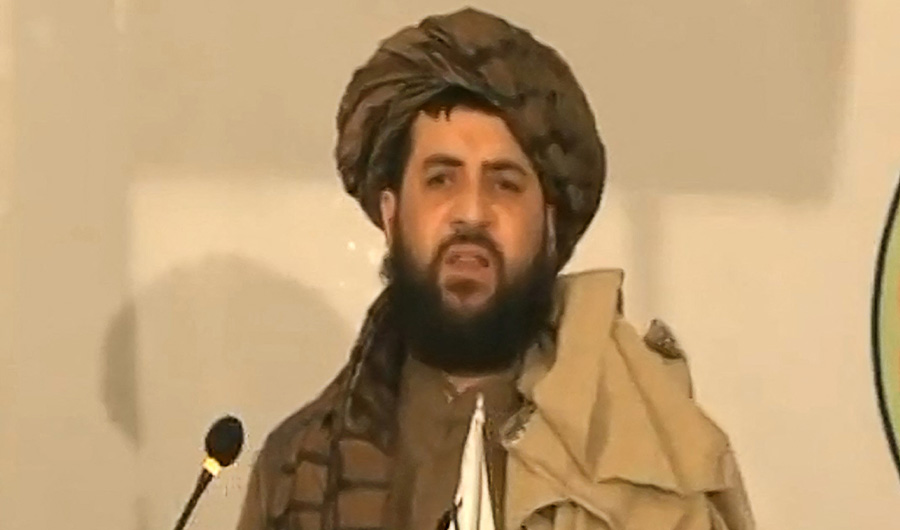


This video frame grab taken from footage released by the Taliban Defense Ministry on October 27, 2021 shows Taliban Defense Minister Mohammad Yaqoob, in Kabul. (AFP/FILE)

Pakistan’s foreign ministry did not immediately respond to a request for comment. 

Pakistani authorities have denied involvement in or advanced knowledge of a drone strike the United States said it carried out in Kabul in July that killed Al-Qaeda leader Ayman Al-Zawahiri. 

Yaqoob’s comments could exacerbate tension between the neighboring nations at a time when the Afghan Taliban is mediating talks between Pakistan and a Pakistani Taliban militant group. Afghanistan also relies heavily on trade with Pakistan as the country experiences an economic crisis. 

The Taliban said it is investigating the July air strike and that it has not found the Al-Qaeda leader’s body. 


Pakistan president eyes strengthening trade, investment, tourism cooperation during Iraq visit

Updated 6 sec ago
Follow

Pakistan president eyes strengthening trade, investment, tourism cooperation during Iraq visit

  • President Asif Ali Zardari arrived in Baghdad on Saturday for four-day visit aimed to bolster bilateral ties
  • Zardari, Iraqi leaders to discuss ways to strengthen cooperation in energy, manpower, technology and education

ISLAMABAD: President Asif Ali Zardari is in Iraq for a four-day visit where he will review bilateral ties and hold meetings with the country’s leadership to strengthen cooperation in trade, investment, religious tourism and energy as well as other sectors, state-run media said this week. 

Zardari arrived in Baghdad on a four-day trip on Saturday where he was received by the country’s Culture Minister Dr. Ahmed Fakkak Al-Badrani.

Pakistan and Iraq established diplomatic relations in 1947 and have traditionally maintained cordial ties, though commercial links remain modest, with officials and business groups identifying scope for cooperation in construction services, pharmaceuticals, manpower and agricultural exports.

“During the visit, President Asif Ali Zardari will hold high-level meetings with the Iraqi leadership, during which all aspects of bilateral relations will be reviewed,” state broadcaster Pakistan Television reported on Saturday. 

“The meetings will consider ways to further strengthen cooperation in key areas of mutual interest, including trade, investment, energy, reconstruction, manpower, technology, education, and people-to-people contacts.”

It said both sides are also expected to discuss regional and international issues, including cooperation at multilateral forums. 

“The president’s visit is expected to further strengthen friendly relations between Pakistan and Iraq, explore new avenues of partnership, and promote people-to-people ties, particularly religious tourism and economic cooperation,” PTV said. 

Earlier this month, Pakistan’s Interior Minister Mohsin Naqvi met his Iraqi counterpart, Abdul Ameer Al-Shammari, on the sidelines of meetings in Brussels, where both sides agreed to enhance cooperation on security and facilitate travel for Pakistani Shia pilgrims to Najaf and Karbala.

The two officials discussed measures to ensure the smoother movement of these pilgrims and their compliance with visa regulations.