

Libya clashes death toll rises to 32, and 159 wounded: ministry

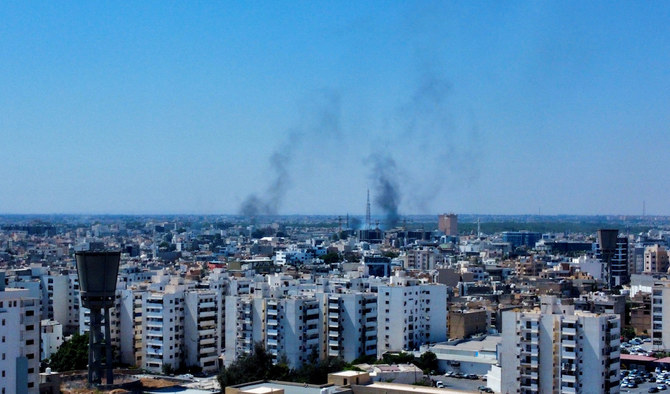
Smoke rises in the sky following clashes in Tripoli, Libya August 27, 2022. (Reuters)
Short Url
Updated 28 August 2022
Follow

Libya clashes death toll rises to 32, and 159 wounded: ministry

  • Small arms fire and explosions rocked several districts of the capital
  • Six hospitals were hit and ambulances were unable to reach areas affected by the clashes

TRIPOLI: Clashes between backers of Libya’s rival governments killed at least 32 people, the health ministry said Sunday in a new toll, after a battle that sparked fears of a major new conflict.
Armed groups had exchanged fire that damaged several hospitals and set buildings on fire starting Friday evening, but a cautious calm had set in by Saturday evening.

Six hospitals were hit and ambulances were unable to reach areas affected by the clashes, the ministry had said earlier, condemning “war crimes.”

The two rival administrations vying for control of the North African country and its vast oil resources — one based in the capital, the other approved by a parliament in the country’s east — exchanged blame.

The UN’s Libya mission called for “an immediate cessation of hostilities,” citing “ongoing armed clashes including indiscriminate medium and heavy shelling in civilian-populated neighborhoods.”
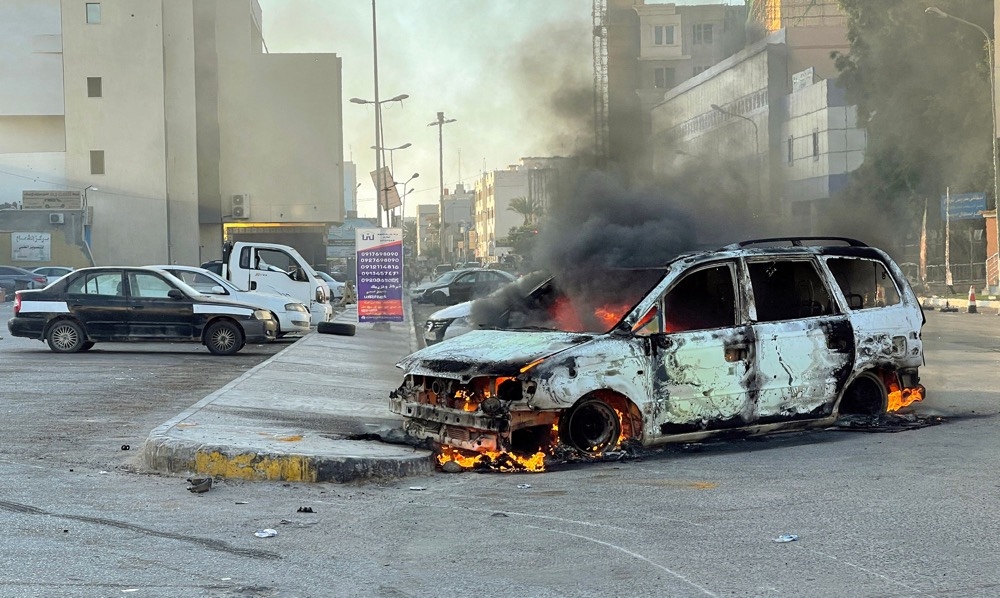


Small arms fire and explosions rocked several districts of the capital. (AFP)

The US ambassador to Libya, Richard Norland, said in a statement that Washington “condemns” the surge in violence, urging an “immediate cease-fire and UN-facilitated talks between the conflicting parties.”

News agency Lana said actor Mustafa Baraka had been killed in one of the neighborhoods hit by fighting, parking anger and mourning on social media.

The Government of National Unity (GNU) of Abdulhamid Dbeibah said fighting had broken out after negotiations to avoid bloodshed in the western city collapsed.

Dbeibah’s government, installed as part of a United Nations-led peace process following a previous round of violence, is challenged by a rival government led by former interior minister Fathi Bashagha.

Bashagha, who is backed by Libya’s parliament and eastern-based military strongman Khalifa Haftar, says the GNU’s mandate has expired.

But he has so far been unable to take office in Tripoli, as Dbeibah has insisted on only handing power to an elected government.

Dbeibah’s government accused Bashagha of “carrying out his threats” to seize Tripoli by force.

Dbeibah’s GNU said negotiations had been underway to “hold elections at the end of the year to resolve the political crisis,” but that Bashagha had “walked out at the last moment.”

Bashagha denied such talks had taken place, and accused Dbeibah’s “illegitimate” administration of “clinging to power.”

Local media reported later Saturday that a group of pro-Bashagha militias that were making their way to the capital from Misrata had turned back.

Emadeddin Badi, a senior fellow at the Atlantic Council, warned that the violence could quickly escalate.

“Urban warfare has its own logic, it’s harmful both to civilian infrastructure and to people, so even if it isn’t a long war, this conflict will be very destructive as we have already seen,” he told AFP.

He added that the fighting could strengthen Haftar and those close to him.

“They stand to benefit from western Libya divisions and have a better negotiating position once the dust settles.”

Meanwhile Badi said on Twitter: “It will be lost on no one that the GNU is more concerned with entrenching itself in Tripoli than with protecting any Tripolitan constituency.”

“The same is valid for the parallel government and its allies.”

Oussama Ali, a spokesman for Tripoli’s ambulance service, told Al-Ahrar television that an unknown number of civilians had been wounded but that his service was “having difficulties moving around.”

Bashagha was appointed in February by the parliament, which was elected in 2014 and is based in the eastern city of Tobruk, but he has been unable to impose his authority in Tripoli.

Initially ruling out the use of violence, the former interior minister has since hinted that he could resort to force.

Last week, he called on “Libyan men of honor” to drop their support for Dbeibah’s “obsolete and illegitimate” administration.

Last month, clashes between rival groups in Tripoli left 16 people dead, including a child.

It was the deadliest violence to hit the Libyan capital since Haftar’s ill-fated attempt to seize it by force in 2019 and 2020.

With AP and AFP


US senator urges military action if Hamas, Hezbollah remained armed

Updated 4 sec ago
Follow

US senator urges military action if Hamas, Hezbollah remained armed

  • Graham’s remarks came a day after mediators urged Hamas and Israel to uphold Gaza ceasefire
  • The 2nd phase of the Gaza truce envisages the demilitarization of the territory, including the disarmament of Hamas

JERUSALEM: US Senator Lindsey Graham called on Sunday for renewed military action against Hamas and Hezbollah if they fail to disarm and accused the Palestinian Islamist group of consolidating its power in Gaza.
The Republican politician, on a visit to Israel, is a staunch ally of US President Donald Trump.
Beginning in October, a fragile ceasefire has so far halted two years of war between Israel and Hamas in the Gaza Strip despite both sides trading accusations of truce violations.
A separate ceasefire between Israel and Lebanon’s Hezbollah also came into effect in November 2024 after more than a year of hostilities, though Israel continues to carry out strikes on Lebanese territory.
Israel has made dismantling the arsenals of both groups, allies of its arch-foe Iran, a key condition for any lasting peace.
“It’s imperative we come up with a plan quickly, put Hamas on a time clock, give them a period of time to achieve the goal of disarmament,” Graham said at a press conference during his visit.
“And if you don’t, I would encourage President Trump to unleash Israel to go finish off Hamas.”
“It’s a long, brutal war, but you cannot be successful anywhere in the region until you deliver in dealing Hamas out of the future of Gaza and disarming them,” Graham added, insisting that the second stage of the truce would fail if Hamas remains armed.
“Ninety days after the ceasefire, they are consolidating power in Gaza,” Graham said.
He also called for military engagement against Hezbollah if it too does not surrender its weapons.
“If Hezbollah refuses to give up their heavy weapons, down the road we should engage in military operations working with Lebanon, Israel and the United States, where we fly with Israel... to take Hezbollah out,” Graham said.

-- Opposition to Turkiye --

The Lebanese government has begun to disarm Hezbollah, starting in the country’s south, and insists it will complete the plan.
Israel, however, has questioned the effectiveness of the Lebanese military, and Hezbollah itself has repeatedly refused to lay down its weapons.
Graham’s remarks came a day after mediators the United States, Qatar, Egypt and Turkiye urged both sides in the Gaza war to uphold the ceasefire.
The mediators are pressing for the implementation of the second phase of the truce, which would involve an Israeli withdrawal from Gaza, the deployment of an international stabilization force and the establishment of an interim authority to govern the territory in place of Hamas.
The second phase of the Gaza truce also envisages the demilitarization of the territory, including the disarmament of Hamas.
Graham backed Israel’s opposition to Turkiye being included in the stabilization force, saying it would “rock Israel to its core.”
“There is no political support anywhere in Israel for having Turkiye being involved in the stabilising force,” he said.
Hamas, meanwhile, has called on the mediators and Washington to stop Israeli “violations” of the ceasefire in Gaza.
On Sunday, Israeli artillery shelling was reported in several parts of Gaza’s southern area of Khan Yunis, according to the civil defense agency, which operates under the authority of Hamas.
On Friday, six people, including two children, were killed in an Israeli bombing of a school serving as a shelter for displaced people, according to the agency.