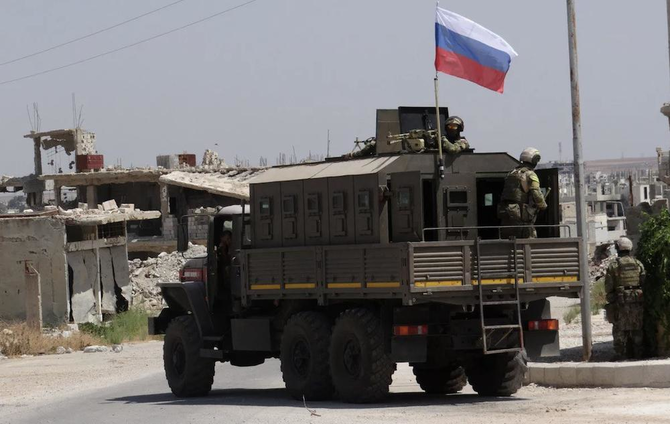
MOSCOW: Russia forces based in Syria on Friday said four Israeli jets had launched a total of four cruise missiles and 16 guided aerial bombs against a research facility in the city of Masyaf on Thursday, Russian agencies reported.
Syrian troops using Russian-made anti-aircraft weapons shot down two missiles and seven guided bombs, Tass and RIA said, quoting a senior Russian officer. The attacks damaged equipment at the facility, he said.
Russian forces have remained in Syria since 2015 when they helped turn the tide in a civil war in favor of President Bashar Assad.
For several years, Israel has been mounting attacks on what it has described as Iranian-linked targets in Syria, where Tehran-backed forces, including Lebanon’s Hezbollah, have deployed to help Assad fight anti-government forces.

Russia forces in Syria say Israeli jets attacked research facility
https://arab.news/r5vda
Russia forces in Syria say Israeli jets attacked research facility
- Syrian troops using Russian-made anti-aircraft weapons shot down two missiles and seven guided bombs
Syria Kurds chief says ‘all efforts’ being made to salvage deal with Damascus
- Abdi said the Syrian Democratic Forces (SDF), the Kurds’ de facto army, remained committed to the deal
- The two sides were working toward “mutual understanding” on military integration and counter-terrorism
DAMASCUS: Syrian Kurdish leader Mazloum Abdi said Thursday that “all efforts” were being made to prevent the collapse of talks on an agreement with Damascus to integrate his forces into the central government.
The remarks came days after Aleppo saw deadly clashes between the two sides before their respective leaders ordered a ceasefire.
In March, Abdi signed a deal with Syrian President Ahmed Al-Sharaa to merge the Kurds’ semi-autonomous administration into the government by year’s end, but differences have held up its implementation.
Abdi said the Syrian Democratic Forces (SDF), the Kurds’ de facto army, remained committed to the deal, adding in a statement that the two sides were working toward “mutual understanding” on military integration and counter-terrorism, and pledging further meetings with Damascus.
Downplaying the year-end deadline, he said the deal “did not specify a time limit for its ending or for the return to military solutions.”
He added that “all efforts are being made to prevent the collapse of this process” and that he considered failure unlikely.
Abdi also repeated the SDF’s demand for decentralization, which has been rejected by Syria’s Islamist authorities, who took power after ousting longtime ruler Bashar Assad last year.
Turkiye, an important ally of Syria’s new leaders, sees the presence of Kurdish forces on its border as a security threat.
In Damascus this week, Turkish Foreign Minister Hakan Fidan stressed the importance of the Kurds’ integration, having warned the week before that patience with the SDF “is running out.”
The SDF control large swathes of the country’s oil-rich north and northeast, and with the support of a US-led international coalition, were integral to the territorial defeat of the Daesh group in Syria in 2019.
Syria last month joined the anti-IS coalition and has announced operations against the jihadist group in recent days.


