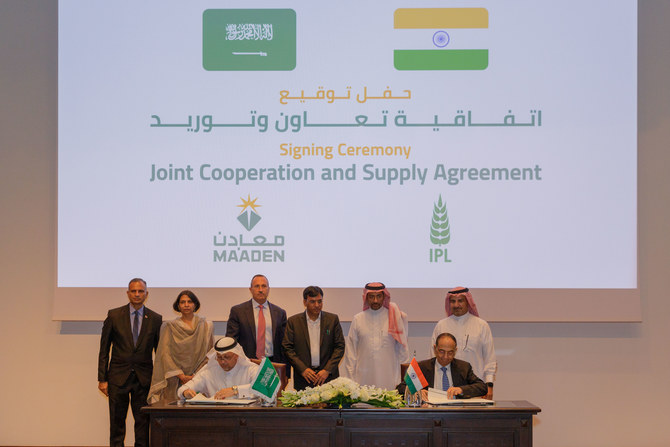

RIYADH: Ma’aden, a Saudi-owned mining company, signed four Memorandums of Understanding (MoUs) to double exports of phosphate products and ammonia to India starting 2023, the Saudi Press Agency (SPA) reported.
The agreements, signed with three Indian fertilizer companies, seek to explore product and technology development collaboration for phosphate fertilizers, specialty products, and logistics solutions.
Saudi Arabia’s Minister of Industry and Mineral Resources Bandar Alkhorayef and India’s Minister of Chemicals and Fertilizers Dr. Mansukh Mandaviya attended the signing on Thursday.
Robert Wilt, CEO of Ma’aden, said the company exported about 1.7 million tons of phosphate products and ammonia to the Indian market annually.
“India is the largest import market for phosphate and ammonia in the world, with steadily increasing demand. Due to the close geographical proximity between our nations, Ma’aden is a natural partner for the Indian market,” he said in a statement cited on SPA.
Wilt said the new agreements help expand the company’s role in global food security and bolster the long-standing relationship between Saudi Arabia and India.
Ma’aden’s mine-to-market phosphate business consists of two mega plants in Saudi Arabia: Wa’ad Al Shamal Industrial Minerals City in the Northern Borders province, and Ras Al Khair Industrial City on the East coast.
It is developing a third large-scale phosphate project called ‘Phosphate 3’, which aims to increase the company’s phosphate fertilizer supply capacity by 3 million tons to 9 million tons over the coming years.