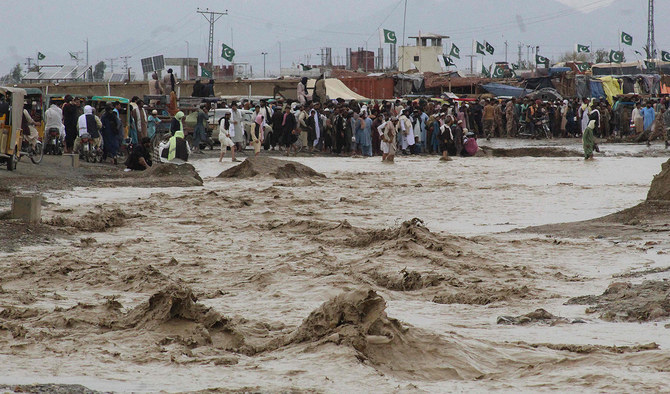

ISLAMABAD: Pakistan’s minister for climate change Sherry Rehman said on Thursday monsoon rains and floods had claimed over 900 lives and rendered about 30 million people homeless since mid-June, as she urged the international community to help her country deal with the devastation.
According to the National Disaster Management Authority (NDMA), 34 more people were killed in rain-related incidents across the country during the last 24 hours, taking the national death toll to 937, including 343 children, since the beginning of the monsoon season.
Much of the devastation has been witnessed in Pakistan’s southern region where 306 people have died in Sindh and 234 in Balochistan.
“Around 30 million people are homeless as they have lost their houses,” Rehman told a media briefing in Islamabad, adding that national and provincial institutions were working tirelessly to provide relief to the affected people.
“The federal government has declared a national emergency and Sindh government has declared its 23 districts calamity hit,” she added.
Sharing the data, the minister said the country had received 241 percent more rain in August alone.
“Sindh has received the largest increase of 784 percent followed by Balochistan which received 496 percent additional rains,” she added.
Rehman noted the intensity of rains was unprecedented and had led to massive urban flooding.
“This flood water in the overall system is more than the super floods of 2010,” she said. “In 2010, flood water was more in river Indus, but this time water has flooded cities and villages more than ever.”
Rehman appealed to the world to help flood victims in Pakistan, saying it was not possible for the federal government and provincial administrations to deal with such massive devastation on their own.
“The NDMA is doing the assessment of losses according to international standards which is about to be completed,” she said, adding the country would formally request international donors for help after the process was completed.
“So far we have got some assistance but need much more from the international community,” she added.
The Sindh administration also decided to constitute district-level committees of senior officials to carry out flood relief activities and damage assessment.
“The purpose [of setting up these committees] is to reach the affected families and support them in a transparent, proper and decent way,” Sindh Chief Minister Murad Ali Shah observed while chairing a meeting to evaluate his administration’s relief efforts.
The meeting was informed that the Provincial Disaster Management Authority (PDMA) in Sindh had distributed 80,000 tents and ordered 180,000 more, though district administrations had generated a requirement of one million tents.
A senior PDMA official, Khalid Mansoor, said the country’s most populous province of Punjab had also witnessed devastation due to torrential rains, saying 165 people had been killed and 44,556 houses damaged in the region during the ongoing monsoon season.
Mansoor added the floods had also destroyed crops on 438,274 acres of agricultural land.
He added the PDMA in Punjab had distributed “22,568 tents, 1200 blankets, and 43,437 food packages” among people in the province.
Providing the lowdown on the situation in Khyber Pakhtunkhwa (KPK), a PDMA spokesperson, Taimor Ali, said more than 60 people had died and 117 injured in the province due to floods since the beginning of the month, while 11,870 houses, five schools and 42 other properties were also destroyed.
“Dera Ismail Khan is the worst affected area of KPK,” he said. “Along with regular funds which were given to district administrations, the provincial government has given additional Rs30 million for the district and set up six relief camps at its different locations,” he continued.
Former director general of the Pakistan Meteorological Department Muhammad Riaz Ahmed agreed with the federal and provincial authorities of Pakistan that the floods this year had been more devastating than in 2010.
“In 2010, we mainly witnessed river flooding which was predictable and the authorities could control the loses in the downstream areas,” he told Arab News. “However, it is mainly urban flooding this year which is caused by torrential rains. Flash floods are more devastating since they affect plains more than riversides.”