



DUBAI: If the Middle East has a James Cameron, it’s Marwan Hamed. The renowned Egyptian director has just accomplished the unthinkable once again, as his latest film, the historical epic “Kira & El-Gin,” became Egypt’s highest-grossing film of all time, breaking the record set by Hamed’s previous film, 2019’s “Blue Elephant 2.” What Cameron did for the global film industry with “Titanic” (1997) and “Avatar” (2009), Hamed is doing for Arab film: Making event movies that unite millions across all demographics, and might just be saving cinema-going culture in the process.
“My goal is simple: I want to make a film that can reach a wide audience. When a record is broken, while that’s not something we are directly aiming for, it does do something important: It shows that there is room for big budgets, that there’s room for ambition, and that there’s an audience that is hungry for different kinds of films than they’ve seen before,” Hamed tells Arab News.
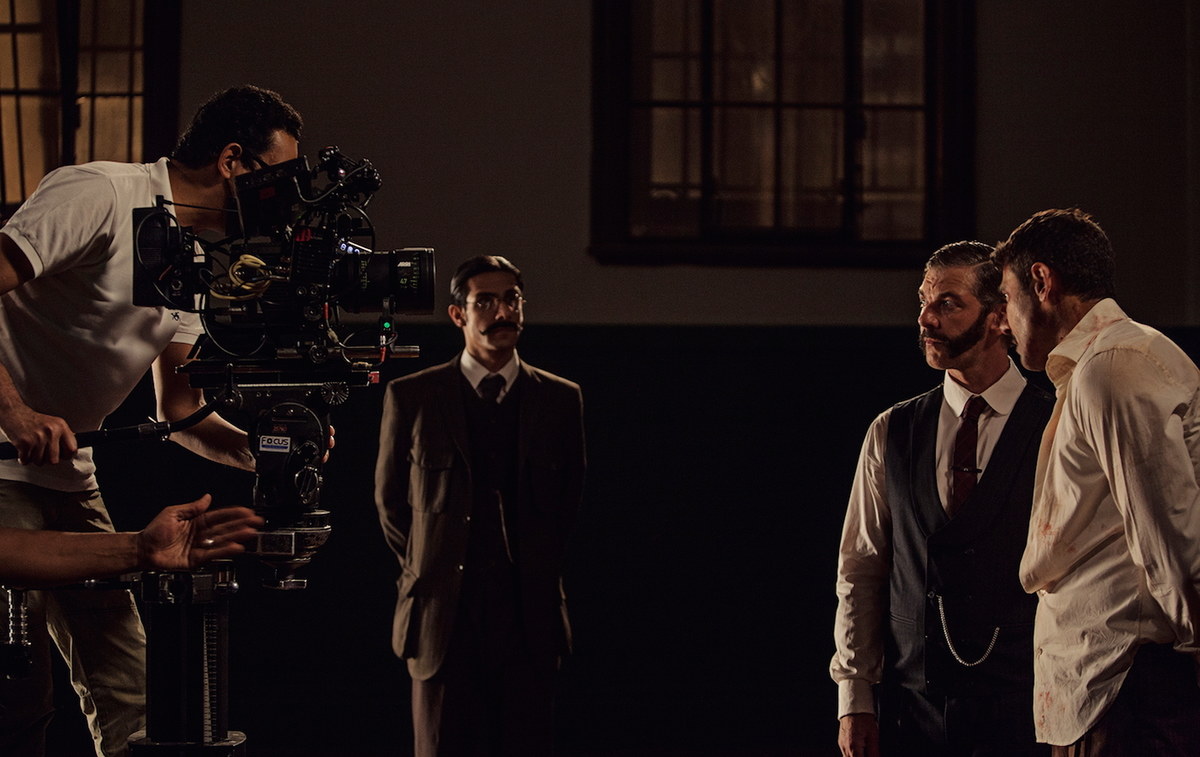
Marwan Hamed (left) on the set of ‘Kira & El-Gin.’ (Supplied)
“Kira & El-Gin,” he hopes, could be the rising tide that lifts all ships — both for his own projects and a new generation of Arab filmmakers who may not be hampered by the constraints that previous generations have faced.
“I've got more opportunity when I'm working within a powerful industry,” Hamed says. “If the industry grows, that can give opportunities to various kinds of films, various voices, various styles and make room for more risks to be taken. If there’s more income, that instills a lot of courage in the producers. They’ll try different ideas, and explore different aspects of production, whether for a low-budget film, or a big-budget film.”

Mohamed Emam, Hend Sabry and Marwan Hamed in Cannes for a screening of their film ‘Yacoubian Building’ in 2006. (AFP)
It's been 16 years since Hamed first emerged as a force to be reckoned with, following up his acclaimed 2001 short “Li Li” with a debut feature that was reportedly the highest-budgeted film in the history of Egyptian cinema up to that point — 2006’s “The Yacoubian Building,” a film that united him behind the camera with his late father, the acclaimed screenwriter Wahid Hamed, who wrote the adaptation of the best-selling book of the same name. That father-son partnership was a bit of a theme, as the film also made a star of a young Mohamed Emam, who appeared in the film opposite his own father, Egypt’s most popular actor Adel Emam.
Hamed’s knack for identifying the best young talent and attracting the biggest names in the business — not to mention huge audiences — to believe in him has been apparent from the very start of his career. It’s a skill he defines plainly.
“It’s simple,” he says. “This industry can be very harsh, but if you make a successful film, people will trust you. Opportunities are scarce, but there’s always an opportunity. People will remember your successful work, and maybe the one before that. That’s why I take my time; I’ve only made seven films in 20 years. I question myself a lot to understand whether something I’m working on can reach the audience I’m making it for—whether that’s a smaller festival film like ‘Li Li’ or a mass-market film like ‘Kira & El-Gin.’”
While the audience is always in Hamed’s mind, the filmmaker doesn’t simply chase the next hit. With each film, Hamed attempts to push himself into new storytelling territory, exploring new genres and personal challenges.
In “Kira & El-Gin” he looked to Egypt’s own past for inspiration, following the titular pair, played by box office heavyweights Karim Abdel Aziz and Ahmed Ezz, as they team up to resist the British occupation of Egypt during the country’s 1919 revolution.
“Pushing myself into new territory forces me to go back and learn before I make each film — open books and do research. For ‘Kira & El-Gin,’ the amount of knowledge I accumulated to make that film was unbelievable, because I had to read not only about Egyptian history but about world history, about the politics of the time and all the people caught up in it. Not to mention the costumes, the look of Cairo at the time, and every other detail the film had to recreate,” says Hamed. “It added a lot to me as a filmmaker, and more. Entering new territory helps me develop as both an artist and a human being. I think audiences appreciate that too.”
The film was ambitious enough to begin with, applying (once-again) the biggest budget in Egyptian filmmaking history to a film unlike any Hamed had attempted before. He began the shoot not long after his previous film “Blue Elephant 2” had rocketed through cinemas, but it proved to be an even greater undertaking than he could have imagined, as COVID-19 shutdowns forced him to delay the film by an entire year.
“The shutdowns affected me greatly. With all my films, I shoot continuously, to capture a continuation of emotions. With the year’s break, I forced myself to constantly work on the film, because I couldn’t let myself forget it. Whether it was as simple as watching footage to keep my mind on it or something more, I had to keep the same drive and the same emotion to be able to give it the same heart once we continued,” Hamed says. “That was worrying me so much. I was scared that people would watch the film and would know something was wrong — that something wasn’t flowing. That’s why I couldn’t let go. I couldn’t let that happen. I just continued.”
While the film ultimately became everything that Hamed, and audiences across the region, hoped it would be, there is one audience member who was unable to see the film that Hamed can’t stop thinking about — his father Wahid, who passed away in early 2021.
“It was very tragic for us. This is one of the films that I really wanted my father to see. He passed away right in the middle of production. He and I had so many discussions about the film. I was always lucky to have my father supporting me, whether emotionally or as a filmmaker,” Hamed says. “I just wish he could have seen it.”


