UN special envoy meets Bangladeshi officials as pressure to repatriate Rohingya grows

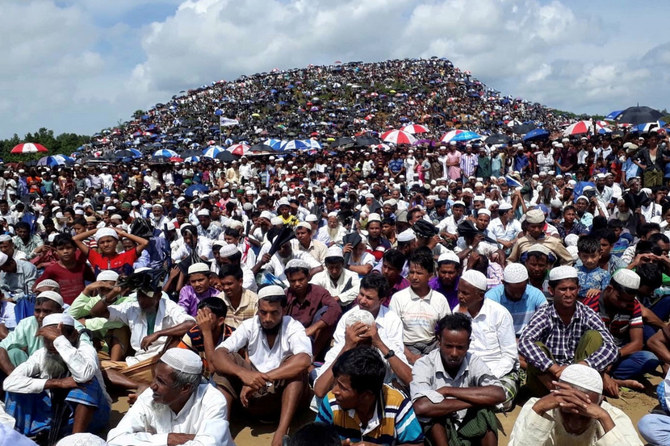
Rohingya refugees gather to mark the second anniversary of the exodus at the Kutupalong camp in Cox's Bazar, Bangladesh, on August 25, 2019. (REUTERS/File Photo)
Short Url
Updated 25 August 2022
Follow

UN special envoy meets Bangladeshi officials as pressure to repatriate Rohingya grows

  • Noeleen Heyzer’s trip to Bangladesh follows her visit to Myanmar
  • Bangladeshi PM called on UN last week to start repatriation of Rohingya refugees

DHAKA: The UN Special Envoy for Myanmar Noeleen Heyzer met with Bangladeshi officials on Wednesday amid growing pressure for the repatriation of Rohingya refugees.

Although Bangladesh is not a signatory to the 1951 UN Refugee Convention, it has been hosting and providing humanitarian support to 1.2 million Rohingya Muslims, most of whom fled neighboring Myanmar during a military crackdown in 2017.

A majority of the refugees live in squalid camps in Cox’s Bazar district, a coastal region in the country’s southeast and the world’s largest refugee settlement.

Despite multiple attempts from Bangladesh over the past years, a UN-backed repatriation process has been failing to take off.

Heyzer arrived in Bangladesh on Monday, after her visit to Myanmar last week.

“The UN envoy to Myanmar visited the Rohingya camps at Cox’s Bazar on Tuesday. She witnessed the facilities over there that Bangladesh has provided to the Rohingya refugees,” Shamsud Douza Nayan, additional commissioner of Bangladesh’s Refugee Relief and Repatriation Commission, told Arab News.

“Today’s meeting was to discuss the issues about the well-being of the Rohingyas.”

Heyzer inspected facilities provided to Rohingya refugees in the camps, where no work is available, sanitation is poor and access to education limited.

Her arrival in Bangladesh follows the visit of UN High Commissioner for Human Rights Michelle Bachelet, whom Bangladeshi Prime Minister Sheikh Hasina called upon to repatriate the Rohingya.

When Bachelet asked Hasina to increase opportunities for education and work for the Rohingya in Bangladesh, the prime minister said such initiatives would not be possible to implement in Cox’s Bazar but could be pursued in Bhasan Char, a remote camp island in the Bay of Bengal, where Bangladeshi authorities have shifted over 20,000 refugees since December 2020 to take pressure off Cox’s Bazar.

Before and during the relocation process, the UN High Commissioner for Refugees and rights groups criticized the camp island project on the grounds of safety and Bhasan Char’s livability, as the island, 68 km from the mainland, is prone to severe weather and flooding.

As international financial support for hosting the Rohingya has decreased since 2020, the pressure on Bangladesh has been also economic, multiplying the challenges the developing country battered by the COVID-19 pandemic is already facing. Hosting Rohingya refugees costs Bangladesh an estimated $1.2 billion a year.

Security in Rohingya settlements has come under the spotlight in recent weeks after two refugee community leaders were shot dead earlier this month, reportedly by an insurgent group active in the camps, which has been accused of killing scores of opponents and local community leaders since last year.

Reports of criminal organizations using refugees as drug traffickers have also been on the rise.

In an appeal to donors, the UN refugee agency said on Tuesday that international support for Rohingyas is “well short of needs.”

The UNHCR said its 2022 response plan sought $881 million for more than 1.4 million people, including Rohingya refugees and host communities, but so far was funded at only 49 percent.


Philippines seeks to regain Chinese visitors as arrivals lag behind regional rivals

Updated 27 December 2025
Follow

Philippines seeks to regain Chinese visitors as arrivals lag behind regional rivals

  • 262,000 Chinese tourists visited Philippines in 2025, compared to 1.7m in 2019
  • Vietnam is top destination for Chinese travelers, with about 4.8m visitors this year

MANILLA: The Philippines is trailing behind other countries in Southeast Asia in winning back Chinese tourists, with arrivals well below a quarter of pre-pandemic levels so far this year, latest data showed.

Known for its white sandy beaches, famous diving spots and diverse culture, the Philippines was welcoming an increasing number of Chinese tourists in the period before the pandemic, with the number peaking at over 1.7 million in 2019, when it was the second-largest source market after South Korea. 

But the post-pandemic rebound has been slow, with China ranking sixth among international arrivals and the number of Chinese visitors reaching only 262,000 as of Dec. 20, according to data from the Philippine Department of Tourism.

“China remains one of the country’s largest and most important source markets,” the tourism department said earlier this week.

Chinese arrivals this year are equivalent to only around 15 percent of the numbers in 2019 and there is stiff competition with regional rivals like Vietnam, Thailand, Malaysia, Singapore and Indonesia each welcoming at least 1 million tourists from China in 2025.

Vietnam has become Chinese travelers’ top travel destination in Southeast Asia with around 4.8 million visitors so far this year, followed by Thailand, which has recorded about 4.36 million.

China is Singapore’s top source market, with nearly 3 million visitors as of November.

To attract more visitors from China, the Philippines reintroduced electronic visas for Chinese travelers in November, after suspending the system for two years.

“The eVisa resumption is a critical step forward and a clear signal that the Philippines is open, ready, and eager to welcome our Chinese friends,” said Ireneo Reyes, the tourism attache to China.

“While the timing meant that its full benefits could not be felt within the peak booking periods of 2025, we expect a more visible impact beginning the first quarter of 2026.” 

The Philippine tourism department said that “recovery has also been constrained by reduced flight capacity, with China-Philippines routes operating at only about 45 percent of pre-pandemic levels,” adding that officials were working closely with relevant stakeholders to “rebuild connectivity and confidence.”

Tourism is an important sector in the Philippine economy, according to a report by the ASEAN+3 Macroeconomic Research Office, accounting for about 13.2 percent of the country’s gross domestic product last year and making up around 13.8 percent of its labor force.