

Saudi crown prince launches Rua Al-Madinah project near Prophet’s Mosque

1 / 5
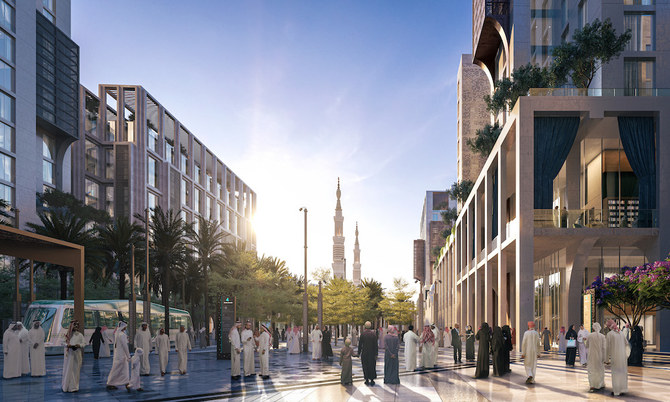
The project will be built on a ​​1.5 million square meter area and will include hotels, open squares and green areas by 2030. (Supplied)
2 / 5
The project will be built on a ​​1.5 million square meter area and will include hotels, open squares and green areas by 2030. (Supplied)
3 / 5
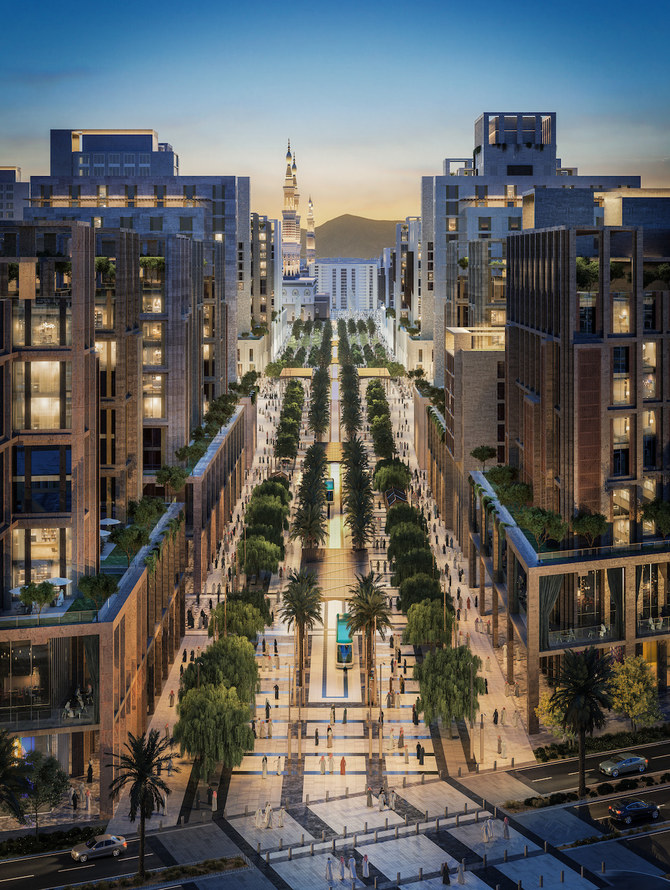
The project will be built on a ​​1.5 million square meter area and will include hotels, open squares and green areas by 2030. (Supplied)
4 / 5
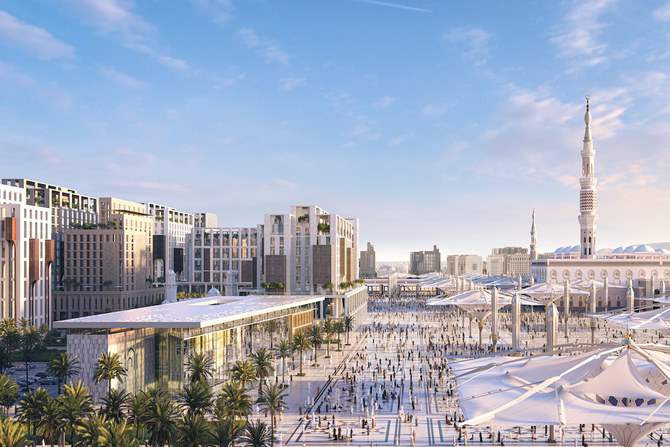
The project will be built on a ​​1.5 million square meter area and will include hotels, open squares and green areas by 2030. (Supplied)
5 / 5
The project will be built on a ​​1.5 million square meter area and will include hotels, open squares and green areas by 2030. (Supplied)
Short Url
Updated 25 August 2022
Follow

Saudi crown prince launches Rua Al-Madinah project near Prophet’s Mosque

  • Development aims to enrich the visitor experience for pilgrims
  • Project will span 1.5 million square meters, feature 47,000 hotel rooms

RIYADH: Saudi Arabia’s Crown Prince Mohammed bin Salman on Wednesday unveiled the master plan for the Rua Al-Madinah project — a mega mixed-used real estate development to the east of the Prophet’s Mosque.

The crown prince, who is chairman of both the Council of Economic and Development Affairs and the Public Investment Fund, said the project, in line with Saudi Vision 2030, would help to raise the hosting capacity for Umrah pilgrims to 30 million over the coming years, the Saudi Press Agency reported.

The project, which will be developed by the PIF-owned Rua Al-Madinah Holding Co., will span 1.5 million square meters — of which 63 percent will be open and green spaces — and feature 47,000 hotel rooms, the report said.

It will also boast nine bus stops, a metro station, tracks for self-driving vehicles and underground parking, all of which will provide easy access to the mosque and the surrounding residential and commercial developments.

As well as providing a host of job opportunities, the project aims to elevate Madinah’s status as a modern Islamic and cultural destination for pilgrims, while improving the quality of life for the city’s residents.

Rua Al-Madinah Holding said that as well as helping to achieve the goals of the Hajj, Umrah, and travel sectors outlined in Saudi Vision 2030, the development would revive the city’s cultural and architectural heritage.

The project will showcase many historical monuments that are of huge significance to the legacy of the Prophet Muhammad and his companions, while the holy city’s unique heritage is reflected in the design of all buildings and facilities.


How KAUST is transforming waste into wealth

Updated 6 sec ago
Follow

How KAUST is transforming waste into wealth

  • Researchers target $275m market with waste-to-value algae innovation

RIYADH: Turning food waste into a valuable industrial product may sound improbable, but scientists at King Abdullah University of Science and Technology are proving it is possible — using algae that has existed for millions of years. 

Last month, researchers at the university unveiled a sustainable method that harnesses an ancient red microalga to reduce food waste in the Kingdom while producing a high-demand natural pigment.

The study was led by bioengineering student Mauricio Masson, with support from Michael Fox, assistant professor of marine science, alongside researchers from KAUST and the Arizona Center for Algae Technology and Innovation. The international team included Kyle Lauersen, KAUST associate professor and lead author of the study.

Scientists at King Abdullah University of Science and Technology (KAUST) developed a sustainable method to use an ancient type of algae while reducing food waste in the kingdom. (Supplied)

The research highlights a “sustainable bioprocessing” approach, demonstrating how an aquatic plant can convert chocolate factory waste into C-phycocyanin — a blue pigment with a global market expected to reach $275 million over the next four years.

“Our research focused on an extremophilic red alga that can thrive in harsh conditions and efficiently consume sugars and nutrients found in food waste streams,” said Lauersen.

Lauersen is an associate professor and chair of the bioscience and bioengineering programs in the Biological and Environmental Sciences and Engineering Division at KAUST. He explained that a key objective of the study was to show that food waste — often discarded or sent to landfills — can be repurposed as a feedstock for producing high-value compounds, including natural pigments and proteins, through algae-based bioprocesses.

“Our main goal was to develop an environmentally friendly approach to turn waste into useful products that have the potential to be scaled,” Lauersen told Arab News.

FASTFACT

Did you know?

• By 2030, the global market for C-phycocyanin is projected to exceed $275 million, reflecting growing demand across food, health, and industrial sectors.

• C-phycocyanin has demonstrated potential benefits in antioxidation, inflammation, cancer research, antimicrobial activity, neurodegeneration, diabetes management, and wound healing.

• As a natural pigment, C-phycocyanin offers a healthier alternative to synthetic food colorants and is approved by the US FDA for use in food products.

He added: “Algae are especially well suited for this because they grow quickly, require relatively few resources, and can metabolize a wide range of organic compounds.”

The red microalga Galdieria yellowstonensis feeds on chocolate waste rich in residual sugars, producing a protein-dense biomass that contains C-phycocyanin, according to KAUST. The pigment is widely used as a natural food coloring — found in products such as ice cream and blue-colored beverages — as well as in cosmetics and pharmaceuticals.

Beyond the study’s original goals, researchers also discovered that elevated levels of carbon dioxide significantly enhance algae growth, even though CO₂ is typically considered a byproduct of microbial sugar consumption.

Another major outcome of the research is its potential to reduce land pollution by transforming food waste into a nutrient source for algae, offering a sustainable alternative to disposal. 

Galdieria yellowstonensis feeds on chocolate waste containing residual sugar, producing a protein-packed biomass that includes C-phycocyanin. (Supplied)

KAUST believes the findings could positively impact Saudi Arabia’s economy by helping food manufacturers lower production costs while addressing environmental concerns.

“The species we studied can grow on waste streams that are unsuitable for conventional crops or microorganisms,” said Lauersen.

“This makes algae an attractive platform for circular economy solutions, where waste is transformed directly into valuable materials rather than being treated as a disposal problem.”

The research effort is ongoing. Scientists at KAUST are currently collecting chocolate waste locally and plan to scale up the process using other industrial waste streams available across the Kingdom. The initiative aims to support companies in transitioning toward a circular carbon economy while contributing to Saudi Arabia’s green agenda.

“Food waste is a major global challenge, contributing to greenhouse gas emissions, resource inefficiency, and environmental degradation,” said Lauersen.

“By recycling waste into useful products, we can reduce pressure on landfills, lower emissions, and make better use of existing resources.”

“These types of solutions are essential as industries worldwide face growing demands to become more sustainable and climate resilient, especially in the Middle East, which relies on heavily on imports.”