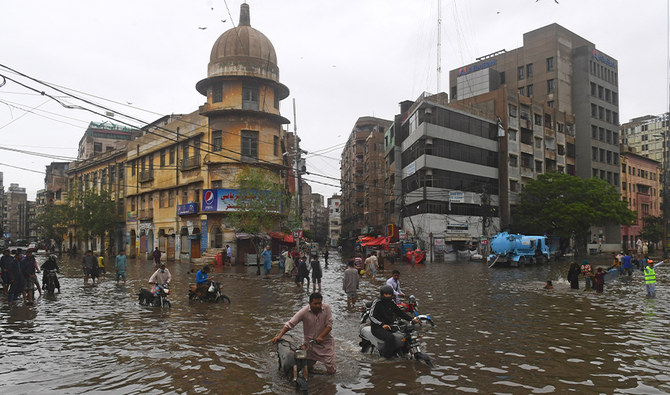
KARACHI: Pakistan’s election body on Wednesday postponed local government polls in the country’s southern port city of Karachi due to “weather conditions,” a day after deferring them in nine other districts of the southern Sindh province where heavy monsoon rains have claimed 239 lives since mid-June.
The total number of casualties caused by monsoon rains throughout Pakistan since June 14 has soared to 830, including 313 children, according to official data compiled by the National Disaster Management Authority (NDMA).
Much of the devastation has been witnessed in southwestern Balochistan province, where 225 have died due to torrential rains and floods, and in the southern Sindh province, where casualties have climbed to 239, officials of the meteorological department said.
“In view of the reports submitted by chief secretary Sindh, IG [inspector general] Sindh and provincial election commissioner Sindh along with the weather conditions, unavailability of law enforcement agencies during elections, problems of logistics and the overall convenience of voters, the election commission has decided to defer local government elections in Karachi division,” a spokesperson of the Election Commission of Pakistan (EPC) said in a statement.
He added that new dates for the elections would be announced once weather conditions improved.
The first phase of local government elections was held in 14 districts of Sindh in June. The second phase of the polls was scheduled to be held in the province’s Karachi and Hyderabad divisions on July 24. However, heavy downpours and subsequent urban flooding in various parts of the districts forced the ECP to postpone the polls.
The ECP had rescheduled the polls in Karachi and Hyderabad for August 28. However, on Tuesday, it decided to delay the elections in nine districts of the province.
The ECP had earlier said it would hold a meeting on Wednesday to decide about local government polls in Karachi division after reviewing various points raised by the provincial government, difficulties in conducting the polls and weather reports for the next few days.
The spokesperson said the secretary of the ECP, citing a report by DG Met Department, told a meeting in Islamabad that heavy rains were forecast in Karachi from August 24 to 26 and that it was very likely that these rains would also take place on August 27 and 28.
The director-general of the Met Office said in his report that 50,000 policemen were required for election duty, for which 16,000 personnel had to be deployed from outside Karachi, which was not possible due to floods in interior Sindh.
The provincial election commissioner said there would be logistical issues and the commission would face difficulty in transporting 63,000 polling staff to 49,000 polling stations across the city, the spokesperson added.


![]()

Pakistan’s election body postpones local polls in Karachi over ‘weather conditions’
Short Url
https://arab.news/wu49d
Pakistan’s election body postpones local polls in Karachi over ‘weather conditions’
- Sindh has reported highest number of casualties from rain-related incidents since June 14
- ECP cites unavailability of law enforcers, logistical problems as reasons to defer the polls
Latest updates


© 2026 SAUDI RESEARCH & PUBLISHING COMPANY, All Rights Reserved And subject to Terms of Use Agreement.