

Pakistani court orders interior ministry to probe alleged torture of ex-PM’s aide

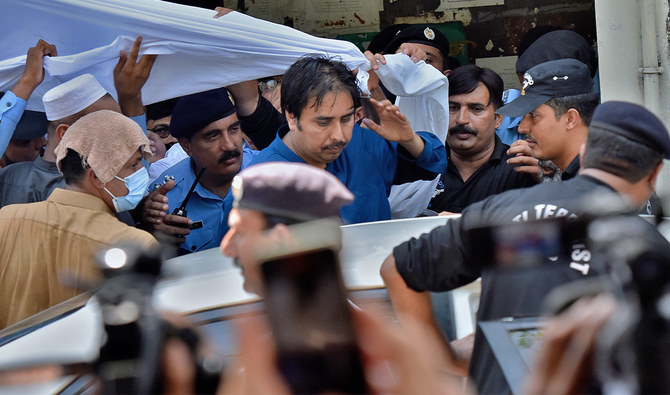
Police officers escort Shahbaz Gill, center in blue shirt, a political aide to former Pakistani prime minister Imran Khan, after a court appearance, in Islamabad, Pakistan, on August 22, 2022. (AP/File)
Short Url
Updated 24 August 2022
Follow

Pakistani court orders interior ministry to probe alleged torture of ex-PM’s aide

  • Islamabad High Court asks interior ministry to appoint an inquiry officer, preferably a retired judge
  • Dr. Shahbaz Gill was arrested on August 9 for allegedly making anti-military comments on a TV channel

ISLAMABAD: A Pakistani court on Wednesday directed the country’s interior ministry to probe allegations that former Prime Minister Imran Khan’s aide, Dr. Shahbaz Gill, was tortured in police custody.

Khan’s Pakistan Tehreek-e-Insaf (PTI) party says Gill, who is under arrest and faces sedition charges, has been tortured in police custody. Gill was arrested on August 9 for allegedly making anti-military comments on a TV channel that was subsequently suspended by the government. He was admitted to a government hospital in the capital last week after his health deteriorated in police custody.

The Pakistan government and police deny Gill was tortured.

In a 21-page order from the Islamabad High Court (IHC), Acting Chief Justice Aamir Farooq took notice of the “very serious issue” of Gill’s allegations and said the matter couldn’t “simply be ignored as it can entail serious consequences for future investigations.”

“It would be only appropriate that Ministry of Interior, Government of Pakistan should look into the matter [Gill’s alleged torture] and appoint an Inquiry Officer preferably a retired Judge of the High Court to examine the issue,” the order read.

It directed the inquiry officer to make detailed findings on the issue and also suggest ways to “curb the practice” of torture.

Justice Farooq said torture to extract evidence is prohibited in Pakistan’s constitution.

“Much judicial ink has been expended safeguarding the rights of the prisoners and accused persons and to protect them from torture,” he wrote.

A medical board at the Pakistan Institute of Management Sciences (PIMS) on August 18 suggested that Gill needed to be monitored and assessed by a cardiologist and pulmonologist. It added that Gill had a “known case of asthma since childhood” and now presented with shortness of breath, body aches including left shoulder, back, neck, right gluteal region and left sided chest pain.

While Pakistan’s constitution prohibits the use of torture “for extracting evidence,” no domestic legislation makes committing torture a criminal offense. Pakistan is a party to core international human rights treaties that prohibit the use of torture and other ill-treatment and mandate parties to the treaty to criminalize the practice.


Pakistan finance chief calls for change to population-based revenue-sharing formula

Updated 6 sec ago
Follow

Pakistan finance chief calls for change to population-based revenue-sharing formula

  • Muhammad Aurangzeb criticizes current NFC formula, says it is holding back development
  • Minister says Pakistan to repay $1.3 billion debt in April as economic indicators improve

ISLAMABAD: Pakistan’s Finance Minister Muhammad Aurangzeb said on Saturday the country’s revenue-sharing formula between the federal and provincial governments “has to change,” arguing that allocating the bulk of funds on the basis of population was holding back long-term development.

The revenue-sharing is done under the National Finance Commission (NFC) Award that determines how federally collected taxes are divided between the center and the provinces. Under the current formula, much of the distribution weight is based on population, with smaller weightages assigned to factors such as poverty, revenue generation and inverse population density.

“Under the NFC award, 82 percent allocation is done on the basis of population,” Aurangzeb said while addressing the Federation of Pakistan Chambers of Commerce & Industry’s regional office in Lahore. “This has to change. This is one area which is going to hold us back from realizing the full potential of this country.”

Economists and policy analysts have long suggested broadening the NFC criteria to give greater weight to tax effort, human development indicators and environmental risk, though any change would require political consensus among provinces, making reform politically sensitive.

Aurangzeb also highlighted the economic achievements of the country in recent years, saying Pakistan’s import cover had improved from roughly two weeks just a few years ago to about 2.5 months currently, adding that the government had repaid a $500 million Eurobond last year.

“The next repayment is of $1.3 billion in April,” he continued, adding that “we will pay these obligations, which are the obligations of Pakistan, as we go forward.”

The minister also noted that unlike in 2022, when devastating floods forced Pakistan to seek international pledges at a Geneva conference, the government did not issue an international appeal during more recent flooding, arguing that fiscal buffers had strengthened.

“This time, the prime minister and the cabinet decided that we do not need to go for international appeal because we have the means,” he said.

He reiterated the government was pursuing export-led growth to avoid repeating past boom-and-bust cycles driven by import-led expansion that quickly depleted foreign exchange reserves and pushed Pakistan back into International Monetary Fund programs.