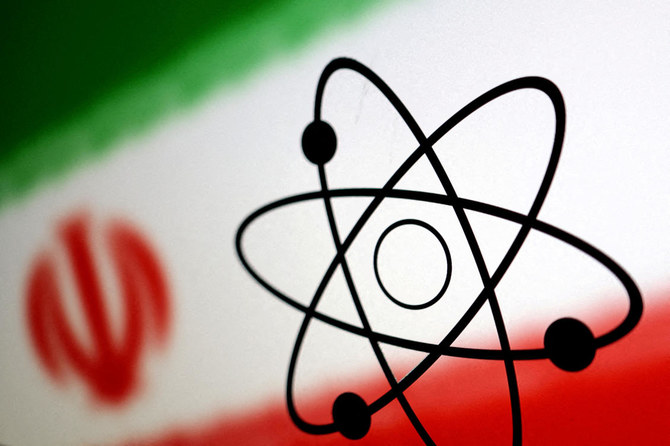
Iran to only accept inspections agreed in 2015 nuclear deal

Iran has dropped some of its main demands on resurrecting the deal to rein in Tehran’s nuclear program, including its insistence that international inspectors close some probes of its atomic program. (Reuters)
Short Url
Updated 24 August 2022
Follow

Iran to only accept inspections agreed in 2015 nuclear deal

  • ‘We are committed to inspections in the framework of the nuclear deal’
  • ‘… not one word more, not one word less’

DUBAI: Iran will not allow inspections beyond what is in a 2015 nuclear deal, the country’s nuclear chief said on Wednesday, as the United States prepares to respond to a proposal to revive Tehran’s nuclear deal with world powers.
“We are committed to inspections in the framework of the nuclear deal that are linked to nuclear restrictions which we have accepted in the past... Not one word more, not one word less,” said Mohammad Eslami, head of Iran’s Atomic Energy Organization, according to a video carried by state media.
A senior US official said on Monday that Iran has dropped some of its main demands on resurrecting the deal to rein in Tehran’s nuclear program, including its insistence that international inspectors close some probes of its atomic program, bringing the possibility of an agreement closer.
Washington aims to respond soon to a draft agreement proposed by the European Union that would bring back the 2015 nuclear deal with Iran that former President Donald Trump abandoned and current President Joe Biden has sought to revive.
Iran has insisted the nuclear pact can only be salvaged if the International Atomic Energy Agency (IAEA) drops its claims about Tehran’s nuclear work. Washington and other Western powers view Tehran’s demand as outside the scope of reviving the deal.
In June, the UN nuclear watchdog’s 35-nation Board of Governors overwhelmingly passed a resolution, drafted by the United States, France, Britain and Germany, which criticized Iran for failing to explain uranium traces found at three undeclared sites.
On Wednesday, Eslami repeated Iran’s assertion that claims of unexplained uranium traces were perpetrated by exiled Iranian dissidents and Iran’s arch-enemy Israel, the official news agency IRNA reported.
In response to the resolution, Iran expanded further its underground uranium enrichment by installing cascades of more efficient advanced centrifuges and also by removing essentially all the IAEA’s monitoring equipment installed under the 2015 deal.


UN rights chief shocked by ‘unbearable’ Darfur atrocities

Updated 19 January 2026
Follow

UN rights chief shocked by ‘unbearable’ Darfur atrocities

  • Mediation efforts have failed to produce a ceasefire, even after international outrage intensified last year with reports of mass killings, rape, and abductions during the RSF’s takeover of El-Fasher in Darfur

PORT SUDAN: Nearly three years of war have put the Sudanese people through “hell,” the UN’s rights chief said on Sunday, blasting the vast sums spent on advanced weaponry at the expense of humanitarian aid and the recruitment of child soldiers.
Since April 2023, Sudan has been gripped by a conflict between the army and the paramilitary Rapid Support Forces that has left tens of thousands of people dead and around 11 million displaced.
Speaking in Port Sudan during his first wartime visit, UN Human Rights commissioner Volker Turk said the population had endured “horror and hell,” calling it “despicable” that funds that “should be used to alleviate the suffering of the population” are instead spent on advanced weapons, particularly drones.
More than 21 million people are facing acute food insecurity, and two-thirds of Sudan’s population is in urgent need of humanitarian aid, according to the UN.
In addition to the world’s largest hunger and displacement crisis, Sudan is also facing “the increasing militarization of society by all parties to the conflict, including through the arming of civilians and recruitment and use of children,” Turk added.
He said he had heard testimony of “unbearable” atrocities from survivors of attacks in Darfur, and warned of similar crimes unfolding in the Kordofan region — the current epicenter of the fighting.
Testimony of these atrocities must be heard by “the commanders of this conflict and those who are arming, funding and profiting from this war,” he said.
Mediation efforts have failed to produce a ceasefire, even after international outrage intensified last year with reports of mass killings, rape, and abductions during the RSF’s takeover of El-Fasher in Darfur.
“We must ensure that the perpetrators of these horrific violations face justice regardless of the affiliation,” Turk said on Sunday, adding that repeated attacks on civilian infrastructure could constitute “war crimes.”
He called on both sides to “cease intolerable attacks against civilian objects that are indispensable to the civilian population, including markets, health facilities, schools and shelters.”
Turk again warned on Sunday that crimes similar to those seen in El-Fasher could recur in volatile Kordofan, where the RSF has advanced, besieging and attacking several key cities.
Hundreds of thousands face starvation across the region, where more than 65,000 people have been displaced since October, according to the latest UN figures.