

India fires three officers for accidentally launching missile into Pakistan in March

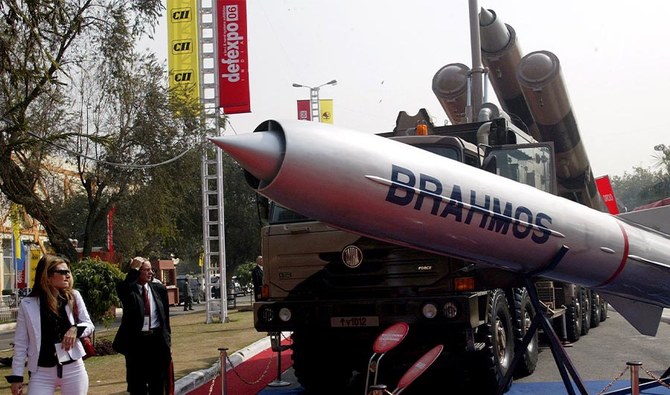
Foreign delegates look at a Brahmos missile on display during the Fourth Defence Expo in New Delhi, 31 January 2006. (AFP/FILE)
Short Url
Updated 24 August 2022
Follow

India fires three officers for accidentally launching missile into Pakistan in March

  • BrahMos, a nuclear-capable cruise missile jointly developed by Russia and India, was fired on March 9
  • Pakistan sought answers from New Delhi on safety mechanisms in place to prevent accidental launches

NEW DELHI: The Indian Air Force said on Tuesday the government had sacked three officers for accidentally firing a missile into Pakistan in March, an incident that the two nuclear-armed rivals handled calmly as there were no casualties.

Military experts have in the past warned of the risk of accidents or miscalculations by the neighbours, which have fought three wars and engaged in numerous smaller armed clashes, usually over the disputed territory of Kashmir.

The BrahMos missile – a nuclear-capable, land-attack cruise missile jointly developed by Russia and India - was fired on March 9, prompting Pakistan to seek answers from New Delhi on the safety mechanisms in place to prevent accidental launches.

"A Court of Inquiry, set up to establish the facts of the case, including fixing responsibility for the incident, found that deviation from the Standard Operating Procedures by three officers led to the accidental firing of the missile," the air force said in a statement.

It said the government had dismissed the three officers with immediate effect on Tuesday.

According to the U.S.-based Arms Control Association, the BrahMos missile's range is between 300 km (186 miles) and 500 km (310 miles), making it capable of hitting Pakistan's capital Islamabad from a northern Indian launch pad.  


IMF mission begins talks in Islamabad as Pakistan seeks next program review

Updated 5 sec ago
Follow

IMF mission begins talks in Islamabad as Pakistan seeks next program review

  • Finance ministry confirms ‘kick-off meeting’ with visiting IMF delegation
  • Review critical for next tranche under $7 billion bailout program

Karachi: Pakistan began formal talks with a visiting International Monetary Fund (IMF) delegation on Monday as the country prepares for the next review of its $7 billion bailout program.

The IMF team is in Pakistan to conduct a review under the Extended Fund Facility (EFF) approved in September 2024, a multi-year program aimed at stabilizing the economy after a balance-of-payments crisis, high inflation and dwindling foreign exchange reserves.

Pakistan has so far received roughly $3 billion of the EFF. Successful completion of the latest review could pave the way for the release of the next tranche of funds, subject to IMF board approval.

Separately in 2024, Pakistan also secured about $1.3 billion under the IMF’s Resilience and Sustainability Facility, a climate-focused funding window aimed at strengthening the country’s capacity to manage environmental and disaster-related risks.

“Kick-off meeting with IMF Mission held today,” the finance ministry said on Monday as it shared visuals of Finance Minister Muhammad Aurangzeb and senior officials meeting the delegation in Islamabad.

IMF country representative in Pakistan, Mahir Binici, told Arab News in an emailed statement; 

“An IMF mission led by Ms. Iva Petrova has started discussions with the authorities in Karachi and Islamabad on the third review of Pakistan’s Extended Fund Facility (EFF) arrangement and the second review of the Resilience and Sustainability Facility (RSF).”

The discussions are expected to focus on Pakistan’s fiscal performance, revenue collection targets, structural reform implementation and broader macroeconomic stability measures agreed under the program.

The review comes at a sensitive time for Pakistan’s economy, with rising global oil prices and regional instability adding pressure to inflation and external accounts. Analysts say continued IMF engagement remains crucial for maintaining investor confidence and securing external financing.

Pakistan entered the IMF program to restore macroeconomic stability, strengthen public finances and rebuild foreign exchange reserves. Authorities have repeatedly described the reform agenda as necessary to ensure long-term economic resilience.

Further meetings between technical teams are expected over the coming days.