RIYADH: Normalization between Israel and Arab nations ought to occur in tandem with resolving the simmering regional conflict because the Abraham Accords alone have not fundamentally changed the situation for the Palestinians, Sven Koopmans, the EU special representative for the Middle East Peace Process, has said.
The Abraham Accords are a series of agreements that have resulted in the establishment of diplomatic relations between Israel and four Arab countries. The UAE was the first to sign the pact in 2020, inaugurating a new era of political, economic and security cooperation with Israel in the face of common strategic concerns and regional threats.
“I think these accords have, in some way, shown that change is possible,” Koopmans, a Dutch international lawyer and former politician, told Arab News during a visit to Riyadh on Monday
“Relations between the countries (concerned) have changed and we see positive things come out of it. At the same time, I do not believe that those agreements have fundamentally changed the situation for the Palestinians.”
Although welcomed by much of the international community at the time, skeptics had warned that normalization alone would do little to resolve the long-running Israeli-Palestinian conflict, nor would it bring about a final settlement based on the two-state solution.

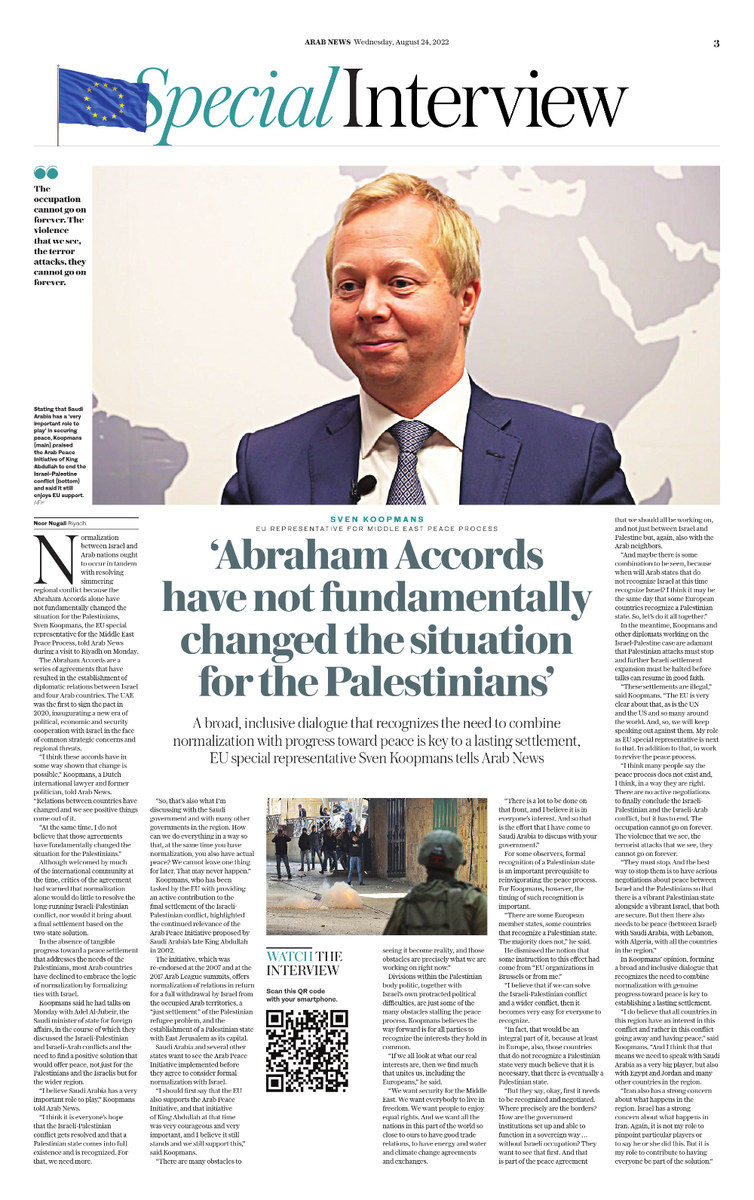
Palestinian demonstrators confront Israeli security forces following Friday prayers in the occupied West Bank town of Hebron. (File/AFP)
In the absence of tangible progress toward a peace settlement that addresses the needs of the Palestinians, most Arab countries have declined to embrace the logic of normalization of ties with Israel.
Koopmans said he had talks on Monday with Adel Al-Jubeir, the Saudi minister of state for foreign affairs, in the course of which they discussed the Israeli-Palestinian and Israeli-Arab conflicts and the need to find a positive solution that would offer peace, not just for the Palestinians and the Israelis but for the wider region.
“I believe Saudi Arabia has a very important role to play,” Koopmans told Arab News.

Assistant Editor-in-Chief of Arab News Noor Nugali and the EU special representative for the Middle East Peace Process Sven Koopmans. (Supplied)
“It is everyone’s hope that the Israeli-Palestinian conflict gets resolved and that a Palestinian state comes into full existence and is recognized. For that, we need more.
“So, that’s also what I’m discussing with the Saudi government and with many other governments in the region. How can we do everything in a way so that, at the same time you have normalization, you also have actual peace? We cannot leave one thing for later. That may never happen.”
Koopmans, who has been tasked by the EU with providing an active contribution to the final settlement of the Israeli-Palestinian conflict, highlighted the continued relevance of the Arab Peace Initiative proposed by Saudi Arabia’s late King Abdullah in 2002.
The initiative, which was re-endorsed at the 2007 and at the 2017 Arab League summits, offers normalization of relations in return for a full withdrawal by Israel from the occupied Arab territories, a “just settlement” of the Palestinian refugee problem, and the establishment of a Palestinian state with East Jerusalem as its capital.

Palestinian security forces stand guard as locals holding up banners and waving national flags protest in Bethlehem in the occupied West Bank. (File/AFP)
Saudi Arabia and several other states want to see the Arab Peace Initiative implemented before they agree to consider formal normalization with Israel.
“I should first say that the EU also supports the Arab Peace Initiative, and that initiative of King Abdullah at that time was very courageous and very important, and I believe it still stands and we still support this,” said Koopmans.
“There are many obstacles to seeing it become reality, and those obstacles are precisely what we are working on right now.”

The EU special representative for the Middle East Peace Process Sven Koopmans. (Supplied)
Splits within the Palestinian body politic, together with Israel’s own protracted political difficulties, are just some of the many obstacles stalling the peace process. Koopmans believes the way forward is for all parties to recognize the interests they hold in common.
“We need to come to a point where everybody is strong enough and willing enough to say now is the time for peace, as I believe,” Koopmans said.
“If we all look at what our real interests are, then we find much that unites us, including the Europeans.
“We want security for the Middle East. We want everybody to live in freedom. We want people to enjoy equal rights. And we want all the nations in this part of the world so close to ours to have good trade relations, to have energy and water and climate change agreements and exchanges.

Palestinian security forces stand guard as Palestinian protesters wave national flags during a demonstration in Bethlehem in the occupied West Bank. (File/AFP)
“There is a lot to be done on that front, and I believe it is in everyone’s interest. And so that is the effort that I have come to Saudi Arabia to discuss with your government.”
For some observers, formal recognition of a Palestinian state is an important prerequisite to reinvigorating the peace process. For Koopmans, however, the timing of such recognition is important.
“There are some European member states, some countries that recognize a Palestinian state. The majority does not,” Koopmans said.
He dismissed the notion that some instruction to this effect had come from “EU organizations in Brussels or from me.”
“I believe that if we can solve the Israeli-Palestinian conflict and a wider conflict, then it becomes very easy for everyone to recognize.
“In fact, that would be an integral part of it, because at least in Europe, also, those countries that do not recognize a Palestinian state very much believe that it is necessary, that there is eventually a Palestinian state.
“But they say, okay, first it needs to be recognized and negotiated. Where precisely are the borders? How are the government institutions set up and able to function in a sovereign way … without Israeli occupation? They want to see that first. And that is part of the peace agreement that we should all be working on, and not just between Israel and Palestine but, again, also with the Arab neighbors.
“And maybe there is some combination to be seen, because when will Arab states that do not recognize Israel at this time recognize Israel? I think it may be the same day that some European countries recognize a Palestinian state. So, let’s do it all together.”
In the meantime, Koopmans and other diplomats working on the Israel-Palestine case are adamant that Palestinian attacks must stop and further Israeli settlement expansion must be halted before talks can resume in good faith.
“These settlements are illegal,” said Koopmans. “The EU is very clear about that, as is the UN and the US and so many around the world. And, so, we will keep speaking out against them. My role as EU special representative is next to that. In addition to that, to work to revive the peace process.
“Many people say the peace process does not exist and, in a way, they are right. There are no active negotiations to finally conclude the Israeli-Palestinian and the Israeli-Arab conflict, but it has to end. The occupation cannot go on forever. The violence that we see, the terrorist attacks that we see, they cannot go on forever.
“They must stop. And the best way to stop them is to have serious negotiations about peace between Israel and the Palestinians so that there is a vibrant Palestinian state alongside a vibrant Israel, that both are secure. But then there also needs to be peace (between Israel) with Saudi Arabia, with Lebanon, with Algeria, with all the countries in the region.”
In Koopmans’ opinion, forming a broad and inclusive dialogue that recognizes the need to combine normalization with genuine progress toward peace is key to establishing a lasting settlement.
“I do believe that all countries in this region have an interest in this conflict and rather in this conflict going away and having peace,” said Koopmans. “And I think that that means we need to speak with Saudi Arabia as a very big player, but also with Egypt and Jordan and many other countries in the region.
“Iran also has a strong concern about what happens in the region. Israel has a strong concern about what happens in Iran. Again, it is not my role to pinpoint particular players or to say he or she did this. But it is my role to contribute to having everyone be part of the solution.”