

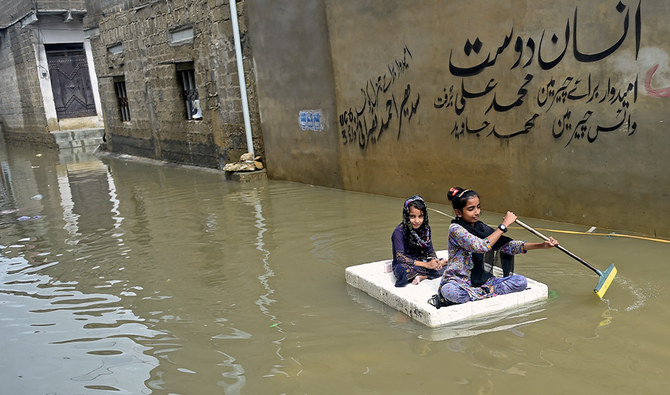
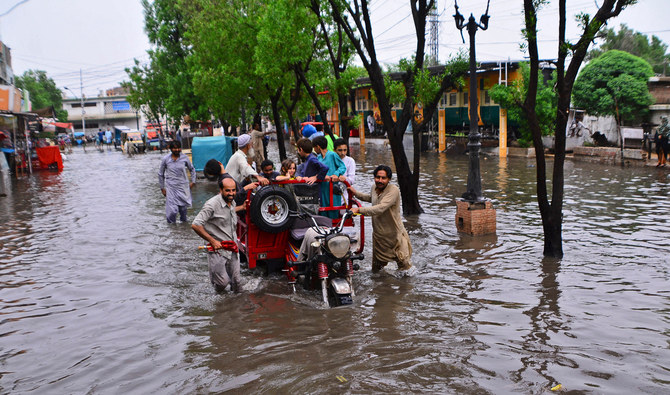
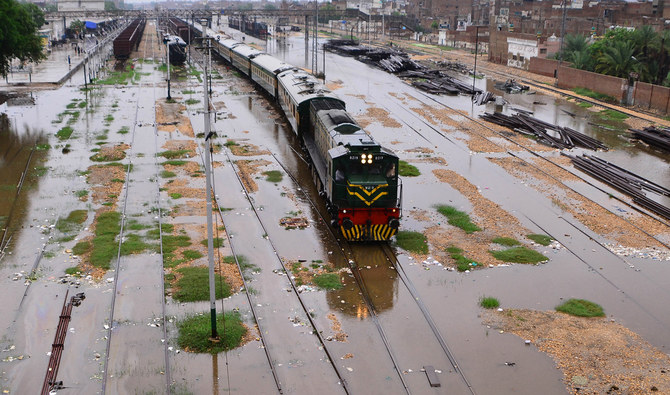

ISLAMABAD/KARACHI: The government in the southwestern Pakistani province of Balochistan on Tuesday said the province was facing heaviest rains in the last 30 years as the countrywide death toll from monsoon showers and floods rose above 800, with millions deprived of homes, livestock and crops in Pakistan.
According to the National Disaster Management Authority (NDMA), 830 people, including at least 313 children, have lost their lives to torrential rains and floods across the country since the beginning of the monsoon season in mid-June.
Much of the devastation has been witnessed in the southwestern Balochistan and southern Sindh provinces where 225 and 239 people have died, respectively.
“Such rains have not occurred in the last 30 years,” Farah Azeem Shah, a spokesperson for the Balochistan government, said at a press conference in Islamabad on Tuesday.
“More than 10 thousand livestock, 600,000 hectares of agricultural land, and over 2,500 solar tubewells have been affected so far.”
Shah said the provincial government had started rehabilitation operations along with rescue and relief efforts, in coordination with the federal government.
“Committees have been formed, the deputy commissioner of each district will be the committee head while Frontier Works Organization (FWO) members are also included in it,” she added.
Balochistan Chief Minister Abdul Quddus Bizenjo, Quetta Corps Commander Lt. Gen. Asif Ghafoor and acting Governor Jan Muhammad Jamali also visited the Provincial Disaster Management Authority (PDMA) office on Tuesday to observe flood relief operations.
“All districts of Balochistan have been affected by floods and all institutions are working according to their full potential,” the chief minister said at the PDMA meeting with provincial officials.
Lt Gen Ghafoor assured the provincial government the army would assist civil administration in restoration of communication links and construction of temporary bridges. “At present, 4,500 soldiers and officers of Pakistan Army are engaged in relief activities in different areas of Balochistan,” he added.
Meanwhile, the Met Office predicted more rains in the country from August 23 till August 26 due to strong monsoon currents penetrating southern and upper parts of Pakistan.
“More rain-wind/thundershower (with scattered heavy to very heavy falls) is expected in Sindh, south Punjab, south and northeastern Balochistan from 23rd to 26th August with occasional gaps,” it said in a weather advisory on Tuesday.
“Rain-wind/thundershowers (with isolated heavy falls) are expected in Khyber Pakhtunkhuwa, Punjab, Kashmir and Gilgit-Baltistan from 23rd (night) to 26th August with occasional gaps.”
In a statement issued on Tuesday, the European Union said it was granting €350,000 (Rs76 million) to provide crucial humanitarian assistance to families affected by severe flooding, which has wreaked havoc across Pakistan. The aid, EU said, will focus on addressing urgent needs of those most affected in some of the hardest-hit districts of Jhal Magsi and Lasbella in Balochistan.
“The devastating floods have left a trail of destruction in Pakistan, causing many to suffer the loss of their homes, livelihoods, and belongings,” said Taheeni Thammannagoda, who oversees EU’s humanitarian programs in Pakistan. “The EU funding will help get vital assistance to the most vulnerable people to support them during this hard time.”
After the devastation caused by monsoon rains in the country, Saudi Arabia’s KSRelief took a lead earlier and decided to send 100 emergency relief trucks, carrying 950 tons of food items to 17 flood-ravaged districts of Pakistan. The consignment included 10,000 food packages.
“More than 70,000 people will benefit from this emergency relief,” Saudi Ambassador Nawaf bin Said Al-Malki said at a ceremony in Islamabad, before the goods were dispatched.
Pakistan’s foreign minister Bilawal Bhutto-Zardari, who called off his official trip to Europe and arrived at his hometown of Larkana, one of the two most affected regions, urged the media on Monday to focus on flood victims in the country after the recent spell of monsoon rains claimed 40 lives in Sukkur and Larkana divisions.
Expressing his gratitude to all the countries and international agencies that have helped Pakistan’s flood victims, Bhutto-Zardari said the recent monsoon rains had devastated much of the country.
“We will have to join forces and fight this natural calamity,” he told a group of reporters after visiting the flood-affected areas. “I will also request the media which is broadcasting the [political] drama in Islamabad day and night that people are in great trouble. Many of them are spending their nights under the sky. This should be the main priority for politicians, federal and provincial administrations and the media.”
Bhutto-Zardari on Tuesday also visited different relief camps in the two districts.
Balochistan Provincial Disaster Management Authority (PDMA) Director-General Nasir Naseer on Tuesday told the Balochistan High Court that recent monsoon rains had inundated 31 districts of the province.
On Tuesday, Pakistan army troops were busy in rescue and relief operations in flood-hit areas of Sindh, Balochistan, Khyber Pakhtunkhwa and Punjab, according to the Inter-Services Public Relations (ISPR).
“Rescue and relief efforts are underway in Hyderabad, Sanghar, Badin, Thatta, Jamshoro, Noshero Feroz and various other districts of Sindh,” the media arm of Pakistan army said, adding two army helicopters were flown from Karachi to affected areas of Sindh to speed up rescue and relief efforts.
Pakistan Army helicopters also assisted civil administration in distribution of relief goods among people in far-flung and inaccessible areas of Dera Ghazi Khan district in Punjab.
“Pak Army Aviation Helicopters have flown 4 sorties for relief operations in most affected areas of DG Khan which included Mubarki, Fazla Katch, Basti Buzdar. Tents and ration were transported to flood victims,” the ISPR said.
Paramilitary Frontier Constabulary troops were also assisting civil administration in flood relief operations in Chitral and other flood-hit areas in the country’s northwest, according to ISPR.


