

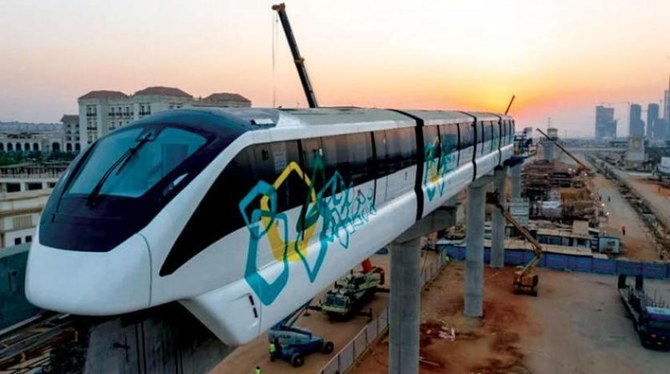
Egyptian investors donate $6m for monorail stations naming rights

Valued at $4.5 billion, Egypt’s first monorail is set to operate by 2023 with two lines extending 100 km that link West and East Cairo.
Short Url
Updated 22 August 2022
Follow

Egyptian investors donate $6m for monorail stations naming rights

RIYADH: Egyptian companies and businessmen have donated €6 million ($5.9 million) to construct monorail stations in return for naming the projects after them. 

Stations of Egypt’s first monorail will be named after residential compounds, malls, and businessmen, Alahram reported citing the Transport Minister Kamel El-Wazir. 

He added that businessman Ahmed El-Sewedy, CEO of El-Sewedy Electric Co., has donated money to build two stations, one to be named after him and the other after a university he owns.

The co-owner of Mansour Group and chairman of Palm Hills Developments, Yassin Mansour, also made considerable donations for the construction of two stations, one to be named after a compound and a mall.

Alongside advertisement spaces to be sold in the monorail and on the tickets, this comes as part of the ministry’s investment plan to finance the cost of the high-speed electric train. 

“The monorail and light rail transit cost a lot and we can’t depend on tickets to return its costs,” El-Wazir said. 

Shops, restaurants, and food courts at the stations will also be offered on lease.

Valued at $4.5 billion, Egypt’s first monorail is set to operate by 2023 with two lines extending 100 km that link West and East Cairo.

Upon completion, the two lines will be able to transport 45,000 passengers per hour.

The investment project comes amid a deepening economic crisis in the North African country, as it struggles from high inflation and pound devaluation, triggered by Russia’s war in Ukraine, drop in tourism and high oil prices. 


First EU–Saudi roundtable on critical raw materials reflects shared policy commitment

Updated 16 January 2026
Follow

First EU–Saudi roundtable on critical raw materials reflects shared policy commitment

RIYADH: The EU–Saudi Arabia Business and Investment Dialogue on Advancing Critical Raw Materials Value Chains, held in Riyadh as part of the Future Minerals Forum, brought together senior policymakers, industry leaders, and investors to advance strategic cooperation across critical raw materials value chains.

Organized under a Team Europe approach by the EU–GCC Cooperation on Green Transition Project, in coordination with the EU Delegation to Saudi Arabia, the European Chamber of Commerce in the Kingdom and in close cooperation with FMF, the dialogue provided a high-level platform to explore European actions under the EU Critical Raw Materials Act and ResourceEU alongside the Kingdom’s aspirations for minerals, industrial, and investment priorities.

This is in line with Saudi Vision 2030 and broader regional ambitions across the GCC, MENA, and Africa.

ResourceEU is the EU’s new strategic action plan, launched in late 2025, to secure a reliable supply of critical raw materials like lithium, rare earths, and cobalt, reducing dependency on single suppliers, such as China, by boosting domestic extraction, processing, recycling, stockpiling, and strategic partnerships with resource-rich nations.

The first ever EU–Saudi roundtable on critical raw materials was opened by the bloc’s Ambassador to the Kingdom, Christophe Farnaud, together with Saudi Deputy Minister for Mining Development Turki Al-Babtain, turning policy alignment into concrete cooperation.

Farnaud underlined the central role of international cooperation in the implementation of the EU’s critical raw materials policy framework.

“As the European Union advances the implementation of its Critical Raw Materials policy, international cooperation is indispensable to building secure, diversified, and sustainable value chains. Saudi Arabia is a key partner in this effort. This dialogue reflects our shared commitment to translate policy alignment into concrete business and investment cooperation that supports the green and digital transitions,” said the ambassador.

Discussions focused on strengthening resilient, diversified, and responsible CRM supply chains that are essential to the green and digital transitions.

Participants explored concrete opportunities for EU–Saudi cooperation across the full value chain, including exploration, mining, and processing and refining, as well as recycling, downstream manufacturing, and the mobilization of private investment and sustainable finance, underpinned by high environmental, social, and governance standards.

From the Saudi side, the dialogue was framed as a key contribution to the Kingdom’s industrial transformation and long-term economic diversification agenda under Vision 2030, with a strong focus on responsible resource development and global market integration.

“Developing globally competitive mineral hubs and sustainable value chains is a central pillar of Saudi Vision 2030 and the Kingdom’s industrial transformation. Our engagement with the European Union through this dialogue to strengthen upstream and downstream integration, attract high-quality investment, and advance responsible mining and processing. Enhanced cooperation with the EU, capitalizing on the demand dynamics of the EU Critical Raw Materials Act, will be key to delivering long-term value for both sides,” said Al-Babtain.

Valere Moutarlier, deputy director-general for European industry decarbonization, and directorate-general for the internal market, industry, entrepreneurship and SMEs at European Commission, said the EU Critical Raw Materials Act and ResourceEU provided a clear framework to strengthen Europe’s resilience while deepening its cooperation with international partners.

“Cooperation with Saudi Arabia is essential to advancing secure, sustainable, and diversified critical raw materials value chains. Dialogues such as this play a key role in translating policy ambitions into concrete industrial and investment cooperation,” she added.