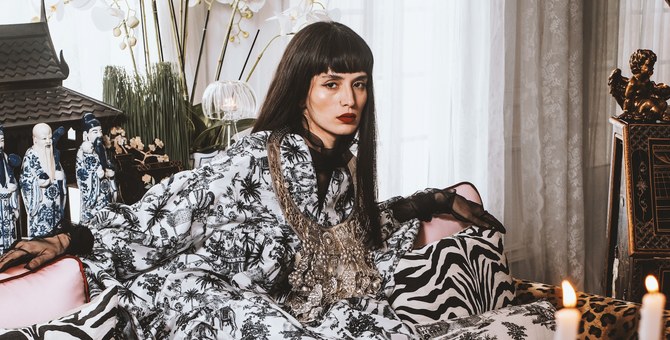

DUBAI: Founded by fashion designers and sisters Abeer and Alia Oraif, the Jeddah-based Atelier Hekayet have set their sights on going global, especially with a little help from the Saudi 100 Brands which took the duo's designs to the US recently.
With a mission to offer a new meaning to outwear through bold and contemporary designs that marry Saudi traditional female dress with the latest trends in international fashion, the brand was recently chosen by the Saudi Fashion Commission to be part of the Saudi 100 Brands program. It exhibited its designs in New York (July 26-Aug. 7) in “Saudi 100 Brands,” a global traveling exhibition featuring a curated selection of clothing and accessories from 100 Saudi designers.
“We like to think of our designs as wearable art pieces,” Alia Oraif told Arab News. The name of the brand “Hekayat,” which means “stories” and “tales” in Arabic, was chosen to reflect its vision. “Suspense is found in our designs through hekayat or stories,” Oraif said. “Mystery is our profession and serenity is our slogan.”
The garments reflect exactly this; an illuminating explosion of color, form and pattern on materials, including lace, silk, organza and chiffon. Bell sleeves and ruffles added to katfans, kimonos and dresses create elements of surprise and drama.
Oraif says that she and her sister grew up in a creative family. Their father is an interior designer. From a young age the sisters would regularly travel to Milan, Paris and Istanbul to attend fashion week.
“We used to design dresses for our relatives and friends and then decided to study fashion and to translate our passion into a business,” Oraif said.
Oraif has a bachelor’s degree in nutrition from King Abdulaziz University in Jeddah and a certificate in the principles of design and sewing from the same university. At the faculty of home economics, she took courses such as clothing and textiles, tricot and crochet and hand embroidery. In January 2022, she was chosen as a founding member of the Kingdom’s first professional non-profit fashion society, created by the Ministry of Culture and approved by Culture Minister Prince Badr bin Abdullah bin Farhan.
Abeer Oraif has a bachelor’s degree in international business management from King Abdulaziz University. She also holds a degree in fashion journalism and the business of fashion from Conde Nast College in London.
The inspiration of the two sisters stems from art, theater and history. “We love to mix vintage pieces with modern ones,” Alia Oraif said. “That is the Hekayat style.”
They also practice sustainable fashion, meaning that their designs are timeless and can be worn from one season to the next. They also use and produce their own fabrics, with a preference for French taffeta, moire and silk. “It all depends on the story of the collection,” Oraif said.
Over the past several years, Atelier Hekayat has collaborated with many luxury brands, including Mouwad Jewelry, Maserati and Chopard.
The label also participated in the first Fashion Futures Saudi Arabia; an event launched in 2019 as the Kingdom’s first dedicated fashion event. Atelier Hekayat was one of nine Saudi fashion brands selected by Princess Nora bint Faisal bin Abdulaziz Al-Saud.
“The fashion industry in Saudi Arabia is looking brighter than ever,” Oraif said. “We are very knowledgeable about fashion and how it can be linked to craft and culture, tradition with art and heritage. Saudi Vision 2030 aims to become one of the pioneers in the fashion industry. We have many projects and surprises coming up. Our aim is to go global.”