

Jordanian princess visits Pakistan to raise awareness about health needs of women, children

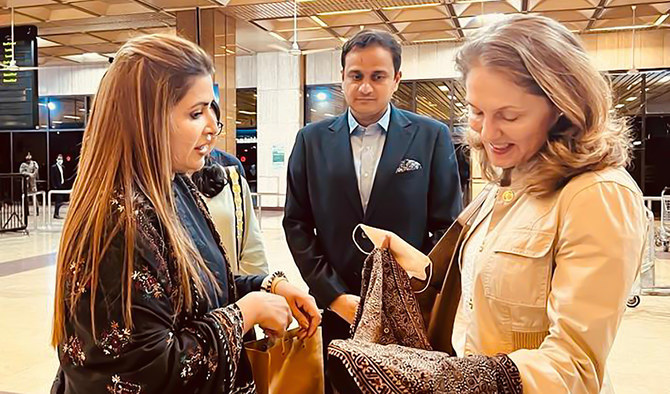
Pakistan's Minister for Poverty Alleviation Shazia Marri, left, receives Jordanian princess Sarah Zeid, right, at the Karachi airport on August 21, 2022. (Photo courtesy: Radio Pakistan)
Short Url
Updated 22 August 2022
Follow

Jordanian princess visits Pakistan to raise awareness about health needs of women, children

  • Princess Sarah Zeid advises the United Nations World Food Program on mother and child health and nutrition
  • She will visit a government center in Badin which is set up to address the issue of stunting among young children

ISLAMABAD: A Jordanian princess, Sarah Zeid, arrived in Pakistan’s southern port city of Karachi on Sunday to increase awareness about the health requirements and vulnerabilities of women and children while witnessing the performance of the South Asian state in the area.
Zeid has been advising the United Nations World Food Program on mother and child health and nutrition along with their special needs in humanitarian and fragile settings.
She arrived at the Jinnah International Airport in Karachi where she was received by Pakistan’s minister for poverty alleviation and social safety, Shazia Marri, and the administrator of the city, Murtaza Wahab.
“The Princess of Jordon @PrincessSarahZR will visit the Benazir Nashonuma program’s center in Badin apart from her meetings with Chief Minister Sindh @MuradAliShahPPP and other officials,” Benazir Income Support Program, which helps the government implement its social welfare plan, said in a Twitter post.


The Benazir Nashonuma is a cash transfer program that specifically deals with health and nutritional issues to address the problem of stunting among children under the age of 23 months.
The government has set up 50 Nashonuma centers under the program in 15 districts of the country.
Fully funded by the federal government, the WFP has been hired by the Pakistani authorities as its implementation partner to carry out the activities of the program.
Like other Muslim nations, Pakistan shares deep-rooted and strong ties with Jordan which date back to the 1960s.


Pakistan’s deputy PM says country seeks to convert $1 billion UAE deposit into investment

Updated 28 December 2025
Follow

Pakistan’s deputy PM says country seeks to convert $1 billion UAE deposit into investment

  • Ishaq Dar says the UAE will acquire shares in Pakistani companies using the amount, with transaction to be completed by March 31
  • The UAE’s remaining $2 billion in deposits, part of funds used to shore up Pakistan’s foreign reserves, are due for rollover in January

ISLAMABAD: Pakistan is seeking to convert part of its financial support from the United Arab Emirates into long-term investment to reduce external debt, Deputy Prime Minister Ishaq Dar said on Saturday, following talks with UAE President Sheikh Mohamed bin Zayed Al Nahyan during his visit to Islamabad.

Dar said Pakistan was engaged with the UAE on converting $1 billion in deposits into equity investment, potentially involving stakes in companies linked to the Fauji Fertilizer Group, a move that would end Pakistan’s repayment obligation on that portion of the funds.

The UAE has been one of Pakistan’s key financial backers in recent years, providing $3 billion in deposits to the central bank as part of a broader effort to stabilize the country’s external finances and unlock support from the International Monetary Fund.

Speaking at a year-end briefing, Dar said Pakistan had already begun discussions with the UAE on rolling over the first $1 billion tranche, but Islamabad now wanted to replace short-term borrowing with investment.

“They will be acquiring some shares, and this liability will end,” Dar said, adding that discussions were under way for the transaction to be completed by March 31.

Dar said the Fauji Foundation Group was taking the lead in the process, with plans for partial disinvestment by Fauji-linked and other companies to facilitate the deal.

He added that Pakistan also raised the issue of a separate $2 billion rollover due in January during talks with the UAE leadership, saying Islamabad had conveyed that converting debt into investment would be preferable to repeated rollovers.

The issue was discussed during Al Nahyan’s visit, which Dar described as cordial, adding that the UAE had expressed willingness to expand its investment footprint in Pakistan.

Pakistan has relied on repeated rollovers of deposits from friendly countries to manage its balance-of-payments pressures, a practice economists say provides short-term relief but adds to debt vulnerabilities unless replaced with foreign direct investment.

The country acquired $5 billion from Saudi Arabia and $4 billion from China, which, along with the UAE, helped shore up its foreign reserves and meet IMF conditions at a time when its external account was under severe pressure.

Dar said Pakistan was now focused on shifting from temporary financing toward longer-term capital inflows to stabilize its economy and reduce reliance on external borrowing.